
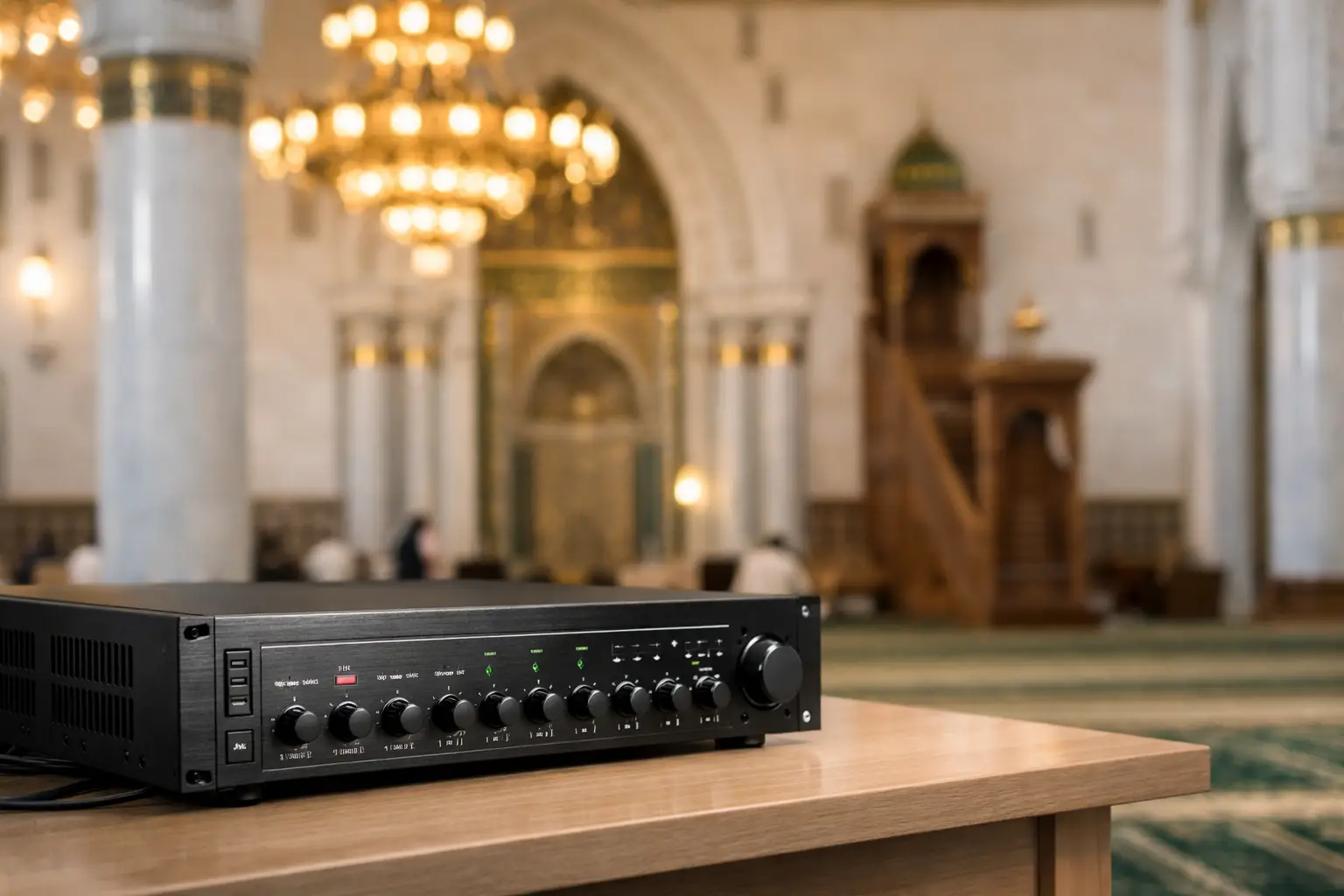
A mosque PA system is judged at the rear prayer rows, in the courtyard. During the transition between prayers – not only at the amplifier rack. ITC TI-5006S zone amplifier mosque PA system Saudi Arabia specification is relevant where a project needs clear, controlled announcements across distinct areas without treating the entire facility as one loudspeaker circuit.
For system integrators, MEP consultants, and government procurement teams, evaluate the TI-5006S as part of a zoned 100V public-address design. Its six-zone architecture and integrated MP3 playback capability can suit mosques, Islamic centers, and multi-use religious facilities. This works well where the project requires separate control of the main prayer hall, women’s prayer hall, entrance areas. Ablution areas, external walkways, and overflow spaces. The result depends on correct loudspeaker loading, zoning logic, microphone placement, and the wider control strategy.
Where the ITC TI-5006S Fits in a Mosque PA Design
The ITC TI-5006S is a six-zone amplifier intended for distributed public-address applications. In a mosque environment, that zoning is more than a convenience. It allows the operator to send a routine message to selected areas while keeping the prayer hall unaffected. To address all configured areas when the operational requirement calls for it.
A typical allocation may use one zone for the main prayer hall, one for a secondary or women’s hall. One for the entrance and shoe-storage area. Additionally, a separate zone can cover ablution facilities, the courtyard, and a parking or perimeter waiting area. This is only a starting point. Larger mosques often need more than six operational zones, while compact facilities may require fewer. The TI-5006S is strongest where six independently managed loudspeaker areas align with the architectural plan.
The integrated MP3 function is useful for controlled background audio or pre-recorded operational messages where approved by the facility operator. It should not be treated as a replacement for a properly planned live microphone system. For khutbah, adhan, iqamah, and formal announcements, speech intelligibility begins with the microphone chain and acoustic conditions. Continues through amplifier headroom and loudspeaker coverage.
Six Zones Need a Clear Operating Purpose
A common project mistake is to divide zones by cable route rather than by how the building will actually be used. Cable routes matter to the installer, but operating zones matter to the imam, facility manager, and security or operations desk.
The main hall and external courtyard are a good example. They may be physically close but acoustically very different. The hall may need carefully distributed ceiling or column loudspeakers at modest levels to preserve intelligibility. The courtyard may require weather-rated horn or projector loudspeakers with a different level setting and different paging requirement. Combining them on one zone reduces control and can lead to either under-coverage outside or excessive sound inside.
Similarly, ablution and circulation areas should not automatically receive the same program level as prayer spaces. Their higher reflective surfaces and ambient noise can make speech difficult to understand. A separate zone gives the operator a practical way to make adjustments without affecting the congregation.
Before selecting the TI-5006S, consultants should define what each zone must do during normal operation. Questions worth resolving include whether all zones receive live speech, whether outdoor areas require separate volume adjustment, whether women’s prayer areas need independent control. Whether recorded messaging is permitted for the intended use. A zoning schedule in the tender documentation prevents ambiguity later in procurement and installation.
Load Planning Matters More Than the Amplifier Label
The TI-5006S must be matched to the total 100V loudspeaker load assigned to each output and to the system’s required operating margin. Specifically, add the selected tap settings of every loudspeaker on a zone. Retain sensible capacity for program peaks, future alterations, and real-world operating conditions.
Designs that use every available watt on paper leave little room for clean speech reproduction. This risk is particularly acute in reverberant prayer halls, where installers may be tempted to increase volume to overcome poor intelligibility. More level does not correct excessive reverberation. It can make consonants less distinct and create a tiring listening environment.
Loudspeaker selection should follow the architecture. Ceiling loudspeakers can be appropriate for lower ceilings and evenly distributed coverage. Column loudspeakers are often considered where controlled vertical dispersion can help reduce unwanted reflections in elongated halls. Outdoor zones require products suited to heat, dust, and exposure conditions expected in the Saudi environment. The amplifier cannot compensate for a loudspeaker type that is wrong for the space.
Cable calculations also deserve attention. Long runs to courtyards, minarets, parking areas, or annex buildings introduce voltage loss. The appropriate cable gauge depends on distance and load. Segregation from power cabling, correct routing through fire-rated areas where required, and clearly labeled zone terminations support both performance and future serviceability.
Plan for More Than Friday Capacity
Friday prayer and Ramadan operations often reveal weaknesses that are not apparent during normal daily use. Overflow occupancy changes the acoustic behavior of a room, and open doors can change how sound reaches entrance and courtyard zones. The PA design should therefore be checked against high-attendance operating scenarios, not only an empty-hall test.
This does not always mean selecting a larger amplifier. It may mean dividing a long hall into more appropriate loudspeaker circuits, using a better loudspeaker pattern, or providing separate control for overflow areas. If the project requires more than six independently operated zones, the ITC TI-120Z, TI-240Z, TI-350Z. TI-500Z multi-zone DSP models may be more suitable candidates. The choice depends on the required control functions and project scope, not simply on building size.
Speech Intelligibility Starts at the Microphone
A mosque PA system carries spoken communication with high importance. A capable zone amplifier cannot correct a poor microphone position, unsuitable microphone type, or inconsistent speaking technique.
The lectern, imam position, and any announcement desk should be reviewed individually. Microphones need adequate gain before feedback, while loudspeakers should be positioned to avoid directing excessive energy back toward microphone pickup areas. In some rooms, the most useful improvement is moving or adding loudspeakers to achieve lower, more even sound levels rather than increasing amplifier output.
Rack-mounted digital amplifier options such as ITC T-120DTB, T-500DTB, and T-650DTB are relevant in simpler single-zone applications or supporting areas. However, they do not replace the operational advantage of the TI-5006S when the mosque requires six separately managed loudspeaker sections. Base ITC product selection on the zoning requirement first.
Emergency Messaging Is a Separate Compliance Decision
Routine PA and emergency voice evacuation have different design and compliance obligations. The TI-5006S can support a zoned announcement strategy. However, projects requiring supervised emergency evacuation, fire-alarm interfaces, emergency microphone priority, monitored speaker circuits, backup power. Mandated life-safety functions need an appropriate voice evacuation platform specified from the start.
ITC 6000, 6100, and 6200 series voice evacuation systems are the relevant product families to assess for those applications. The consultant must verify the applicable Saudi Civil Defense requirements, authority expectations, project specifications, and approved fire strategy. It is not technically sound to describe a standard zoned PA amplifier as a complete voice evacuation solution without confirming those requirements.
This distinction matters on government facilities, large mosque complexes, transport-linked developments, and Vision 2030 project packages. Documentation and authority approvals may be as significant as audio performance. Procurement teams should request a clear compliance matrix rather than assuming that paging, background music, and emergency evacuation are interchangeable functions.
Tender Documentation That Prevents Site Changes
A strong TI-5006S specification should identify the required number of zones, expected loudspeaker loads per zone, audio sources, paging positions, rack requirements. Power backup expectations, and any emergency-system interface. Stating only “500W zone amplifier” is not enough. It leaves the integrator to interpret functions that should have been confirmed by the consultant and end user.
For Saudi projects, documentation should also define environmental expectations for outdoor equipment, preferred language requirements for labels or operating instructions, and acceptance testing criteria. A practical test should cover zone selection, all-call operation, microphone clarity at representative listener positions, recorded-message operation where used. Behavior during loss and restoration of mains power.
ITC equipment is widely applicable across mosques, airports, stadiums, theaters, and command centers because its PA portfolio covers straightforward paging through to IP PA and voice evacuation. That breadth is useful when a mosque project includes adjacent administrative buildings, parking structures, visitor facilities, or a central operations point. It does not mean every facility needs the most complex system. The correct solution is the one that maps to the building’s actual communication needs.
For integrators sourcing an ITC TI-5006S package in Saudi Arabia, Seven Sectors provides an authorized local partner route for product availability, model verification, and technically aligned supply support. Start with a zone schedule and loudspeaker load table. Those two documents will tell you far more about whether the TI-5006S is the right fit than an amplifier rating alone.
Ready to discuss your project? Contact Seven Sectors or contact us directly on +966-012 229 3474.