
A reader specified only as “RFID” can create an expensive constraint long before a door is handed over. For commercial, government, and infrastructure projects, HID Signo reader NFC Bluetooth RFID access control Saudi Arabia requirements should start with credential strategy. Controller compatibility and compliance documentation matter just as much. They matter more than reader appearance or read range.
HID Signo readers are built for organizations that need to run mixed credential environments. At the same time, they want to move toward stronger, mobile-ready access control. That makes them relevant to Saudi projects. An installed card population must stay operational today, while consultants and end users want a managed migration path for future sites, departments, or tenant areas.
Why HID Signo Readers Suit Enterprise Access Control
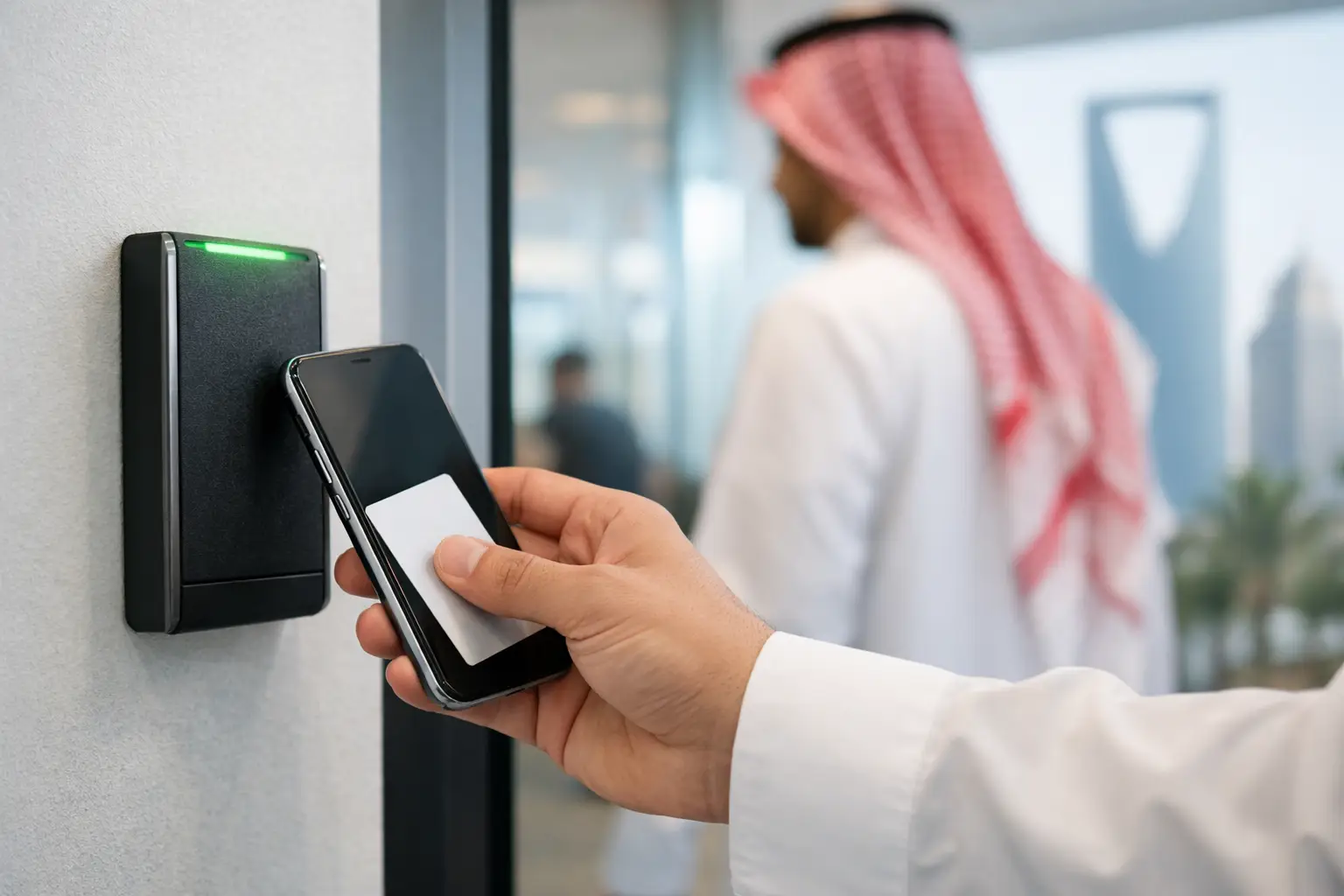
HID Signo is an access reader family. It is designed to work across physical cards, key fobs, mobile credentials, and selected credential technologies. NFC and Bluetooth Low Energy support let organizations use compatible smartphones as credentials. RFID support covers the card-based access methods still common across offices, industrial facilities, hospitals, airports, and government estates.
The key point for specification teams is simple. A Signo reader is not just a device that opens a door. It sits at the point where an employee, visitor, contractor, or operator presents identity to the access control system. So the reader choice affects the organization’s credential lifecycle, user experience, door hardware interface, and future expansion options.
This flexibility matters for a multi-building program in Riyadh, Jeddah, Dammam, or a Vision 2030 project zone. It can reduce the need to replace readers every time credential policy changes. A project may begin with physical smart cards in critical areas. It can then issue mobile credentials to management and facilities teams, and later to temporary contractors, as the access policy matures.
NFC, Bluetooth, and RFID Have Different Roles
These terms are often grouped together in tender documents. However, they should not be treated as identical requirements. RFID is the broad category that includes many proximity and smart-card technologies. It remains practical where a site needs fast, familiar card presentation, and the end user already has a managed badge program.
NFC generally suits close-range smartphone or card interactions. Bluetooth Low Energy can support a longer, configurable mobile credential experience, depending on the reader configuration, credential platform, and security policy. Some organizations prefer deliberate tap-to-open behavior at sensitive doors. Others want a less manual experience at high-throughput staff entrances. Neither approach is automatically better. The right choice depends on risk, throughput, accessibility expectations, and the end user’s mobile-device governance.
HID Signo readers let consultants and integrators specify a platform that supports these choices without treating mobile access as a separate reader estate. This is especially useful in phased projects, where physical cards may stay mandatory for certain users or controlled zones.
HID Signo Reader NFC Bluetooth RFID Access Control in Saudi Arabia
Saudi projects commonly face a combination of requirements. Existing credentials cannot be replaced overnight. New facilities demand mobile readiness. Tender conditions require traceable product sourcing. HID Signo readers provide a credible route for addressing this combination, but the specification must be written carefully.
Start with the credential technology currently in use. A proximity card, a high-frequency smart card, and a mobile credential are not interchangeable just because they all present at a reader. The consultant or system integrator should document what must be retained, and which user groups can be migrated. They should also confirm whether the target platform needs stronger credential security than the legacy system.
Next, consider the connection between reader and controller. Reader interface, cable distance, supervised communication requirements, door controller capability, and the broader access management software all need confirmation before equipment is finalized. A reader can support advanced credential methods, but the complete access control design must support the intended workflow. The controller makes the door decision; the reader captures and passes credential data according to the approved architecture.
For high-security facilities, this distinction matters. Procurement teams should ask whether the proposed reader-controller connection and credential configuration meet the project security policy. A reader should never be approved solely because it carries a recognized brand name.
Migration Is Usually the Business Case
The strongest reason to select HID Signo is often migration, not novelty. Rebadging thousands of employees in one phase can be disruptive. This is particularly true for government campuses, industrial facilities, logistics operations, and occupied commercial towers. A staged approach can keep approved existing credentials working while new secure credentials are issued by department, site, or access-risk level.
Mobile credentials can also improve administration when managed properly. A credential may be issued or withdrawn without collecting a physical card. This is valuable for contractors and personnel with changing assignments. However, a mobile program needs clear policies for phone replacement, lost devices, enrollment approval, privacy expectations, and offline access procedures. Mobile credentials reduce some operational burden, but they do not remove the need for disciplined access administration.
For sites with visitors, do not assume a mobile-first model replaces a temporary badge workflow. Reception, contractor onboarding, turnstiles, parking, and restricted-area approvals can each need different credential rules. Mobile access should be planned as part of a complete access policy, not as a standalone feature purchase.
What to Confirm Before Releasing a Purchase Order
A good bill of materials identifies more than the reader part number. It should confirm:
- The required credential technologies, including legacy card support and the target mobile credential method.
- Reader form factor, mounting condition, keypad need, environmental exposure, and door count by location.
- Controller interface and access software compatibility, including any requirement for supervised reader communications.
- Documentation required by the consultant, client, or government procurement authority for origin, compliance, warranty, and approved sourcing.
This level of discipline prevents a familiar problem. Readers arrive on site, but the intended credentials, controller interfaces, and mounting accessories were not included in the approved package. It also protects the integrator from late substitutions that affect approvals or the project schedule.
Compliance Requires an End-to-End View
NDAA and TAA requirements increasingly appear in Saudi government and major-project procurement. This is especially true where security systems are evaluated as part of wider infrastructure compliance. These requirements should be verified against the exact project scope and current manufacturer documentation. They should never be assumed based on a product category, or applied selectively to only one component.
An access control package includes readers, controllers, management software, credentials, locking hardware, power supplies, and often network infrastructure. Each may have its own procurement and compliance considerations. The same applies when access control is integrated with video surveillance, intercom, visitor management, or building management systems.
For example, a project may pair HID access control with AETEK PoE infrastructure for networked security devices in a wider deployment. It may also use Milesight AI cameras for perimeter or entry-point verification. Note that AETEK is a PoE infrastructure brand, not a camera manufacturer. These systems can support a coordinated security architecture, but they remain distinct procurement packages with separate technical approvals.
Supply Support for Saudi Project Teams
System integrators and consultants need dependable technical product identification before tender submission and before final procurement. Reader selection should include the intended credential path, accessories, interfaces, and documentation requirements from the outset. This matters most for projects shipping to remote or schedule-sensitive locations, where correcting a reader specification after delivery creates avoidable delay.
Seven Sectors supports Saudi access control project teams with HID Signo reader sourcing for commercial, government, industrial, and major infrastructure requirements. As a specialized B2B security partner, our focus is on supplying the correct product package. We help procurement teams maintain clarity between approved specifications, required documentation, and the equipment ordered.
The better HID Signo specification is not the one with the longest feature list. It is the one that lets the client issue, manage, revoke, and evolve credentials without forcing another reader replacement cycle when the access policy changes.
Frequently Asked Questions
What is the HID Signo reader and which credential types does it support?
The HID Signo reader is a multi-technology access control reader from HID (part of ASSA ABLOY) that supports NFC, Bluetooth Low Energy (BLE), 13.56 MHz smart cards, and 125 kHz legacy RFID cards in a single unit. This allows organizations to run mixed credential environments — existing cards plus smartphone-based mobile credentials — without replacing all existing hardware at once.
Does the HID Signo reader work with existing RFID card populations in Saudi buildings?
Yes. HID Signo readers support legacy 125 kHz RFID credentials alongside modern smart card and mobile technologies. Organizations can keep issuing existing cards to staff while introducing HID mobile credentials on smartphones for new users or higher-security areas. This makes Signo practical for phased access control upgrades on large Saudi commercial and government sites.
Is HID Signo NDAA compliant for Saudi government and Vision 2030 projects?
Yes. HID (ASSA ABLOY) access control products are NDAA Section 889 compliant. They are appropriate for Saudi government facilities, Vision 2030 giga-projects, and any procurement scope requiring verified supply-chain compliance. Seven Sectors can provide the relevant compliance documentation for tender submissions.
What is the difference between NFC and Bluetooth mobile access on HID Signo?
NFC mobile access requires the smartphone to be held within a few centimetres of the reader, similar to a tap-to-pay action. Bluetooth BLE allows hands-free access — the door can trigger from a short distance as the user approaches. Both use HID Mobile Access credentials issued via the HID Origo platform. The correct mode depends on your security policy and user workflow.
How do I source HID Signo readers for a project in Saudi Arabia?
Seven Sectors is the authorized HID partner in Saudi Arabia. We can supply Signo readers, smart cards, and mobile credential licenses for projects of any scale. Share your floor plan, door count, and access control system to receive a specification review and formal quote with lead times.
Ready to discuss your project? Contact Seven Sectors or contact us directly on +966-012 229 3474.