
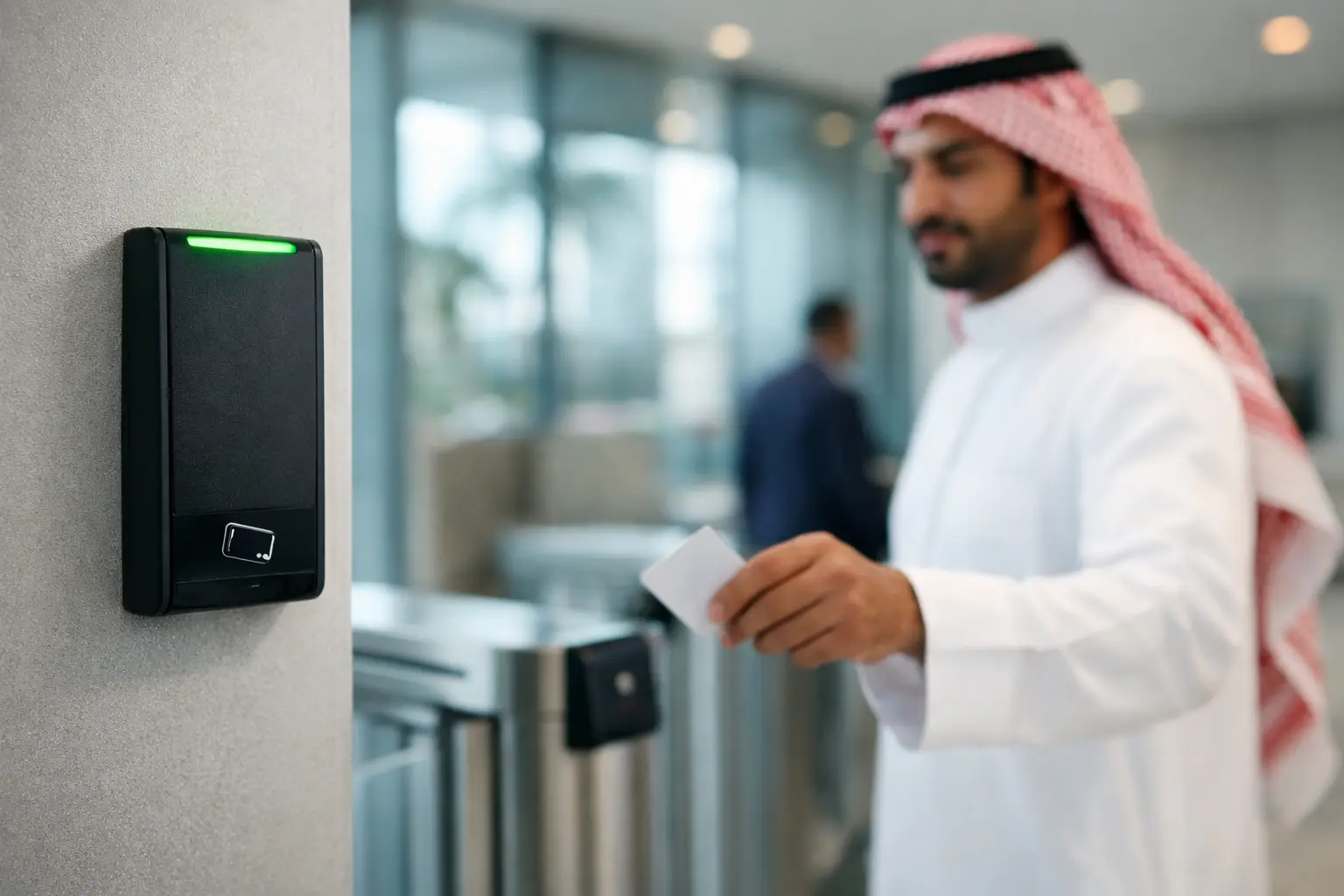
A reader choice made at the door can affect a project for years. HID Signo readers are specified not simply for card presentation, but for how they support credential migration, mobile access, controller communications, and a consistent user experience across an enterprise estate. For Saudi government, commercial, industrial, and giga-project applications, that makes Signo a practical access control platform component rather than a basic RFID reader replacement.
Why HID Signo Fits Modern Access Control Programs
Many installed access control systems still depend on older low-frequency credentials and legacy reader wiring. Replacing every credential, reader, and controller in one phase can create unnecessary cost and operational disruption. HID Signo is designed to help organizations transition more methodically, supporting multiple credential technologies in a single reader family.
This matters for sites where employees, contractors, visitors, and critical operations personnel may not move to a new credential at the same time. A hospital, airport support facility, government office, university campus, or industrial plant can retain compatible legacy credential use during a planned migration while issuing more secure credentials for new users or high-risk openings.
Depending on the selected model and configuration, HID Signo readers can support contactless RFID credentials, HID mobile credentials presented through Bluetooth Low Energy and NFC-capable smartphones, and keypad functionality where PIN verification is required. The correct reader is therefore determined by the opening type, risk level, credential policy, controller interface, and future expansion plan – not by reader appearance alone.
For consultants and procurement teams, the key benefit is standardization. One HID reader family can be applied across perimeter doors, office entries, data rooms, controlled staff areas, and other openings while allowing different authentication policies by door. That reduces the number of reader platforms an integrator must support and gives the end user a clearer route for future credential upgrades.
HID Signo Credential Strategy Comes First
The reader is only one part of the access decision. Before selecting HID Signo hardware, the project team should establish which credentials are in use today and which credentials the organization expects to issue over the next five to ten years.
Legacy proximity cards may remain necessary during an early migration stage, particularly in occupied facilities. However, legacy credentials should not be treated as the long-term security baseline for a sensitive site. Higher-security smart card technologies, including configurations based on modern HID credential technologies, provide a stronger foundation when the project requires better protection against cloning and a more controlled credential lifecycle.
Mobile credentials add another option. They can reduce the operational burden of card issuance for selected user groups and are useful where temporary or rapidly changing access privileges are common. Examples include contractor programs, multi-site corporate users, field teams, and managed visitor workflows. Mobile access is not automatically the right answer for every door, however. Credential enrollment processes, device policy, battery dependency, user adoption, licensing, and the customer’s identity management workflow should be assessed before mobile credentials are made a mandatory standard.
A mixed credential environment is often the sensible approach. Physical smart cards can remain the preferred credential for high-throughput staff access and regulated facilities, while HID mobile credentials can serve executives, visitors, contractors, or users who benefit from phone-based access. HID Signo allows system designers to build around that reality rather than forcing one credential method across every opening.
Selecting Authentication by Door Risk
A standard office entrance may require a single credential presentation. A server room, records archive, command center, or restricted government workspace may require card plus PIN, subject to the site’s risk assessment and policy. A reader with keypad capability can support this requirement, but it should be specified only where the operational value justifies the added user step.
High-security doors also require more than a capable reader. The controller, locking hardware, door contacts, request-to-exit devices, power supply, cabling, and alarm monitoring must all support the intended security outcome. Access control specifications fail when authentication is treated as an isolated device decision.
OSDP and Reader-to-Controller Security
For new enterprise access control projects, reader communications deserve the same attention as credentials. HID Signo readers support Open Supervised Device Protocol, commonly known as OSDP, when deployed with compatible controllers and configured correctly. OSDP can provide supervised communications and, where supported across the system, Secure Channel protection between the reader and controller.
This is a significant improvement over older Wiegand connections, which remain widely installed but have inherent limitations. Wiegand is typically one-way and does not provide the same supervised, encrypted communication capability. On projects where tamper risk, credential security, or lifecycle support are major concerns, OSDP should be considered from the design stage rather than added as an afterthought.
That said, migration requirements vary. Existing panels may only support Wiegand, or a phased refurbishment may require a temporary mixed interface approach. In these cases, HID Signo can support a staged program, but the project documentation should define exactly which doors will use OSDP, which will remain on legacy interfaces, and what conditions trigger the final upgrade. Avoid writing “OSDP-ready” into a tender without confirming controller compatibility, cable routes, addressing, reader configuration, and commissioning responsibility.
Practical Deployment Factors for Saudi Projects
Reader selection must reflect the physical environment. Indoor office doors, parking entrances, staff turnstiles, exterior gates, and industrial plant access points have very different exposure, mounting, and operational requirements. The HID Signo model, trim, keypad need, mounting method, and environmental rating should be reviewed against the actual opening condition.
For external doors in Jeddah, Riyadh, Dammam, or project sites in coastal and desert environments, installers should consider heat exposure, dust, humidity, enclosure condition, cable protection, and direct sunlight. A reader is only as dependable as its installation environment and the door hardware supporting it. Poor cable termination, unstable lock power, inadequate enclosure protection, or incorrect mounting height can create failures that are then incorrectly attributed to the reader.
Networked security architecture also affects the access control deployment. Controllers, network switches, servers, and identity systems must be coordinated with the security consultant’s design. Where access control panels or associated equipment require Power over Ethernet infrastructure, AETEK PoE switches and extenders can be considered as part of the network infrastructure package. AETEK is a PoE infrastructure brand, not a camera brand, and its role should be specified accordingly.
HID Signo access control can also sit alongside video verification, intercom, and incident management workflows. For example, a Milesight AI camera may provide video coverage at a vehicle or pedestrian entrance, while the HID reader handles the access event itself. These are complementary systems with different functions. A clear system architecture prevents the common mistake of expecting a CCTV platform to replace access control audit trails, or expecting a reader to provide video evidence.
Procurement Requirements Beyond the Reader
Government and Vision 2030 project procurement frequently requires documented compliance, approved-country-of-origin considerations, cybersecurity review, and supply-chain verification. NDAA or TAA requirements should be evaluated at the product, configuration, and project-documentation level rather than assumed based on a brand name or a generic data sheet.
Procurement teams should request the exact HID Signo model numbers, supported credential technologies, interface requirements, keypad requirements, mounting accessories, and compatibility statement with the proposed controller platform. This prevents substitutions that appear similar in a bill of quantities but do not support the required mobile credential, secure communication, or legacy migration strategy.
Availability also needs to be planned early, especially when a project requires consistent reader finishes, large quantities, specific smart card formats, or phased deliveries across Riyadh, Jeddah, the Eastern Province, NEOM, or Red Sea Project locations. Access control is often delayed not by the controller but by late confirmation of credentials, reader variants, and door schedules.
Building a Better HID Signo Specification
A strong HID Signo specification starts with a door schedule, not a generic reader count. Each opening should identify its user population, credential method, authentication level, reader interface, controller compatibility, installation environment, and any special requirement such as keypad entry or mobile access.
The project team should then separate immediate requirements from future options. If mobile credentials are planned later, confirm that the selected reader and software ecosystem can support the intended rollout. If OSDP Secure Channel is a future objective, avoid limiting the project with controllers or cabling practices that make the upgrade difficult. If legacy credentials must remain active during migration, document their planned retirement date rather than allowing them to become permanent by default.
Seven Sectors supports system integrators, consultants, and procurement teams with HID access control sourcing for Saudi projects, including HID Signo readers, mobile credential requirements, and smart card selection. The right reader strategy protects both the current door schedule and the next phase of the security program. For pricing, availability, and project support, contact Seven Sectors at info@7sectors.com or submit your requirement through the website’s Get Quotation form.
Ready to discuss your project? Contact Seven Sectors or contact us directly on +966-012 229 3474.