
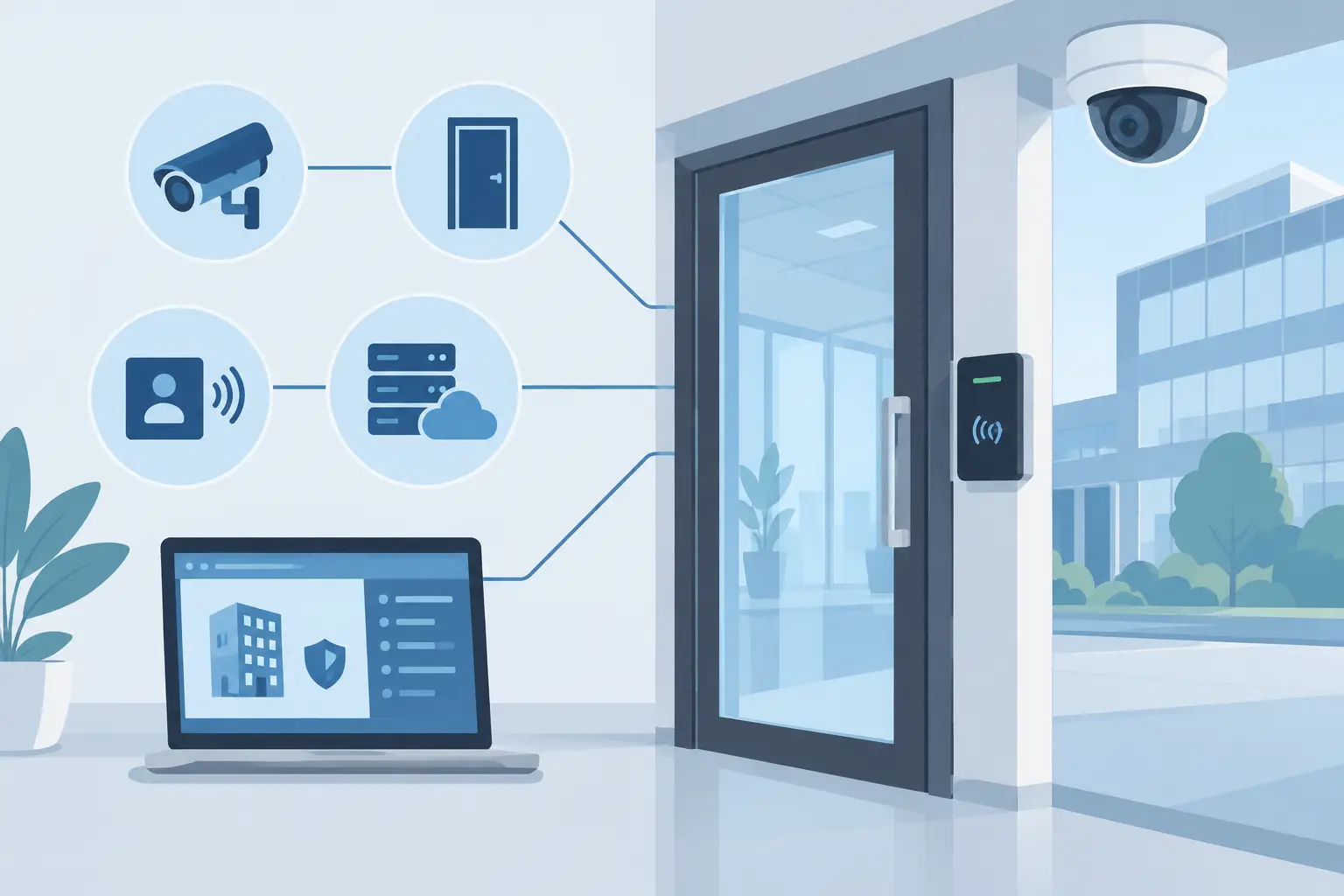
A failed access control decision rarely fails at the reader. It fails when a controller cannot support the required door logic, when credentials do not match the operator’s workflow, or when the handover team inherits a system that cannot be expanded cleanly. This enterprise access control buyer guide is for consultants, system integrators, MEP contractors, and procurement teams sourcing commercial, industrial, government, and critical-infrastructure systems in Saudi Arabia. Seven Sectors Trading Co. supplies HID access control solutions as an authorized partner, helping project teams source established hardware through one specialist trade channel.
The right purchase is not simply a card reader and a door controller. It is an operating model for how people, contractors, visitors, and restricted areas are managed over the life of a facility. Start with the doors and workflows that create risk, then buy the architecture that can support them without forcing exceptions later.
Start With the Door Estate, Not the Product List
The first procurement question is how many doors the project has. The more useful question is what each door must do. A controlled office entrance, a data room, a plant room, a loading dock, and a vehicle or pedestrian gate may all sit under one access control platform, but their risks, schedules, and interface requirements are different.
Build a door schedule before issuing an RFQ. For each opening, record the door type, locking arrangement, egress method, fire alarm interface, door status monitoring, request-to-exit requirement, reader location, power approach, and required behavior during a communications or power event. This prevents a common tender gap: pricing a standard controlled opening when the actual opening needs multiple monitored inputs, special lock control, or a defined emergency release sequence.
Also separate doors by operational criticality. Some doors need local decision-making if the host platform is unavailable. Others can tolerate limited functionality during an outage. The answer affects controller selection, communications design, backup power planning, and acceptance testing. It should be agreed by the security consultant, life-safety stakeholders, and the installing integrator before equipment is selected.
Choose an Architecture That Can Expand
Enterprise systems are usually procured in phases. A headquarters may open with a defined door count, then add tenant areas, parking access, remote offices, staff accommodation, or new restricted zones. The platform should accommodate that growth without requiring a separate credential population or parallel administration process.
Ask whether the proposed architecture supports the project’s intended topology: a single building, a campus, multiple locations, or a mix of local and centrally managed sites. Confirm how controllers are commissioned, how downstream doors are added, how events are retained, and how the system handles network interruptions. These are practical questions, not software demonstrations. They determine the workload placed on the facilities and security teams after handover.
Controller capacity should not be assessed only against the opening-day door count. Allow for planned expansion, spare capacity in high-change areas, and the real cost of revisiting containment, power, and network connections later. Oversizing every panel can waste budget. Under-sizing the architecture can be more expensive once walls, ceilings, and operations are live. The right balance depends on the phasing plan and the cost of future disruption.
Clarify online and offline requirements
Most enterprise installations combine online access control with openings that may need a different operating model. Remote utility spaces, low-traffic doors, and temporary construction zones may not justify the same network and controller design as a core building entrance.
Treat these as deliberate design choices. Define where real-time monitoring is mandatory, where audit visibility is required, and where local credential validation is acceptable. Do not let a lower-cost door category become an unmanaged exception that weakens the overall security plan.
Select Credentials for Operations, Security, and Lifecycle
Credentials affect user experience, security policy, replacement cost, and future migration. The buyer should decide what the organization needs people to present at the door and how identities will be issued, revoked, recovered, and audited.
Physical cards remain appropriate for many controlled environments, particularly where issuance is centralized and visitors or contractors need temporary access. Mobile credentials may suit organizations that want to reduce card handling or support a workforce already using managed smartphones. Multi-technology readers can be valuable during migration, allowing an organization to change credential formats without replacing every credential on day one.
The trade-off is operational, not cosmetic. Mobile access depends on clear device and enrollment policies. Cards can be issued quickly at scale but require physical inventory management. A mixed environment can smooth a transition but needs a documented plan so old credentials do not remain active indefinitely.
For HID-based systems, specify the credential approach alongside reader compatibility and controller architecture. Avoid treating readers as interchangeable peripheral items. Reader selection influences credential security, migration options, mounting requirements, and the user experience at every controlled opening.
Evaluate Integration at the Interface Level
“Integrates with” is too vague for a tender requirement. An access control platform may need to exchange information with visitor management, identity management, elevators, intrusion systems, video management, intercoms, HR databases, or building management systems. Each integration has a different purpose and level of dependency.
Write down the actual use case. For example, should a visitor record create a time-limited credential? Should a denied access event call up related video for investigation? Should elevator permissions change according to a cardholder’s access profile? Should personnel records be created from an approved identity source, or simply exported for reporting?
Then establish who owns each system, which party is responsible for the interface, and what must be demonstrated during testing. A platform may technically support an integration, but project success depends on licensing, configuration responsibility, network access, data-field mapping, and agreed fault handling. Procurement teams should require this evidence before treating an interface as included scope.
Buy the Full Door Package, Not Isolated Components
Access control hardware operates across several disciplines. Readers, controllers, locks, power supplies, enclosures, door hardware, cabling, network connections, and life-safety interfaces must work as one controlled opening. A procurement package that separates these items without clear responsibility can create costly coordination issues on site.
Your bill of materials should state what is included at controller level and at door level. It should distinguish access control equipment from lock hardware, power equipment, containment, structured cabling, network switching, and installation accessories. It should also identify whether the project requires spare units, replacement credentials, test equipment, labeling, or documentation sets.
This is especially relevant for large or phased projects, where purchasing may occur through different packages. A consistent controller and credential strategy avoids a site becoming a collection of incompatible access methods. Where the access control network requires dedicated connectivity and power-over-Ethernet infrastructure, coordinate early with the network scope rather than treating it as a late-stage security requirement.
Make Cybersecurity and Administration Procurement Requirements
Physical access is also an identity and network issue. The buyer should request a clear explanation of administrator roles, password and account policies, audit trails, remote access methods, system updates, and the procedure for removing access when staff or contractors leave.
Define who may create cardholders, approve access levels, change schedules, override doors, and export event reports. These permissions should reflect the organization’s real governance model. A government facility, industrial site, and multi-tenant commercial property will not necessarily assign the same authority to security, HR, facilities, and IT.
For network-connected equipment, confirm that the project team can document IP addressing, segmentation, switch-port requirements, time synchronization, and recovery procedures. The goal is not to burden a security package with unnecessary IT paperwork. It is to ensure the deployed system can be supported after the project team has left.
Use Tender Questions That Reveal Delivery Risk
The enterprise access control buyer guide should end in a measurable procurement process, not a generic request for compliance. Ask suppliers and integrators to respond against the door schedule, architecture, credential policy, integrations, and test requirements. Responses should identify assumptions rather than hiding them in exclusions.
Useful tender reviews examine whether the offered equipment supports the stated door functions, whether readers and credentials are compatible, whether controller quantities match the schedule, and whether the proposed system leaves a credible expansion path. Review documentation requirements as carefully as hardware quantities. As-built records, controller addressing, credential procedures, access-level matrices, and test records are all part of an enterprise system’s usable value.
Supply sourcing also matters. Authorized partner status, traceable product selection, and accurate documentation reduce uncertainty when equipment must align with consultant specifications and project submittals. For Saudi projects that involve multiple stakeholders and formal approval routes, that clarity can be as valuable as the hardware itself.
Frequently Asked Questions
Should every door use the same reader and credential type?
Not always. Standardizing wherever possible simplifies administration and spares, but higher-risk zones may need a different credential policy or additional authentication. Define exceptions by risk and workflow, not by individual department preference.
How much spare capacity should a controller system have?
It depends on the project phasing plan, the cost of later expansion, and the likelihood of layout changes. Reserve capacity where future disruption would be difficult or where expansion is already planned. Do not apply one percentage to every building without reviewing the actual door estate.
What should be tested before handover?
Test normal access, denied access, door-held and forced-door events, egress, emergency behavior, controller communications loss, power recovery, event reporting, and each specified integration. The acceptance plan should be agreed before equipment arrives on site.
A well-bought access control system gives operators confidence at the door, gives consultants a defensible specification, and gives integrators a clearer installation path. If you are preparing an HID access control bill of materials or reviewing a tender schedule, contact Seven Sectors Trading Co. at info@7sectors.com or use the Get Quotation form to source the required hardware with project requirements clearly defined.
Ready to discuss your project? Contact Seven Sectors or contact us directly on +966-012 229 3474.