
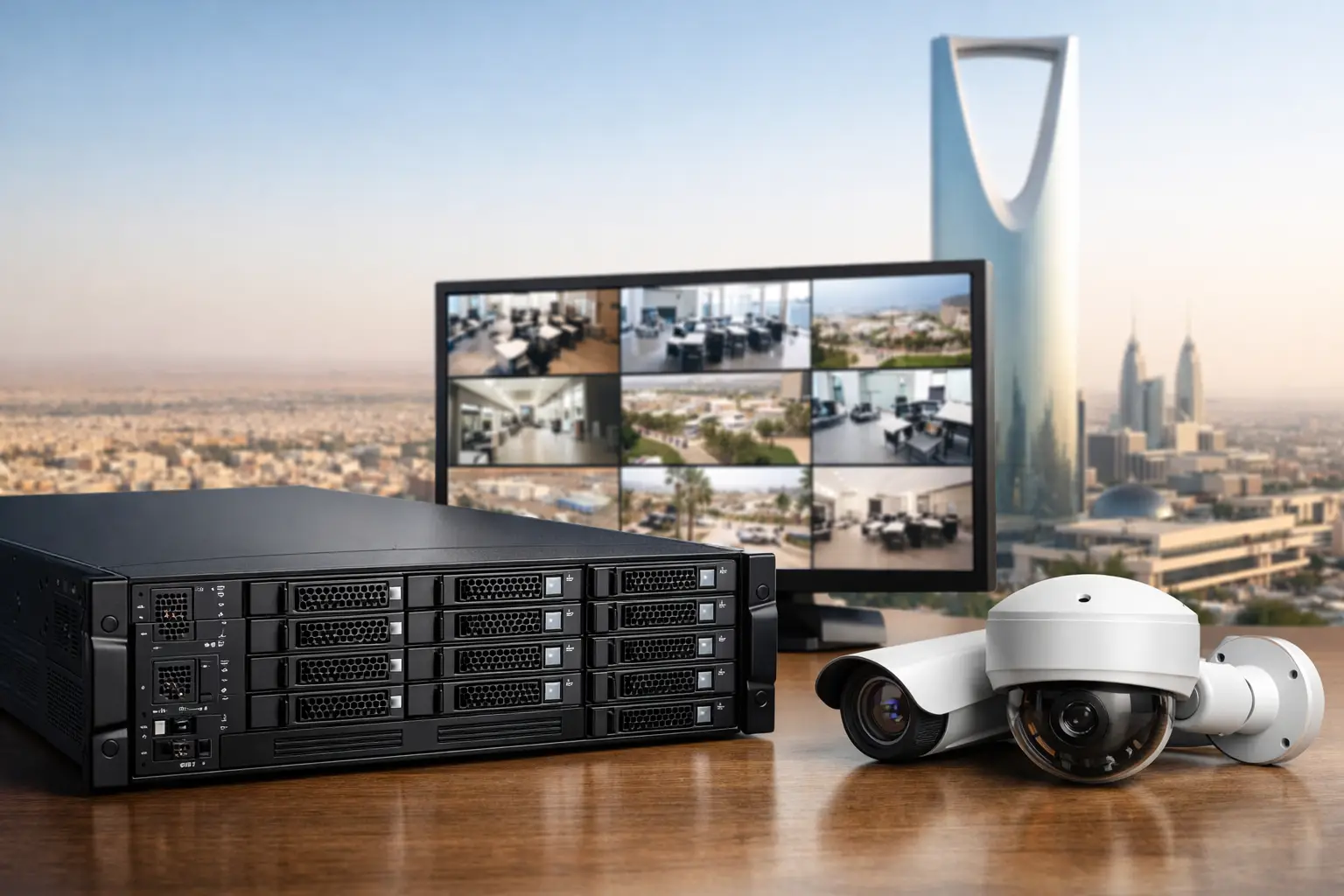
A FIBRENETIX enterprise NVR CCTV storage server Saudi Arabia specification is not a standard server purchase. In a government complex, industrial facility, transport corridor, or giga-project package, the storage platform carries real weight. It decides whether recorded evidence stays accessible when operators need it most. Camera count matters. However, retention period, recording bitrate, analytics load, failover expectations, and the selected VMS matter just as much.
FIBRENETIX enterprise CCTV servers and surveillance storage suit this specific operating environment: sustained video recording, controlled evidence retention, and predictable performance under continuous workload. For Saudi system integrators and consultants, the correct starting point is the recording requirement. It is not a generic IT hardware configuration.
Why Enterprise CCTV Storage Needs Its Own Design
Video surveillance storage behaves differently from ordinary office storage. A business application server may experience variable demand with quiet periods between transactions. An NVR recording hundreds of IP camera streams writes data continuously. Meanwhile, security operators may search archived footage, export incidents, view live video, or run VMS analytics at the same time.
That combination creates a mixed workload. If you size storage only by raw terabytes, a project can look compliant during handover. Later, once the camera estate reaches full operation, it can develop delayed playback, missing retention days, or poor export performance. Enterprise surveillance storage has to account for recording throughput and usable capacity after protection overhead. It also needs enough performance to retrieve video without interrupting recording.
FIBRENETIX focuses on enterprise NVRs, CCTV servers, and surveillance storage rather than general-purpose compute. This distinction matters when a consultant needs the recording layer specified around surveillance behavior. Adapting a standard office-server bill of materials rarely works.
Sizing a FIBRENETIX Enterprise NVR CCTV Storage Server
A defensible specification begins with actual recording assumptions. The number of cameras is only one input. Consider two 200-camera projects. One uses low-bitrate fixed cameras with motion-based recording. The other is a perimeter deployment with high-resolution cameras recording continuously, plus PTZ streams and analytics metadata. Their storage behavior is materially different.
Start with the real recording profile
The system integrator should establish each camera group’s resolution, frame rate, codec, average and peak bitrate, recording mode, and retention target. Continuous recording is easier to calculate. However, variable bitrate, scene complexity, low-light noise, and camera activity can push storage consumption beyond a simple average estimate.
Integrators often select Milesight AI cameras for applications that require TrueColor performance, LPR capture, panoramic coverage, or AI event filtering. These capabilities can reduce false alarms and improve incident review. Even so, the recording server still needs to match the camera configuration and VMS policy. Never separate a camera’s image quality and analytics role from the recording design.
State retention in days and tie it to the project’s evidence policy. Thirty, 60, and 90 days each carry different consequences for usable capacity, expansion planning, and budget. Procurement teams should also clarify the scope of retention. Does it apply to all cameras, or only to critical areas such as entrances, perimeter zones, custody areas, and LPR lanes?
Separate usable capacity from raw capacity
Raw disk capacity is not the capacity available for recorded evidence. RAID or other data-protection approaches reduce it. So do hot spares, operating system allocation, VMS databases, and recommended headroom. A storage calculation that presents only raw capacity can create a false impression of compliance.
The right question is simple. How many protected, usable days of video will the platform retain under the defined recording policy? This keeps the discussion grounded in the operational outcome the client is procuring.
Capacity headroom also matters. Projects rarely remain static. Additional cameras, changed retention rules, new analytics requirements, and expanded facility phases are common. This holds true across commercial campuses, industrial sites, and Vision 2030 developments. Sizing a server exactly to day-one consumption leaves little room for controlled growth.
Validate recording and retrieval performance together
An NVR platform must support sustained inbound recording while providing operators with usable playback. A security control room may need to review multiple cameras around an incident while live views and recording continue. If the storage architecture cannot handle concurrent write and read activity, operators experience the limitation at the worst possible time.
Performance validation should consider aggregate inbound bandwidth, concurrent users, playback and export activity, and VMS services. It should also include any analytics processing placed on the server. The appropriate configuration depends on the platform’s role. It may serve as a dedicated NVR appliance, a recording server within a larger VMS environment, or part of a distributed multi-site architecture.
Integration with the VMS and Network Layer
Select FIBRENETIX storage with the VMS architecture in view. The VMS controls how the system records, indexes, searches, and presents camera footage. The NVR and storage layer carries the sustained recording workload. Confirm compatibility, supported camera counts, recording methods, and server roles for the exact VMS version and project scope.
For projects using ISS SecurOS, the server design should reflect whether the deployment requires Professional, Premium, Enterprise, or MCC capabilities. A multi-site command environment has different recording, management, and communications requirements than a single-facility system. This is especially relevant for infrastructure and border-related environments that need both centralized oversight and local recording.
Network design is never an afterthought. Camera traffic must reach the recording server without oversubscribing uplinks or creating avoidable congestion. AETEK PoE switches and extenders support the field network layer, including outdoor, industrial, and extended-distance PoE requirements. The enterprise storage server then receives the resulting video streams. AETEK is PoE infrastructure, not a camera platform. Its role is to provide dependable network and power connectivity for the IP surveillance estate.
Document the handoff between camera network, core switching, VMS services, and recording storage before procurement. This helps the integrator identify bandwidth bottlenecks, define VLAN and security policies, and avoid sizing the NVR in isolation.
Resilience Is an Operational Requirement
Consider a failed storage disk, server hardware issue, network interruption, or site outage during specification, not after deployment. The appropriate resilience level depends on the facility’s risk profile. A small commercial site may accept a simple recovery approach. A government command center, oil and gas location, airport, or city surveillance program will not.
Key decisions include disk protection, spare strategy, redundant power, and recording-server failover. Decide as well whether critical cameras need distributed or edge recording during communication loss. The project team should also define monitoring responsibilities. A server may be technically online yet approaching capacity, reporting disk faults, or losing recording streams. It needs attention before an incident exposes the gap.
Do not confuse FIBRENETIX with Dell infrastructure. Dell PowerEdge servers, Precision workstations, and PowerVault storage cover broader VMS infrastructure needs. FIBRENETIX, by contrast, focuses specifically on enterprise CCTV servers, NVRs, and surveillance storage. Rasilient is another specialist option for forensic surveillance storage and No Frames Dropped requirements. The correct choice depends on VMS compatibility, performance expectations, retention policy, resilience needs, and the client’s approval framework.
Compliance and Tender Documentation in Saudi Arabia
Government and Vision 2030 project teams increasingly require traceable, approved equipment selection. NDAA and TAA compliance may be mandatory for certain tenders, particularly where security policy, government procurement, or international project requirements apply. Verify compliance at the model and solution level rather than assuming it from a category label.
For the storage layer, tender submissions should clearly identify the proposed FIBRENETIX platform. Include the usable storage calculation, retention basis, VMS compatibility, warranty terms, and expansion path. If the surveillance stack includes NDAA/TAA-compliant components, collect supporting declarations from the relevant manufacturers for the exact products offered.
Clear documentation protects everyone involved. It gives consultants a basis for technical review and helps procurement compare like-for-like proposals. It also gives system integrators fewer surprises when approval, delivery, and commissioning milestones arrive.
A Better Procurement Conversation
Before requesting a server quotation, provide a schedule of cameras and the recording policy. Add the retention requirement, VMS preference, site topology, and resilience expectation. A meaningful proposal can then distinguish between initial capacity and planned expansion, rather than presenting a single unexplained storage number.
Seven Sectors supports Saudi security integrators, consultants, and procurement teams with FIBRENETIX enterprise CCTV storage options. This sits alongside the wider project security stack. The value is not simply sourcing a server. It is helping ensure that the proposed recording platform matches the evidence, performance, and documentation requirements of the project.
When video evidence is required months after an incident, storage is no longer background infrastructure. It is the part of the surveillance system that proves whether the original specification was good enough.
Frequently Asked Questions
What is FIBRENETIX and how is it different from Dell PowerEdge servers?
FIBRENETIX builds purpose-designed enterprise CCTV servers, NVRs, and surveillance storage for the security market. Dell PowerEdge is a general-purpose enterprise server platform adapted for VMS use. FIBRENETIX products are engineered for the sustained write loads, mixed recording-plus-retrieval workloads, and continuous operation that IP surveillance generates. The two product lines serve different parts of the same project and are not interchangeable.
What VMS platforms does FIBRENETIX work with?
FIBRENETIX surveillance servers and NVRs are VMS-agnostic and work with all standard video management platforms including ISS SecurOS, Milestone XProtect, Genetec, and Avigilon. Seven Sectors can advise on the correct FIBRENETIX configuration for your project VMS and camera estate.
How much storage do I need for an enterprise CCTV project in Saudi Arabia?
Storage sizing depends on camera count, resolution, frame rate, compression (H.265 vs H.264), recording mode, and retention period in days. Contact Seven Sectors with those parameters and we will produce a formal storage sizing calculation and product recommendation at no cost.
Is FIBRENETIX suitable for government and giga-project deployments in KSA?
Yes. FIBRENETIX enterprise CCTV servers are designed for the high-reliability, continuous-duty requirements of government facilities, transport corridors, industrial sites, and large-scale Vision 2030 projects. The product line supports the sustained throughput and controlled retention that Saudi public-sector scopes require.
What is the difference between FIBRENETIX and Rasilient surveillance servers?
Both brands build purpose-designed surveillance storage rather than general-purpose IT hardware. Rasilient is distinguished by its NFD (No Frames Dropped) certification and forensic-grade recording guarantee, particularly suited for legal evidence chains. FIBRENETIX covers enterprise CCTV servers and NVRs across a broad capacity range. Seven Sectors supplies both and can recommend the right fit for your VMS, analytics load, and evidence requirements.
See the full Surveillance Storage & Servers overview for the complete Rasilient, Dell and Fibrenetix range.
Ready to discuss your project? Contact Seven Sectors or contact us directly on +966-012 229 3474.