
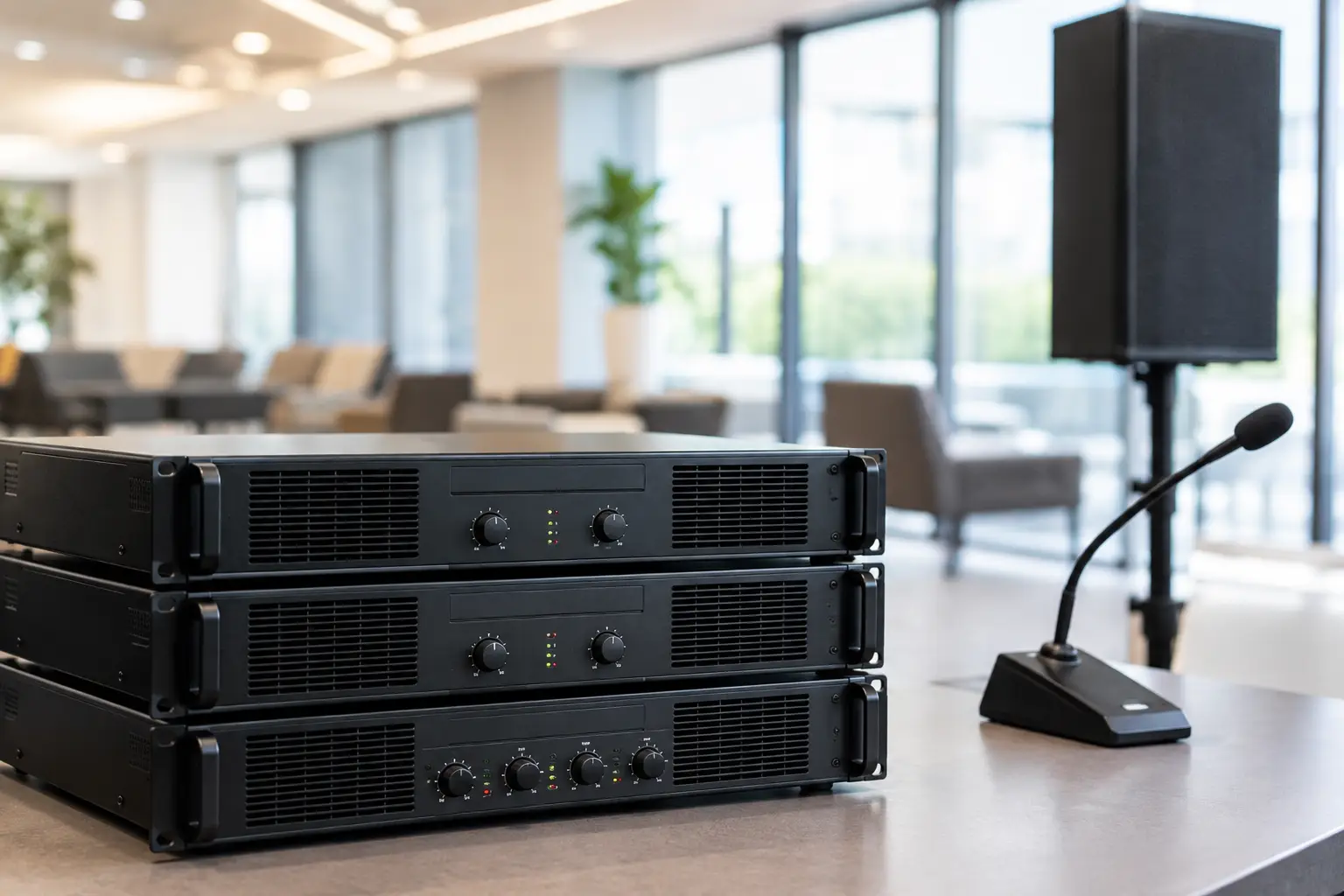
A PA system can look complete on a drawing and still fail the operational test: a clear evacuation message must reach the right area, at the required priority, without affecting critical communications elsewhere. Selecting ITC amplifier options is therefore not just a wattage decision. It is a decision about zoning, source priority, expansion, fault strategy, and the way the audio system will be maintained after handover.
ITC provides commercial audio and public-address equipment for projects where paging, background music, announcements, and emergency messaging need a structured platform. For system integrators, MEP contractors, consultants, and procurement teams, the objective is to match the amplifier architecture to the project brief before equipment is released for supply.
Start With the Audio System’s Operating Requirement
The first question is not, “Which amplifier has the highest output?” It is, “What must this audio system do every day, and what must it do during an incident?” A retail environment may need scheduled background music with selective staff paging. A transport, education, industrial, or government facility may need multiple paging priorities, restricted microphone access, and clear communication across separate operational zones.
That difference changes the amplifier selection. A simple centralized system may be suitable where all loudspeaker circuits operate together. A larger facility may require independently controlled zones, separate sources, or an architecture that supports phased expansion. If the brief includes emergency voice communication, the consultant’s life-safety requirements and the approved system design must govern every component decision.
Before comparing equipment, establish the required operating scenarios: routine music, local paging, all-call announcements, scheduled messages, emergency messages, and any integration point with other building systems. This prevents a common procurement problem: selecting amplifiers based on a single headline figure while overlooking the control logic and source priorities that make the system usable.
ITC Amplifier Options by System Architecture
ITC amplifier options should be reviewed as part of an audio architecture, not as standalone boxes. The same project may use different amplifier approaches in different areas when the zoning, cabling, and operational priorities vary.
Mixer amplifiers for straightforward commercial zones
A mixer amplifier can suit smaller or less complex areas where local inputs and basic source mixing are required. Typical examples include reception areas, retail floors, restaurants, prayer areas, meeting spaces, and service corridors. The decision is usually driven by the number of required input sources, the need for microphone paging, and whether individual areas need independent adjustment.
This approach can reduce system complexity, but it has limits. If zones are expected to grow, if separate paging permissions are required, or if multiple locations need coordinated control, a simple mixer-amplifier arrangement may create operational constraints later. Procurement teams should confirm the intended number of zones and sources against the exact ITC model documentation rather than assuming capability across a product category.
Power amplifiers for larger distributed loudspeaker systems
Where the system uses distributed loudspeaker circuits across a large footprint, separate power amplification may provide a more appropriate path. The amplifier is then part of a broader chain that can include paging control, source management, zone selection, and monitoring equipment.
The key planning exercise is to calculate the connected loudspeaker load for each circuit, allow for the project’s approved engineering margin, and allocate circuits according to the zone strategy. This work belongs in the system design and consultant approval process. At sourcing stage, the equipment schedule should identify the required amplifier channels, the designated zones, the input arrangement, and any stated backup requirement.
Avoid treating one large amplifier as an automatic cost-saving measure. Consolidation can simplify rack space and equipment count, but it may also place more zones behind a single point of failure. Several appropriately assigned amplification paths may offer better operational separation where continuity matters.
Networked and centrally managed audio environments
Some projects require more than local audio distribution. Campuses, high-rise developments, large venues, logistics facilities, and multi-building sites may need audio routed from central control while retaining local paging access and zone-level operation.
For these projects, the conversation must include network topology, controller compatibility, user permissions, cable routes, and system recovery procedures. The amplifier is only one element. A well-specified central system can make changes easier across many zones, but it requires disciplined coordination between the AV, ELV, IT, and MEP stakeholders.
Do not assume that networked control is automatically the best answer. A centralized platform can add flexibility, while a more localized approach can reduce dependency on shared infrastructure. The right choice depends on the project’s control requirements, maintenance resources, and approved design intent.
Match Amplifier Capacity to Zones, Not Just Floor Area
Floor area is a weak proxy for amplifier selection. Ceiling height, ambient noise, room use, speaker placement, architectural finishes, and the acoustic brief all affect the loudspeaker design. An open warehouse, a reverberant concourse, and a carpeted office floor may have very different requirements despite similar dimensions.
For procurement, the equipment schedule should separate each zone or circuit clearly. It should state the loudspeaker quantity and assigned load, the required amplifier allocation, the source or paging function, and any operational priority. This gives the supply chain a reliable basis for confirming compatible ITC equipment and identifying omissions before an order is finalized.
It also helps prevent accidental overloading caused by late additions. Extra loudspeakers, revised partitions, or newly added tenant areas can change the load on a circuit. If expansion is likely, reserve capacity should be addressed in the approved design rather than left to a last-minute substitution request.
Prioritize Paging Control and Message Clarity
An amplifier alone does not determine whether a paging message is intelligible. Microphone selection, gain structure, zone routing, speaker coverage, ambient conditions, and the behavior of source priorities all matter.
Define who can page which zones. A security desk may require all-call authority, while a reception point may only need access to a local area. A scheduled music source may need to mute when an authorized microphone is active. In more critical environments, the approved system strategy may require specific alarm and message priorities.
These workflows should be documented before products are selected. Asking for “paging capability” without identifying users, zones, priorities, and source behavior leaves too much open to interpretation. It can also lead to equipment being supplied that performs correctly in isolation but does not meet the actual operating procedure.
Plan for Continuity, Service Access, and Future Changes
Continuity planning is not limited to emergency systems. A failed audio channel in a major public area can create disruption, confusion, and tenant complaints. The appropriate resilience level depends on the facility’s risk profile and its approved design requirements.
For higher-consequence areas, assess whether the system requires spare amplification capacity, fault indication, separated zones, or a documented replacement strategy. For less critical zones, a simpler arrangement may be commercially sensible. The point is to make the trade-off explicit instead of applying the same architecture everywhere.
Serviceability matters as well. Racks should allow access for identification, testing, and replacement. Clear labeling of amplifier channels, zones, and loudspeaker circuits reduces diagnosis time. Procurement documentation should preserve exact model references, quantity breakdowns, and approved substitutions so future maintenance teams are not working from incomplete records.
Include ITC LED Displays Only When They Serve the Communication Plan
ITC also offers an LED display line, which can be considered where visual messaging supports the same operational communication plan. A display may reinforce public information, queue instructions, event content, or facility announcements. It should not be treated as a replacement for intelligible audio where audible messaging is required.
The audio and display scopes should remain technically coordinated but commercially distinct. Confirm content responsibility, control interfaces, mounting requirements, power provisions, and acceptance criteria before combining them in one package. Exact LED display specifications should be selected against the approved project requirement and confirmed for the chosen ITC range.
What to Include in an RFQ for ITC Amplifier Options
A well-prepared RFQ speeds up technical review and reduces clarification cycles. Include the approved equipment schedule where available, the number of zones, intended use of each zone, loudspeaker circuit allocation, source inputs, paging stations, priority requirements, and any stated need for future expansion or fault strategy.
Also identify whether the request is for a tender submission, a design-approved supply package, or an urgent replacement. These are different commercial situations. A tender may need alternate options aligned to a specification, while a replacement request depends on confirming compatibility with the existing system.
Seven Sectors Trading Co. is an authorized ITC partner supporting commercial and project-based sourcing requirements in Saudi Arabia. For quotation support, send the equipment schedule and operational requirements to info@7sectors.com or use the Get Quotation form. The strongest amplifier selection is the one that preserves the project’s intended communication workflow when the building is busy, noisy, and least forgiving.
Ready to discuss your project? Contact Seven Sectors or contact us directly on +966-012 229 3474.