
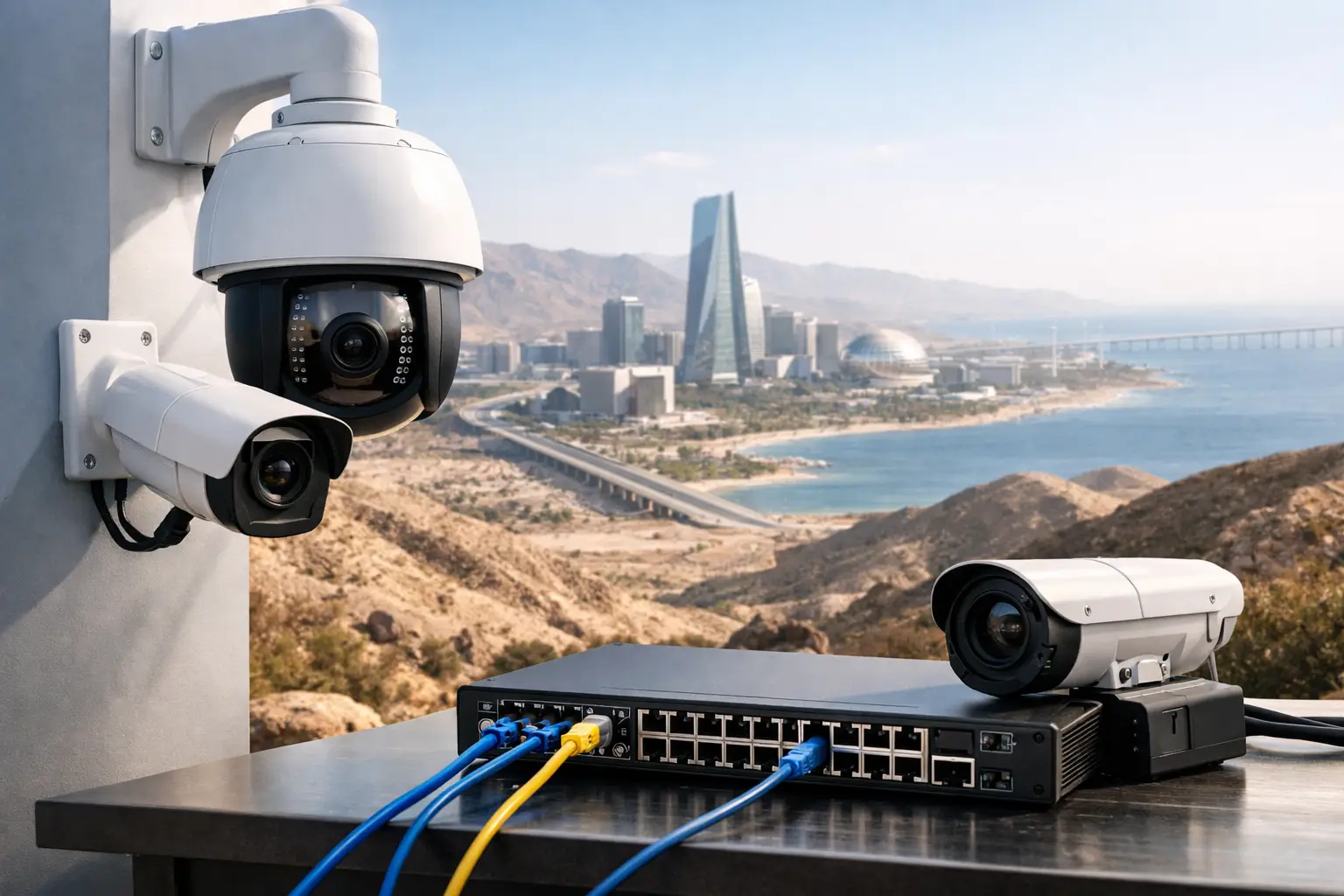
A NEOM security procurement case study should not begin with camera resolution or a lowest-price comparison. For a remote, phased giga-project environment, the more consequential procurement question is whether the PoE infrastructure can deliver dependable power and data across outdoor zones, survive site conditions, and remain supportable when the surveillance estate grows. This illustrative case study centers on AETEK PoE infrastructure as the network foundation for a compliant perimeter and facilities surveillance package.
The scenario reflects the decisions security consultants, system integrators, and procurement teams face on major Saudi developments. It is not a claim of a specific NEOM deployment. It is a practical framework for evaluating the equipment that sits between the camera and the recording platform – an element that is often specified too late.
The Procurement Challenge Behind the Cameras
A typical phased package may include perimeter roads, temporary facilities, substations, logistics yards, worker access points, and future permanent buildings. These locations differ substantially in exposure, cable distance, available cabinet space, and maintenance access. A single indoor PoE switch type may appear to simplify the bill of materials, but it can create unsuitable outdoor enclosures, additional power conversion points, and unnecessary service risk.
The procurement team in this case needed an infrastructure approach that could support NDAA/TAA-compliant project requirements, work with selected IP cameras and VMS platforms, and be supplied through a verified local channel. The solution also needed to distinguish between outdoor edge locations, indoor technical rooms, and industrial areas rather than treating every network point as identical.
That distinction matters. Cameras may be the visible part of the security system, but a camera with unstable power, poor network continuity, or a difficult-to-service edge cabinet does not meet the operational objective. The PoE layer affects availability, fault isolation, expansion planning, and the quality of evidence reaching the VMS.
NEOM Security Procurement Case Study: Why AETEK PoE Was Specified
AETEK is a Taiwan-made PoE infrastructure manufacturer, not a camera brand. Its product families give consultants and integrators a more disciplined way to match network equipment to the deployment environment. In this case, the AETEK H-series was evaluated for outdoor field locations because it provides IP67 protection suited to exposed applications. The C-series addressed indoor PoE switching requirements, while the D-series was relevant where industrial conditions and higher environmental demands influenced the equipment selection.
This product-family approach is stronger than writing a generic specification for “PoE switches” and leaving critical conditions open to interpretation. Procurement documentation can define the intended installation environment, expected endpoint load, uplink architecture, enclosure requirements, and compliance documentation before quotations are compared.
For longer cable runs, AETEK PoE Extenders supporting up to 250 meters were included as a design option. They are not a substitute for every fiber backbone decision. Fiber remains the better choice where distance, bandwidth aggregation, electrical isolation, or future expansion requires it. But for isolated cameras or gate points where a practical copper extension can avoid a new local power source and additional civil work, a PoE extender can reduce scope complexity.
The selection also considered AETEK Ceiling PoE Switches for areas where conventional cabinet placement would be intrusive or inefficient. These are useful only when the physical environment, service access, heat conditions, and cable routing have been properly assessed. A ceiling-mounted switch is not automatically the right answer for every occupied building zone.
Compliance Was a Procurement Gate, Not a Footnote
For government, critical infrastructure, and Vision 2030-related packages, NDAA/TAA compliance is frequently a bid qualification issue. It should be addressed during the submittal stage, not after an equipment choice has been made. AETEK’s NDAA/TAA-compliant positioning allows project teams to evaluate the PoE infrastructure alongside compliant cameras, servers, and access-control components.
In a surveillance package using Milesight AI cameras, for example, the camera specification and the network-power specification should be reviewed together. Milesight cameras provide the imaging and analytics capability; AETEK provides the PoE switching and extension infrastructure that powers and connects the edge devices. Treating these as separate procurement decisions can lead to mismatched power budgets, unsuitable environmental protection, or fragmented support responsibility.
The same principle applies to the recording side. Whether the project uses ISS SecurOS with Rasilient forensic storage, FIBRENETIX surveillance servers, or Dell PowerEdge and PowerVault infrastructure, the edge network must reliably move video toward the recording environment. The PoE switch is not responsible for VMS sizing or retention calculations, but it is part of the path that determines whether video arrives consistently.
Technical Evaluation Criteria That Changed the Decision
The case study procurement team avoided selecting equipment solely on unit cost. Instead, it assessed the total practical cost of each field location. That included switch hardware, enclosure needs, local power requirements, cable distance, labor implications, spares strategy, and likely maintenance access.
First, environmental fit was assessed. Outdoor locations required equipment suitable for exposure rather than an indoor switch placed inside an improvised cabinet. The AETEK H-series IP67 approach was relevant where field conditions justified protected outdoor PoE infrastructure. Indoor technical areas could use the C-series where the site environment was controlled. Industrial facilities required separate consideration, making the D-series a more appropriate category for evaluation.
Second, the team reviewed PoE demand at the endpoint level. A fixed camera, a PTZ camera, an illuminator, and an intercom do not necessarily have the same power profile. A network design must account for the actual load and startup behavior of connected devices, with capacity for defined future additions. Quoting a switch without checking the project endpoint schedule is a common tender-stage weakness.
Third, cable distance was reviewed before local power supplies were added by default. Where the run exceeded conventional Ethernet distance but the network architecture and endpoint demand supported the approach, AETEK PoE Extenders created an alternative for up to 250-meter connections. The trade-off is clear: an extender may simplify a single remote endpoint, but it should be evaluated against fiber for locations likely to add multiple cameras, access-control doors, or other IP devices later.
Finally, the team required a clear support route. On a giga-project, replacing a failed field device can involve permit procedures, restricted access, mobilization time, and work-window limitations. Standardizing on an identified manufacturer and an authorized Saudi partner helps reduce ambiguity over documentation, availability, and product selection.
The Result: A Procurement Structure Built for Phased Delivery
The value of the AETEK-based approach was not that one switch solved every location. The value was a structured bill of materials: H-series products for exposed field applications, C-series products for indoor areas, D-series products for industrial conditions, and PoE Extenders where extended copper runs were justified.
That structure supports phased procurement. Early construction packages can secure the appropriate field infrastructure without forcing the consultant to commit future buildings to an unsuitable outdoor product. Later packages can retain a common AETEK platform while selecting the correct series for the final environment. This provides consistency without false standardization.
For procurement teams, the case also demonstrates why compliance files, model-specific submittals, and endpoint schedules should move together. A compliant camera alone does not make a compliant surveillance package. The power and network layer, recording infrastructure, and access-control interfaces must all be assessed against the project requirement.
What Integrators Should Include in Their Tender Review
Before submitting a PoE infrastructure alternative, confirm the planned camera and endpoint count by location, the power requirement for each device, cable distances, outdoor exposure, cabinet constraints, uplink requirements, and the project’s NDAA/TAA documentation expectations. This review is especially valuable for remote project zones in Tabuk, Umluj, Riyadh, and the Eastern Province, where replacement logistics and future expansion can materially affect the total project cost.
AETEK should be specified as the PoE infrastructure layer, with the model family selected according to the real installation condition. That creates a cleaner division of responsibility: cameras such as Milesight handle image capture and AI analytics, AETEK handles powered network connectivity, and the selected VMS and storage platform manages recording and investigation.
For AETEK PoE infrastructure availability, project documentation support, and tender pricing, contact Seven Sectors at info@7sectors.com or submit your requirement through the website’s Get Quotation form. A clear endpoint schedule and site environment description will produce a more accurate supply recommendation from the start.
nnFrequently Asked Questions — NEOM-Scale Security Procurement with AETEK PoE
nnAETEK H-Series outdoor PoE switches carry IP67 protection, making them suitable for exposed installations across perimeter roads, utilities, and construction-phase infrastructure. Taiwan-made and NDAA/TAA-compliant, they support the supply chain verification that large Saudi government and giga-project procurements require alongside the environmental performance to sustain camera uptime in harsh site conditions.
It means the PoE switches in the bill of materials are verified free of components from manufacturers restricted under Section 889 of the U.S. NDAA, and in the case of TAA compliance, manufactured or substantially transformed in a designated country. For NEOM, Red Sea Project, and other Vision 2030 developments with government or international contractor requirements, this documentation supports tender and compliance submissions.
AETEK PoE Extenders can extend camera connectivity up to 250 metres beyond the standard 100-metre Ethernet distance limit. This is valuable on large outdoor sites where running fibre to every camera location is impractical or where phased infrastructure needs temporary or permanent copper-based extensions at perimeter points.
AETEK PoE switches power any ONVIF or 802.3af/at-compliant IP camera. For Saudi giga projects, Seven Sectors typically pairs AETEK PoE infrastructure with Milesight AI cameras and ISS SecurOS VMS, creating a single-source, authorized supply chain for the network, camera, and software layers.
Seven Sectors supplies authorized AETEK PoE infrastructure, Milesight AI cameras, ISS SecurOS VMS, Rasilient servers, and HID access control as a verified local partner based in Jeddah. We provide procurement documentation, project specification support, and local channel availability — contact us with your project scope for a structured supply proposal.
Ready to discuss your project? Contact Seven Sectors or contact us directly on +966-012 229 3474.