
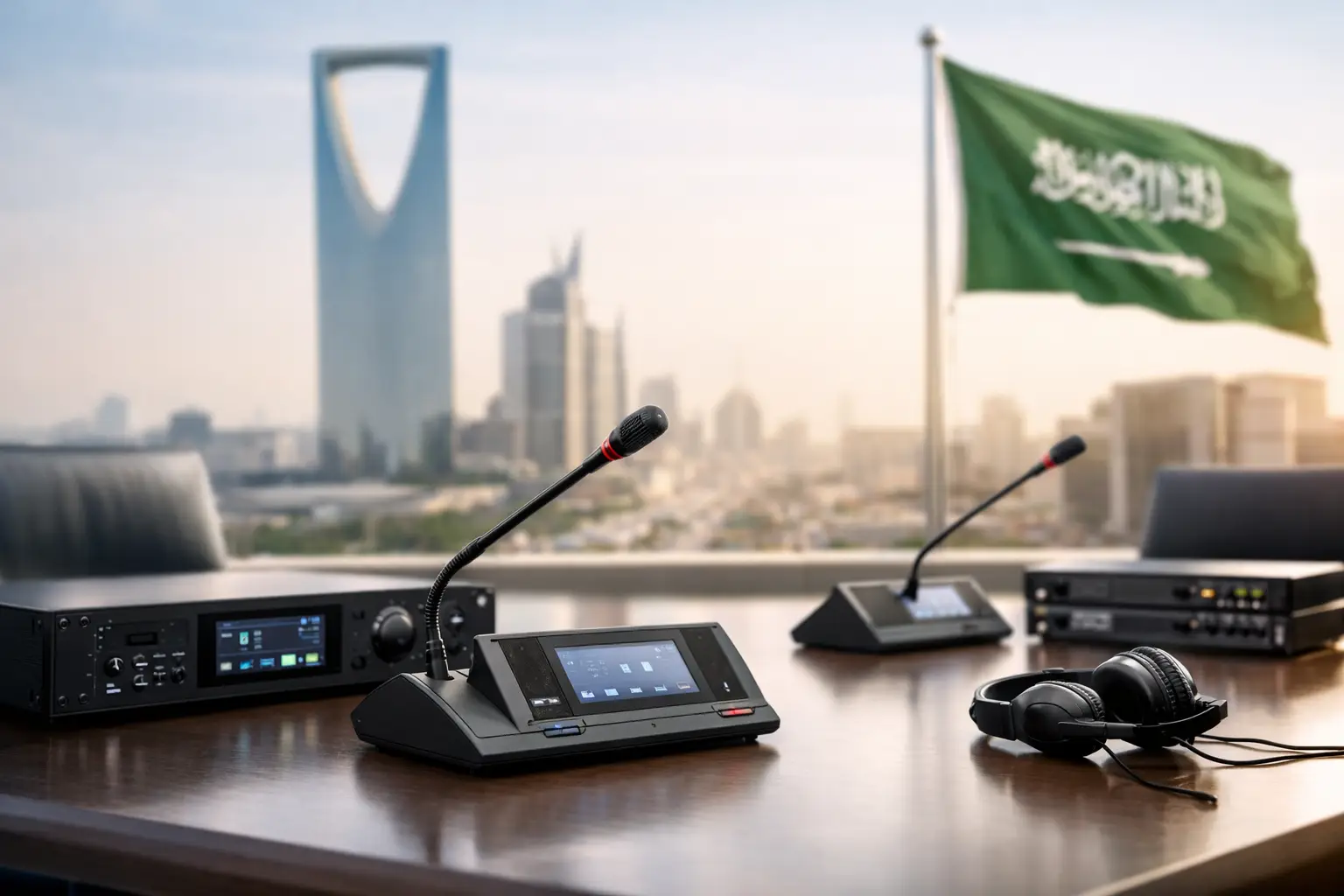
A committee room can have excellent displays, camera tracking, and control systems. Yet it still fails its users if delegates cannot be heard clearly or the chairman cannot control the floor. For consultants and integrators evaluating an ITC TS-0305 requirement, the critical question goes beyond whether the room needs conference microphones. It is whether the proposed conference architecture, audio network, control logic, and operational workflow form one coordinated system.
The ITC TS-0305 and TS-0305A are full-digital chairman and delegate conference units intended for formal meeting environments. They fit projects where structured speaking control matters: government meeting rooms, municipal councils, boardrooms, command centers, education campuses, and major project offices. In Saudi Arabia, these spaces increasingly combine conferencing, AV recording, video tracking, interpretation, and networked audio. Verify that combination carefully at tender stage, especially when Dante appears in the specification.
ITC TS-0305 Digital Conference System Dante Saudi Arabia Requirements
Dante is an audio-over-IP platform, not a generic description for any digital audio connection. A digital conference system can be fully digital while using a dedicated conference bus or proprietary control/audio architecture rather than native Dante transport. That distinction is essential when reviewing the ITC TS-0305 for a Saudi project.
If a bill of quantities states “Dante conference system,” the consultant or integrator should confirm exactly where Dante is required. It may be required for connection to a DSP, digital mixing console, recording appliance, streaming encoder, or building-wide audio network. It may also be a preferred transport standard for interoperability with existing AV infrastructure. These are different requirements, and they can lead to different system architectures.
Do not assume every TS-0305 component has native Dante connectivity. Check the current ITC documentation, controller configuration, and approved interface options for the proposed system. Confirm the audio signal path in writing. Trace it from chairman and delegate units, through the conference control equipment, into the DSP or audio network, and onward to recording, reinforcement, or broadcast destinations.
This verification protects everyone involved. This prevents a late-stage situation where the conference microphones work correctly but cannot connect to the Dante network as the consultant described. It also avoids unnecessary cost when a dedicated digital conference connection is sufficient. You may only need Dante at the DSP or mixer boundary.
What the TS-0305 Brings to Formal Meeting Spaces
The TS-0305 series is designed around chairman and delegate roles rather than open, unmanaged microphone operation. This is the correct operating model for meetings where speaking order, participant authority, and room discipline matter. A chairman unit provides a different role from a delegate unit. It lets a meeting organizer maintain control where many participants may request to speak.
That role-based structure is valuable in government and corporate meeting rooms, but select it deliberately. A small executive boardroom with six regular attendees may need only straightforward microphone access and simple reinforcement. A council chamber, ministry meeting room, or operations center may need a defined chairman position and delegate stations. Voting workflows and camera tracking integration may also apply. The TS-0305 is better assessed against the second type of room.
For larger deployments, also evaluate the system for meeting behavior, not only microphone quantity. How many delegates will be active? Must speakers request permission before talking? Can multiple microphones operate at once? Is the room used for routine internal meetings, formal public sessions, or hybrid meetings with remote participants? These questions determine the required control mode, audio processing, operator workflow, and recording strategy.
Chairman and delegate placement is an acoustic decision
Do not treat microphone placement as furniture coordination alone. The position of loudspeakers, displays, ceiling height, HVAC noise, participant seating, and camera sightlines all affect speech intelligibility. In a reflective chamber with ceiling speakers, microphone gain before feedback may be the main constraint. In a large boardroom, distant loudspeakers and poor DSP settings can make remote participants sound detached even when local speech is clear.
A properly specified TS-0305 deployment starts with the intended seating plan. The chairman station should match the meeting protocol. Delegate locations should support natural speaking posture and clear identification of each participant. Any video tracking requirement should align conference microphone positions with camera presets and the control method selected for the room.
Designing the Dante Boundary Correctly
When a project requires Dante, define its boundary in the system rather than treating it as a product checkbox. In many projects, the cleanest design keeps conference control within the ITC platform. Present the required program, mix-minus, recording, or reinforcement audio to the wider AV system through a verified interface or DSP stage.
That architecture gives the integrator clear responsibility lines. The conference platform manages delegate participation and meeting control. The DSP manages room equalization, automixing where needed, acoustic echo cancellation for hybrid calls, and routing to USB, codecs, or recording systems. The Dante network transports the defined audio channels between compatible devices. Each layer has a specific purpose.
Channel planning matters. A system carrying only a mixed output to a recorder has very different requirements. One needing isolated microphone channels, remote interpretation feeds, assistive-listening, overflow audio, and broadcast outputs demands far more planning. More channels may provide greater flexibility for post-production and advanced mixing, but they add commissioning time, switch configuration requirements, and fault-finding complexity.
Handle network design with the same discipline as other critical project networks. Audio-over-IP requires a managed network approach. This means appropriate clocking, multicast planning, a documented VLAN policy, and clear separation between AV and enterprise traffic. The exact design depends on endpoint count, redundancy expectations, and project IT policy. It also depends on whether the audio network must span multiple rooms or buildings.
An AETEK PoE switch is relevant where compatible PoE-powered network endpoints need protected, managed infrastructure, but it should not be specified as a substitute for confirming the conference system’s own power and communication requirements. AETEK is a PoE infrastructure brand, not a conference microphone or camera manufacturer. The conference topology must be based on ITC’s approved architecture first, then supported by the appropriate network infrastructure.
Video Tracking and Hybrid Meeting Integration
Many Saudi meeting-room tenders now request camera tracking alongside the conference system. ITC TS-0699 is the relevant ITC video tracking controller to consider where the project requires conference microphone activity to trigger PTZ camera positioning. The value is practical: remote attendees and recordings can show the active speaker rather than a static wide shot of the room.
However, define camera tracking expectations realistically. A camera preset identifies the speaking position; it does not automatically solve poor lighting, obstructed views, or an unsuitable camera lens. The integrator should coordinate preset locations, participant name displays, room layout, and the selected PTZ camera’s optical range before finalizing the workflow.
Hybrid meetings add another layer. Local speech must reach remote participants with consistent level and intelligibility, while remote audio must return to the room without echo. That usually calls for a properly specified DSP and conferencing codec integration. The TS-0305 provides the structured local conference layer. The full hybrid outcome depends on the entire audio chain: acoustic echo cancellation, USB or codec routing, loudspeaker zoning, and room acoustics.
Tender Documentation That Avoids Scope Gaps
In government procurement and Vision 2030 tenders, vague wording such as “digital conference system with Dante” creates avoidable ambiguity. Tender documents should identify chairperson quantities, meeting control modes, and audio output requirements. Also specify display or voting needs, video tracking scope, recording outputs, and the precise Dante interoperability expectation.
A useful submittal should include a block diagram, cable and network topology, and a unit schedule. Also include an interface schedule and note which equipment is Dante-enabled. State clearly whether Dante is a mandatory native interface at the controller, provided through external equipment, or limited to selected audio feeds.
For sensitive government and giga-project applications, review product compliance at package level. NDAA/TAA requirements should never be copied into a specification without confirming the actual compliance position of each proposed manufacturer and model. Evaluate the ITC conference package on its own documented eligibility. Check adjacent security and network components separately. A compliant Milesight camera or AETEK PoE infrastructure selection does not establish compliance for unrelated AV equipment.
Local Supply Support for Project Teams
Seven Sectors supports Saudi system integrators, consultants, and procurement teams. We source ITC conference and PA solutions for commercial, government, and infrastructure projects. For large-venue PA and subwoofer design, see the ITC KS-218 Line Array guide for Saudi stadiums. The productive starting point is a reviewed requirement, not a generic microphone count. Share the room layout, participant quantity, audio output needs, whether Dante is mandatory, and any TS-0699 tracking requirement before finalizing equipment.
That level of clarity gives the project team a better chance of receiving the correct conference architecture, compatible interfaces, and documentation aligned with the tender. This leaves space for informed trade-offs. A simpler room may not need full networked audio integration. A high-profile council chamber may justify the added engineering discipline of a defined Dante and video-tracking workflow.
The most useful next step is to turn the phrase “Dante-enabled conference system” into a signal-flow drawing with named interfaces. Once every audio path and control handoff is visible, the TS-0305 stands on its own merits. It gives formal meetings a controlled, intelligible, and accountable voice.
Ready to discuss your project? Contact Seven Sectors or contact us directly on +966-012 229 3474.