
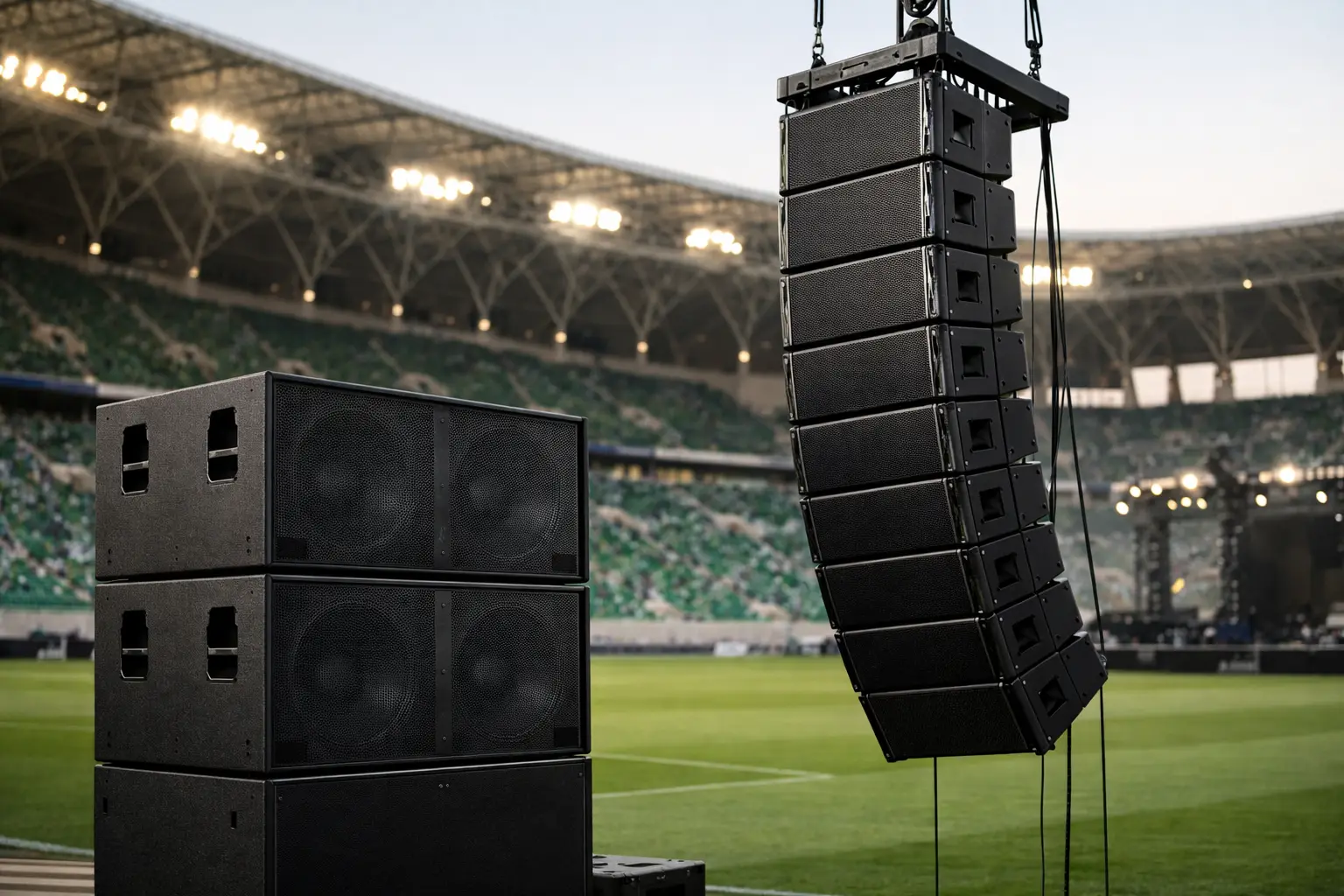
The phrase ITC KS-218 line array outdoor stadium speaker Saudi Arabia is common in project searches. This search phrase combines two different parts of a professional sound system. The ITC KS-218 is a professional subwoofer, not a line-array cabinet. In an outdoor stadium design, the KS-218 supports compatible ITC LA-series line arrays and extends low-frequency output for music, event production, and high-impact playback. For intelligible announcements across a large Saudi venue, the line-array system, zoning strategy, amplification, and acoustic design remain equally decisive.
For consultants, system integrators, and procurement teams, this distinction avoids a common specification error. Instead, do not select a stadium PA package based on a single speaker model. Evaluate it as an engineered audio chain that delivers controlled coverage, speech clarity, operational resilience, and practical serviceability under demanding outdoor conditions.
Where the ITC KS-218 Fits in Stadium Audio
The ITC KS-218 serves the low-frequency section of a professional PA system. Its role is to reproduce the energy that smaller line-array cabinets cannot deliver efficiently at the lowest frequencies. That matters during opening ceremonies, sporting-event music, and live performances. It also applies to crowd engagement and any program material where bass impact shapes the audience experience.
It does not replace the main PA. ITC LA-series products, including the LA-2650, LA-2100, LA-2800K, and LA-2120 series, are the primary candidates to assess for controlled mid- and high-frequency coverage. Their selection depends on stadium geometry, throw distance, mounting positions, target sound-pressure levels, audience capacity, and whether the system must cover seating only or also concourses, hospitality zones, player tunnels, and external gathering areas.
Specify the KS-218 as part of a matched system. The appointed audio designer or integrator should review amplification, signal processing, crossover settings, and physical deployment. A subwoofer may add impressive energy, but poor alignment with the main arrays can reduce clarity rather than improve it.
Outdoor Stadium Sound Is a Coverage Problem First
An outdoor stadium has no forgiving acoustic shell. Sound disperses into open air. Wind can alter perceived high-frequency performance, and long throw distances create audible timing differences between speaker positions. The main design objective is not simply maximum volume. It is even coverage and intelligible speech in the seats that matter.
A typical approach uses flown line-array hangs aimed at distinct seating blocks. Carefully placed delay loudspeakers fill areas where venue geometry requires them. The line arrays address directional coverage and projection. ITC KS-218 subwoofers provide the low-frequency foundation, normally in locations selected for both performance and practical access.
The trade-off is straightforward. More subwoofer output can support concerts and ceremonial programming, but uncontrolled bass can travel beyond the venue, excite structural elements, and create uneven response across seating areas. Ground-stacked, flown, or centrally grouped low-frequency deployment each produces different results. The correct option depends on the stadium structure, operational requirements, and the limits set by the project consultant.
Speech Intelligibility Must Lead the Brief
Stadium operators need announcements to be understood during normal operation and high-noise moments. Music playback is valuable, but do not allow it to dominate the system specification where the PA also supports operational communication.
Direct-to-reverberant ratio, speaker aiming, delay alignment, ambient noise, and microphone quality all affect speech performance. In an open venue, reflections are often less severe than in an enclosed arena. Yet grandstands, roofs, façades, and large video structures can still create problematic reflections. High-output equipment cannot correct poor aiming or incorrect delay settings.
For this reason, a tender should identify expected use cases early: match-day announcements, national ceremonies, live entertainment, emergency communication interfaces, multilingual messaging, and broadcast-related playback all place different demands on the system.
Selecting ITC Line Arrays and KS-218 Subwoofers
Assess the ITC LA-series as the main loudspeaker platform, and evaluate the KS-218 for low-frequency support. Avoid specifying the KS-218 as a stand-alone solution for stadium coverage. Instead, treat it as a specialized component within the larger professional audio system.
System integrators should obtain the following information before finalizing product quantities or array configurations:
- Stadium drawings showing seating tiers, roof structure, field dimensions, and potential loudspeaker mounting points.
- Required audience areas, including VIP sections, concourses, entrances, public plazas, and back-of-house operational zones.
- Expected program priorities, such as voice announcements, recorded music, live performance, or ceremonial playback.
- Available electrical infrastructure, equipment-room locations, cable pathways, and control-room requirements.
- Environmental exposure, including direct sun, dust, wind, humidity, and access restrictions for maintenance.
These details determine whether an array needs long throw capability, wide horizontal coverage, multiple hangs, fill loudspeakers, or delay positions. They also determine whether the subwoofer system should prioritize compact placement, high-output event performance, or controlled low-frequency coverage.
Amplification and DSP Are Not Secondary Items
A professional line-array and subwoofer package needs compatible amplification and DSP. Amplifier channel allocation, limiting, high-pass filtering, crossover points, equalization, and time alignment should be part of the approved system design documentation.
This is especially relevant when combining ITC KS-218 units with LA-series arrays. The main arrays and subwoofers must operate as one system rather than as separate loudspeaker groups. Incorrect polarity, delay, or crossover configuration can produce cancellation in critical low-mid frequencies, where speech and musical definition are easily affected.
For stadium operators, DSP also supports practical operating modes. A sports-day announcement preset may prioritize voice intelligibility and controlled output. An event preset may permit broader bandwidth and stronger low-frequency performance where the venue rules allow it. Control access to these modes, and provide clear handover documentation for the end user.
Saudi Conditions Affect Equipment Planning
Saudi outdoor projects require attention to more than sound output. Heat exposure, airborne dust, UV conditions, and occasional moisture all influence enclosure selection, installation methods, protective housings, cabling, and maintenance planning.
The final environmental protection approach must follow the product documentation and the consultant’s specification. It is not appropriate to assume that every professional loudspeaker can remain permanently exposed without additional protection. In many stadium applications, loudspeakers sit beneath roof overhangs, within purpose-designed housings, or in locations that reduce direct weather exposure while maintaining the required acoustic coverage.
Cable management deserves the same level of attention. Long loudspeaker runs require proper conductor sizing, route segregation, labeling, and termination practices. Equipment racks need suitable ventilation and access, particularly where amplifiers and processing equipment operate for extended periods in high ambient temperatures.
If the stadium PA is part of a wider venue technology package, coordination is also needed with LED displays, broadcast systems, public-address control, emergency communication, and network infrastructure. AETEK PoE switches may support IP-based peripheral infrastructure where applicable, but they are network infrastructure products, not replacements for professional audio amplification or loudspeaker signal distribution.
Procurement Considerations for Government and Giga Projects
For stadium work in Riyadh, Jeddah, the Eastern Province, NEOM, Qiddiya, or other Vision 2030 project zones, procurement teams should request a clear bill of materials. This should separately list line arrays, KS-218 subwoofers, amplification, DSP, rigging hardware, cabling, racks, control interfaces, and any required accessories.
This separation matters because stadium sound projects are often revised after structural coordination, acoustic modeling, or event-operations review. A transparent equipment schedule makes it easier to track substitutions, verify compatibility, and protect the intended performance outcome.
NDAA and TAA requirements are often central in security and government technology procurement. Where these compliance requirements apply to the broader project, verify them by category and manufacturer rather than assume across unrelated product groups. Audio, surveillance, access control, servers, and network infrastructure each require their own compliance review.
Seven Sectors is an authorized Saudi partner for ITC professional PA and audio systems, supporting project teams with product sourcing for stadium, airport, mosque, theater, and command-center applications. For an outdoor stadium requirement, provide the venue drawings, intended use cases, mounting assumptions, and requested coverage zones early. That gives the appointed integrator and consultant a sound basis to select the right ITC LA-series array configuration and determine whether KS-218 subwoofers are needed, where to deploy them, and what supporting equipment the system requires.
A stadium PA succeeds when every spectator hears the message clearly and every event has the headroom it needs. The ITC KS-218 can be a valuable part of that result. Specify it for its proper role alongside a correctly engineered ITC line-array system.
For a complete guide to PA system specification and procurement for Saudi stadiums and sports venues, see our overview of Saudi stadium PA systems.
See how ITC systems are specified for high-demand environments: ITC audio systems for Saudi critical facilities.
Ready to discuss your project? Contact Seven Sectors or contact us directly on +966-012 229 3474.