
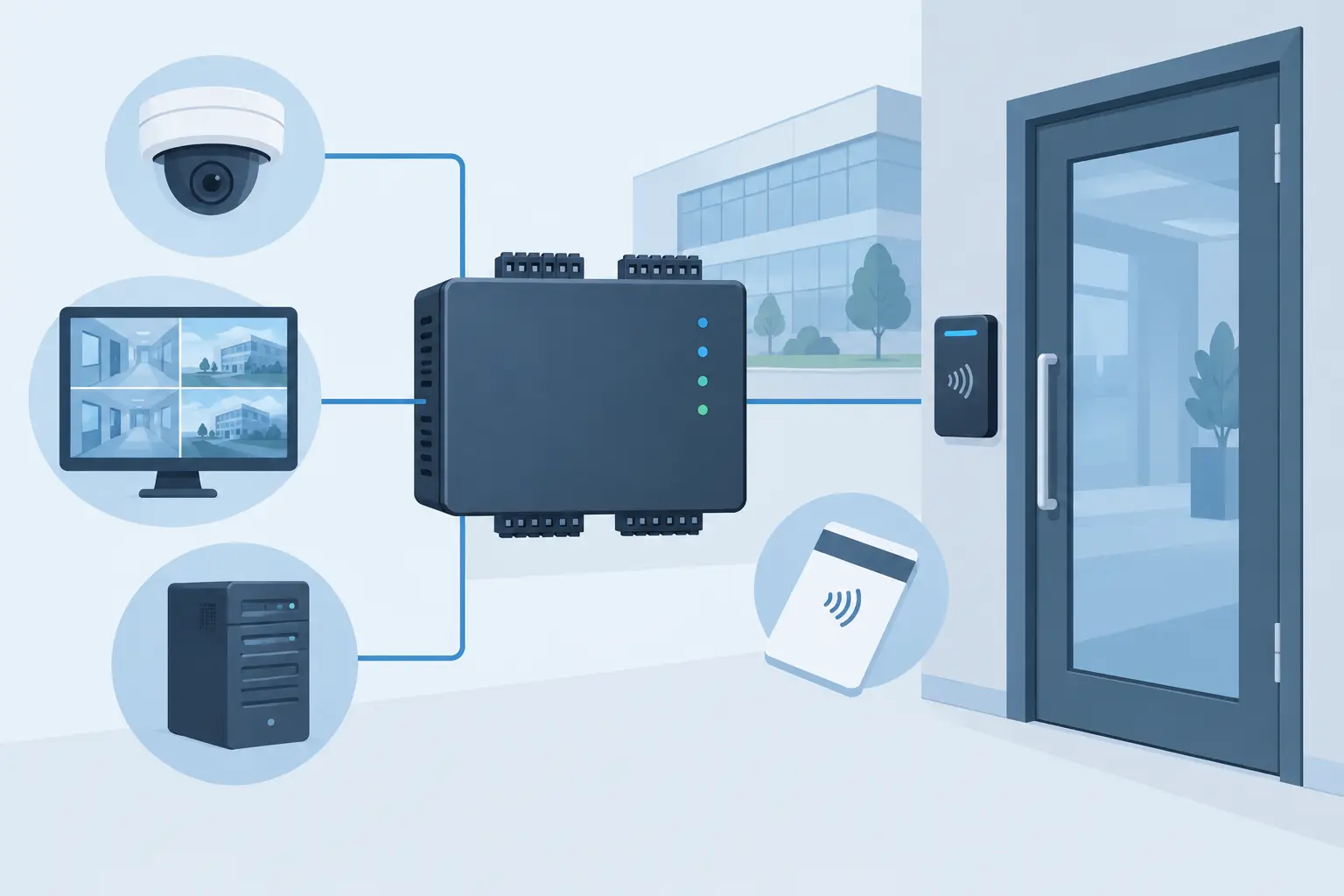
An access control controller is rarely the most visible item in a security package, but it can determine whether a system remains manageable after occupancy, expansion, and handover. Knowing how to select HID controllers means looking beyond a door count and assessing the facility’s operating model, security requirements, network conditions, and future phases. As an authorized HID partner, Seven Sectors Trading Co. supports Saudi system integrators, consultants, contractors, and procurement teams with HID access control hardware for commercial, government, industrial, and major infrastructure requirements.
The correct choice is not always the controller with the largest stated capacity. A smaller controller placed close to the controlled opening may suit a distributed site, while a centralized arrangement can simplify cabinet management in a single building. The decision should follow the security design and procurement requirement, not a generic product preference.
Start With the Door Architecture
Before selecting controllers, define what each opening must do. A standard staff entrance has different requirements from a restricted data room, perimeter gate, plant room, elevator lobby, or high-traffic public entrance. Each opening may require a different combination of reader, locking hardware, request-to-exit device, door position monitoring, emergency release interface, and alarm monitoring.
This exercise identifies the real controller input and output requirement. Counting doors alone can create a false sense of capacity. A door with monitoring, interlocks, alarm linkage, or specialized operational rules can consume more connections and demand more careful panel programming than a straightforward access point.
Consultants should also identify whether doors operate independently or in groups. For example, a secure passage sequence, controlled corridor, or staff-only zone may require logic that affects several doors. Where an opening has life-safety interfaces, the access control scope must be coordinated with the fire and MEP design. The controller supports the access decision, but it must not be treated as a substitute for the required life-safety system design.
How to Select HID Controllers by System Topology
Controller selection begins with the architecture of the wider access control system. Determine where decision-making, credential records, event history, and administration will sit. Then assess how controller cabinets will connect to the site network and how the design will continue operating during a temporary network interruption.
A centralized controller approach can be practical when doors are concentrated in one riser, security room, or electrical space. It can reduce cabinet locations and make service access more straightforward. The trade-off is longer field runs to doors, which may add containment, labor, and coordination challenges.
A distributed arrangement places controllers nearer to the doors they manage. This can reduce field cabling and suit campuses, industrial facilities, multi-building sites, and projects with separated security zones. It does, however, increase the number of cabinet locations that must be planned, powered, protected, documented, and made accessible for authorized maintenance.
For either approach, confirm the network ownership and cybersecurity process early. Government and enterprise projects may impose requirements for addressing, segmentation, switch port configuration, approved network devices, user roles, audit records, and server placement. A controller that appears suitable on a drawing can become difficult to deploy if its network path and management responsibilities have not been agreed with the IT team.
Match Capacity to Growth, Not Only Day-One Doors
A tender schedule may show the initial number of controlled openings, but access control systems often grow after handover. Tenants change, secure areas are subdivided, parking arrangements evolve, and operational teams add doors that were originally mechanical. Leaving a sensible expansion path is usually more efficient than replacing an entire controller arrangement later.
Capacity planning should consider three layers: controlled openings, field interfaces, and administration. The first is the physical door count. The second includes the monitored points and outputs required for each opening or security function. The third covers credential populations, operator workflows, event reporting, visitor processes, and integrations that may be required as the site becomes operational.
Expansion should be intentional rather than excessive. Buying capacity that has no foreseeable use can increase cabinet size, power demand, and project cost. Conversely, selecting a design with no practical way to add doors can create avoidable variation orders. For phased developments, document which panels serve the first phase, which areas are reserved for later phases, and what infrastructure must be available from the start.
Evaluate Reader and Credential Requirements Early
The reader and credential strategy drives controller decisions. A project may use cards, mobile credentials, multi-technology credentials, biometric verification at selected points, or a combination based on risk and operational needs. The controller and its field interfaces need to support the specified reader communications and security approach.
For higher-security deployments, consultants often assess supervised reader communications rather than relying only on older reader wiring methods. The right choice depends on the threat model, the client’s standards, cable pathways, controller-to-reader distance, and the need to identify tampering or communication faults.
Do not allow credential selection to become an afterthought. If a facility expects migration from legacy cards to a more secure credential format, the migration plan should be reflected in the selected reader and controller ecosystem. This may mean accommodating more than one credential type during a controlled transition period. It is easier to plan this before procurement than to revisit door hardware and panel configuration after occupancy.
Check Power, Enclosure, and Field Coordination
Controller hardware does not operate in isolation. Its performance depends on stable power, correctly coordinated locking devices, protected cabling, appropriate enclosures, and clear earthing and surge-protection requirements where applicable. These are project coordination items, not minor installation details.
The power calculation must cover controllers, readers, locks, auxiliary interfaces, and any required battery backup arrangement. Electrified locking can have a very different demand profile from a basic reader connection. Door hardware selection, fire alarm release requirements, and power distribution should therefore be reviewed together by the responsible project disciplines.
Cabinet location also matters. It should be secure from unauthorized access while remaining serviceable for authorized technicians. In large facilities, panel placement should account for risers, electrical rooms, security zones, heat, dust exposure, and access restrictions. A panel located in an inconvenient or uncontrolled area can complicate maintenance throughout the system’s life.
Specify Cybersecurity and Operational Control
Access control is both a physical security and an information security system. Procurement documents should clearly define expectations for network access, controller administration, account permissions, password policy, firmware governance, backup procedures, and event retention. These requirements should be tested against the proposed system architecture before an award decision is made.
It also helps to establish ownership at handover. Identify who will administer access rights, who can approve changes, who monitors alarms, and who has authority to modify controller configurations. A technically capable platform can still underperform if the operational team receives incomplete records, unclear permissions, or no agreed procedure for managing exceptions.
For critical facilities, ask how the system will behave if a server, network segment, or upstream connection is unavailable. The answer should be based on the selected controller architecture and the required door behavior. Different areas may need different rules. A public entrance, a secure equipment room, and a controlled egress route should not automatically be treated the same way.
Procure Against a Clear Submittal Schedule
A good controller schedule gives bidders and suppliers a defined basis for supply. It should identify the controller type or required function, associated field interfaces, cabinet and power requirements, reader communication approach, controlled-door quantities, and required software or licensing elements. It should also state documentation expectations, including serial tracking, warranties, configuration records, and handover materials where included in the project scope.
Avoid substitutions based solely on door capacity or a broad claim of compatibility. Controllers must be assessed as part of an operating system that includes readers, credentials, locks, software, network connectivity, and site procedures. Equivalent-looking hardware can create differences in management workflow, field wiring, security controls, and long-term supportability.
For Saudi projects with multiple stakeholders, align the schedule before purchase orders are released. The security consultant, system integrator, electrical contractor, IT team, and end-user representative may each influence the final controller requirement. Early alignment protects the project from late-stage changes after cabinets, containment, or doors have already been finalized.
Frequently Asked Questions
Should every door use the same HID controller arrangement?
Not necessarily. Standard office doors, high-security rooms, vehicle barriers, and remote buildings can require different panel arrangements. Standardizing where practical helps administration and spares planning, but the physical risk and operational purpose of each area should still guide the design.
Is centralized or distributed control better?
It depends on building layout, cable routes, available secure rooms, network design, and expansion plans. Centralized layouts can simplify panel management, while distributed layouts can reduce field cable runs and suit separated buildings or zones.
What information should be ready before requesting a quotation?
Prepare a door schedule, reader and credential requirements, expected expansion, lock and monitoring needs, preferred cabinet locations, power assumptions, network requirements, and any mandated project standards. Clear inputs allow the supplied hardware schedule to match the intended system architecture.
A well-chosen controller strategy gives the integration team a cleaner path from approved design to commissioning and gives the facility team a system they can manage with confidence. For HID controller supply aligned to your door schedule and procurement requirements, contact Seven Sectors Trading Co. at info@7sectors.com or submit a Get Quotation form with the project documentation.
Ready to discuss your project? Contact Seven Sectors or contact us directly on +966-012 229 3474.