
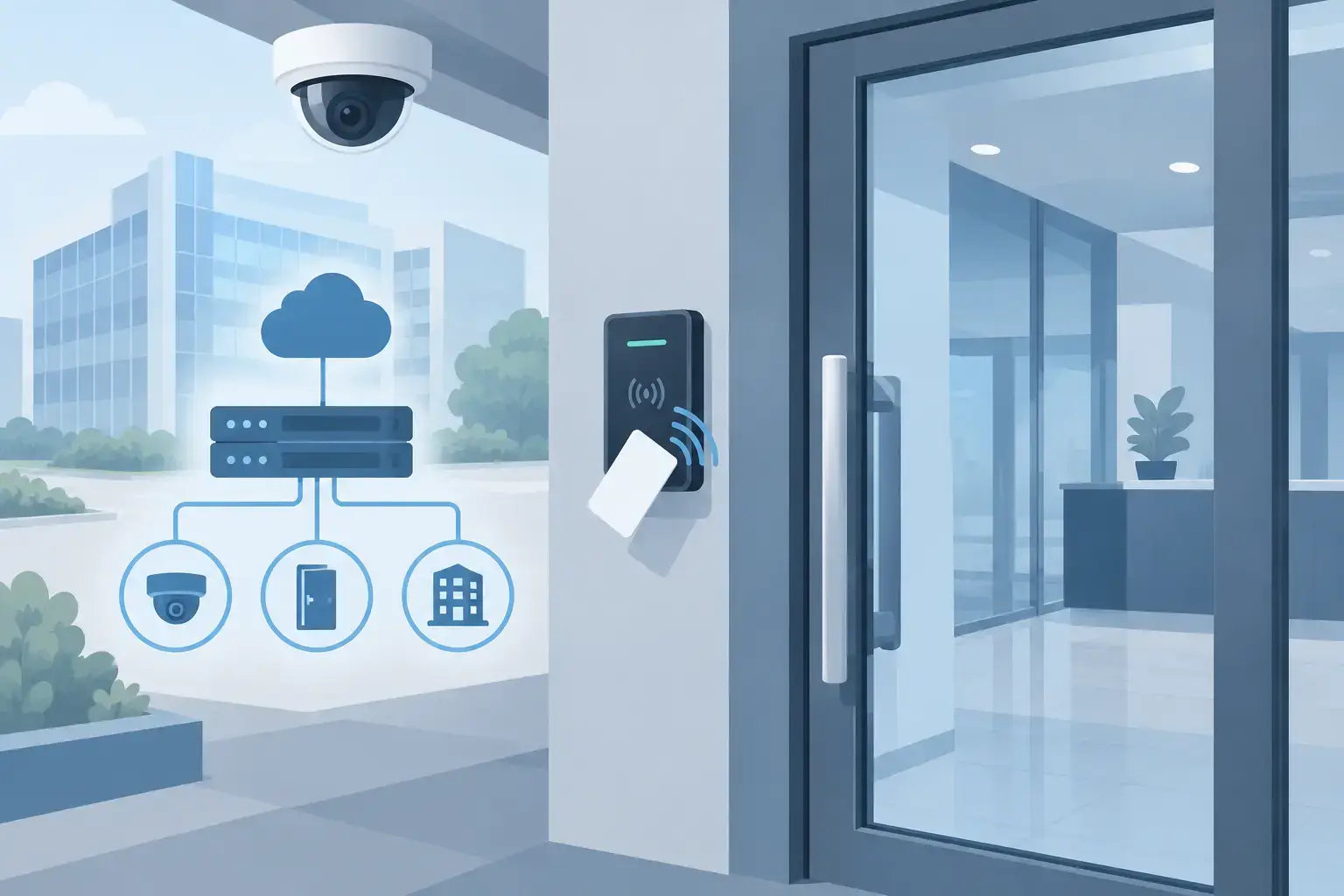
A door schedule may look complete on a drawing, yet access control can still fail at the point of handover if credentials, door hardware, network dependencies, and operating rules were never aligned. For commercial buildings, government facilities, industrial sites, and major infrastructure work, the decision is not simply which reader to mount beside a door. Seven Sectors Trading Co. supplies HID access control hardware to help Saudi project teams source established components through an authorized partner.
The right system protects people, assets, and restricted operations without creating unnecessary friction for authorized users. That requires a procurement conversation built around doors, risk, workflows, and maintainability – not a generic bill of materials.
Start With the Door, Not the Reader
Every opening has a different security and life-safety role. A main entrance used by employees and visitors has different requirements from a telecom room, data center, control room, loading bay, or emergency exit. Treating all doors alike can inflate cost in some locations while leaving critical openings under-specified in others.
Begin by grouping doors according to their function. Identify where users need regular access, where access must be limited to named personnel, and where entry needs a higher level of verification. Then confirm the door condition itself: lock type, door position monitoring, request-to-exit method, emergency release requirements, and the interface between the access system and fire or life-safety systems.
This early work matters because access control electronics cannot compensate for unsuitable field hardware. A reader may validate a credential correctly, but the opening still needs the right lock, cabling, power arrangement, and door monitoring to operate as intended. System integrators and MEP contractors should resolve these dependencies before purchase orders fragment responsibility across multiple trades.
Define the operating outcome for each opening
A practical specification describes what happens at the door. Who may enter? At what times? Does the door unlock automatically during business hours? Is a visitor escorted? Should forced-door and held-open conditions be reported? What must happen during an alarm event or loss of communications?
These questions also prevent a common mistake: specifying a high-security reader while retaining a weak credential policy. Security is determined by the complete chain – credential issuance, identity management, reader behavior, controller logic, door hardware, audit records, and the people responsible for exceptions.
Choose Credentials for Risk and Daily Use
Credentials affect both security posture and user adoption. Cards, fobs, mobile credentials, PINs, and biometric methods each have a place, but the choice should follow the use case rather than fashion.
For a large workforce, a managed card or mobile credential can simplify issuance and replacement. For high-risk spaces, multi-factor authentication may be appropriate, combining something a user has with something they know or are. In areas where personnel wear gloves, helmets, or other protective equipment, the authentication method must remain practical under real operating conditions.
HID is widely specified for commercial and institutional access environments because its portfolio supports credential and reader requirements across varied project types. The correct approach is to confirm compatibility between credentials, readers, controllers, and the selected management platform before procurement. Avoid assuming that legacy cards, existing readers, and new security requirements will automatically work together.
Migration deserves particular attention in refurbishment projects. Retaining existing credentials can reduce disruption, but it may preserve older security limitations. Replacing everything may improve standardization, but requires re-enrollment, communications planning, and a controlled transition. There is no universal answer. The better choice depends on site risk, installed infrastructure, and the owner’s long-term credential policy.
Build the System Around Resilience
Access decisions are often made at the door, but reliability is determined across the whole architecture. Controllers, power supplies, enclosure arrangements, communications paths, network switching, and backup power all affect whether the system keeps operating during a fault.
For critical facilities, ask what happens if the management server is unavailable, the network connection drops, or a controller loses power. The answer should be documented for each class of opening. Some doors may need to remain secure, others may need to permit egress or follow a defined emergency state based on applicable codes and the project’s approved life-safety design.
Networked access control also needs coordination with the IT and security teams. Segmenting security devices, documenting IP addressing, protecting management access, and defining support ownership reduce avoidable faults later. Where the access system shares infrastructure with video, intercom, or building systems, capacity and fault isolation need to be considered rather than assumed.
AETEK network infrastructure can be relevant where a project requires managed connectivity and power distribution for security devices, but the network design remains the responsibility of the appointed designer and integrator. The supply decision should follow the approved architecture and device requirements.
Make Integration a Defined Requirement
Access control rarely operates alone in a substantial facility. It may need to exchange events with video management, intrusion detection, visitor management, elevators, turnstiles, parking systems, or a central security operations workflow. Integration can add real operational value, but only when its purpose is clear.
For example, linking a door event to associated video can help an operator investigate an alarm quickly. Connecting visitor records to temporary credential issuance can improve front-desk control. Integrating elevator permissions may limit access beyond the lobby. Each use case needs defined events, permissions, responsibilities, and test criteria.
Do not specify “integration” as a broad promise. Ask which systems must exchange data, what information is required, whether integration is native or requires additional software, and who will maintain it after handover. An integration that cannot be supported by the site team can become a source of operational risk.
Procurement Should Protect the Project Schedule
Security procurement teams need more than a part number. They need an approved and traceable hardware schedule that accounts for the complete opening. That includes readers, controllers, licensing where applicable, enclosures, power components, interfaces, and any accessories required by the approved design.
Before releasing an order, reconcile the access control schedule against architectural door numbers, the hardware schedule, electrical requirements, and the network plan. Changes in door handing, lock type, or opening use can affect the final hardware requirement. A clean reconciliation process reduces substitutions and site-level decisions made under pressure.
For government and large-project procurement, authorization and product traceability also matter. Source equipment through authorized partners and retain the documentation required by the project’s procurement process. A lower initial purchase cost is not a meaningful saving if it introduces uncertainty around authenticity, compatibility, warranty support, or future expansion.
Seven Sectors supports system integrators, consultants, MEP contractors, and procurement teams with HID access control supply for projects across Saudi Arabia. The focus is on supplying the specified hardware through an established channel, allowing the appointed project parties to design, install, test, and commission the system.
Questions to Resolve Before You Request a Quotation
A quotation is stronger when the buyer provides enough detail to validate the supply scope. At minimum, prepare the number and type of controlled openings, the credential approach, reader and controller requirements, network expectations, required interfaces, and any phased delivery structure set by the project.
It is also useful to identify whether the project is new build, expansion, or replacement. New sites may prioritize standardization and future capacity. Expansions must account for compatibility with installed equipment. Replacement projects require a transition plan that protects site operations while old components are retired.
Is mobile access always the best option?
Not necessarily. Mobile credentials can reduce physical card handling and support flexible user administration, but they depend on organizational policy, user device readiness, and a clear process for lost or changed phones. A physical credential may remain the better choice for certain workforce environments, visitor workflows, or secure operational sites.
Should every door have the same level of security?
No. A consistent platform is usually beneficial, but door security should reflect the risk and use of each area. Applying identical controls to every opening can create unnecessary expense and inconvenience. A layered approach typically provides better protection and a clearer justification for the specification.
What causes most access control changes after procurement?
Unresolved door hardware details, late architectural revisions, incomplete interface requirements, and assumptions about existing credentials are frequent causes. Early coordination between the security consultant, architect, MEP team, IT stakeholders, and system integrator limits these changes.
A well-specified access system should make authorized movement straightforward while giving the facility team credible control when it matters. If you are preparing a door schedule, tender package, or hardware request, contact Seven Sectors Trading Co. at info@7sectors.com or use the Get Quotation form to discuss HID access control supply requirements.
Ready to discuss your project? Contact Seven Sectors or contact us directly on +966-012 229 3474.