
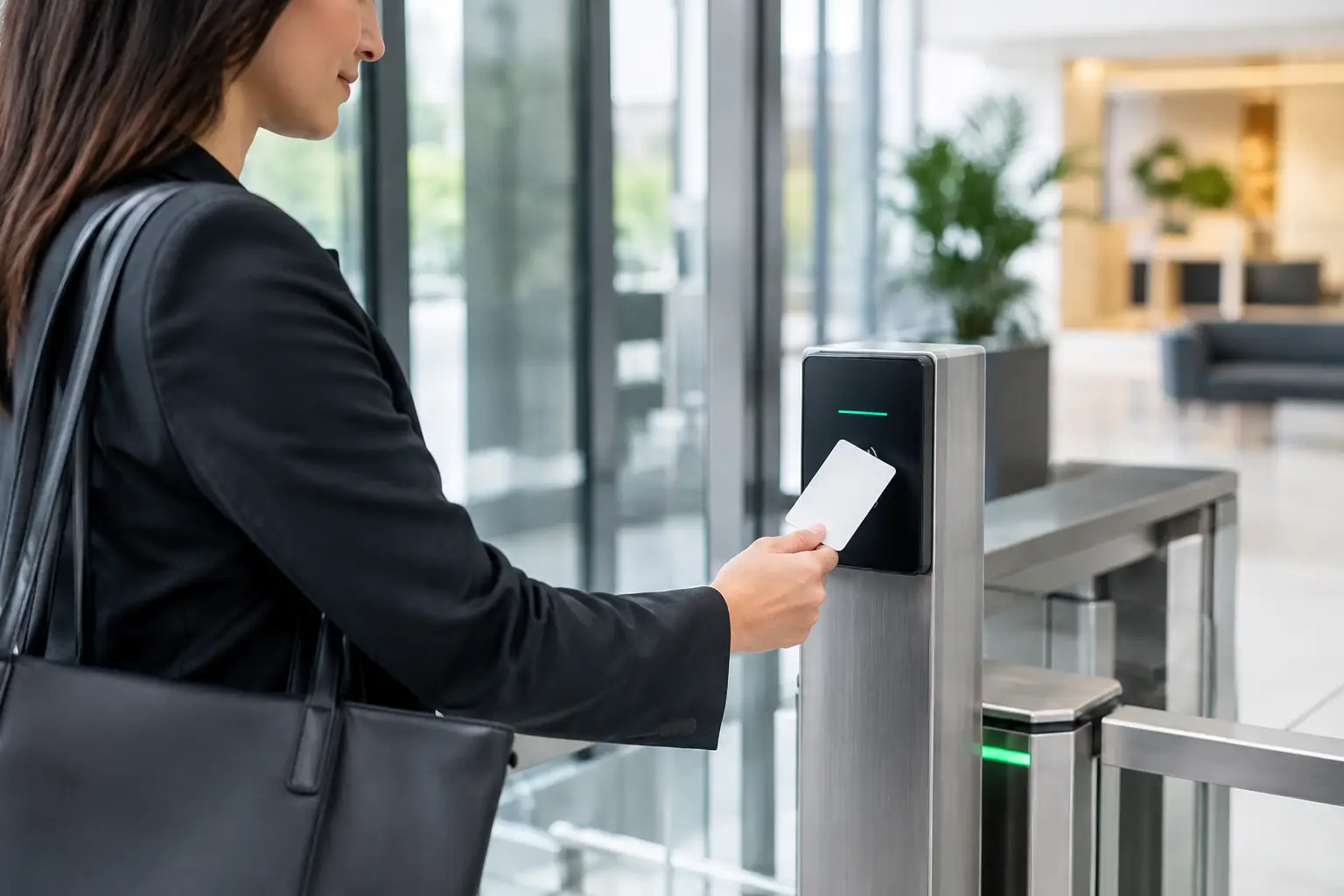
A commercial facility can have high-quality doors, cameras, and guards yet still lose control at the point where people move between spaces. An access control system for commercial buildings establishes who can enter, which door they can use, and when that permission applies. For Saudi offices, mixed-use developments, government facilities, logistics sites, and major Vision 2030 projects, the specification must work beyond the first handover. It needs to remain manageable as tenants, departments, contractors, and security policies change.
HID access control provides a strong foundation for this requirement. HID Signo readers support RFID cards, NFC, and Bluetooth-based mobile credentials, allowing integrators and consultants to specify credential options without replacing the reader estate when user expectations change. The right result is not simply a door that opens electronically. It is a controlled, auditable opening that fits the building’s operational model.
What an access control system must control
A commercial access control deployment starts with the opening, not the reader. Each controlled door requires a defined approach to locking, request-to-exit, door position monitoring, emergency release, and power continuity. A reader is only one element in a chain that includes the credential, controller, lock hardware, cabling, power supply, software, and the operating procedures behind them.
This matters because different openings have different risks. A main lobby may require convenient employee entry and visitor workflows. A data room, finance office, command center, or pharmaceutical store needs tighter permissions, more detailed audit records, and possibly multi-factor authentication. Loading bays and plant rooms may require contractor access that expires automatically at the end of a shift or project phase.
Consultants should define access levels by role and risk rather than issuing broad building-wide permissions. A facilities manager may need access to technical rooms across several floors, while a tenant employee needs only the assigned office suite and common routes. The system should make these policies easy to administer without creating a confusing number of individual exceptions.
Why HID Signo readers suit commercial projects
HID Signo readers are designed for organizations moving from conventional card access toward mobile-first identity management. Their support for RFID, NFC, and Bluetooth gives procurement teams flexibility when defining the credential strategy. A project can begin with smart cards for employees and add HID mobile credentials for management, frequent visitors, or selected departments as the organization’s policies mature.
Mobile credentials reduce the operational burden of issuing, collecting, and replacing physical cards. They are particularly practical for commercial buildings with changing contractor populations or multiple tenant organizations. That said, they should not be treated as an automatic replacement for cards. Some government environments, industrial sites, and high-security facilities may retain physical credentials for policy, workflow, or device-management reasons. A mixed credential model is often the sensible specification.
Reader selection also needs to match the installation environment. Exterior entrances, parking access points, and exposed service doors require suitable enclosure ratings and properly protected connections. Interior reader locations may prioritize aesthetics, accessibility, and integration with door hardware. The consultant’s door schedule should identify the reader type, lock type, opening direction, fire alarm interface, and required egress behavior for every controlled opening.
Credentials are part of the security policy
A card number alone is not a complete security policy. Credential technology, enrollment procedures, lost-card response, and access revocation all affect the real level of protection. HID smart cards and mobile credentials should be paired with clear rules for issuance and approval, especially where access is granted to sensitive offices, server rooms, or restricted government areas.
For higher-risk doors, a project may require an additional verification method such as PIN entry or biometric verification, subject to the customer’s privacy policy and system design. The goal is proportional control. Requiring extra authentication at every internal office door creates friction without necessarily improving the security outcome. Applying it to a small number of critical openings is more defensible and easier to operate.
Design the system around operations, not just door count
Door count is useful for budget planning, but it does not define the complexity of an access control system for commercial buildings. A 20-door headquarters with multiple tenants, visitor approvals, after-hours policies, elevators, and restricted IT rooms can require more careful configuration than a 100-door warehouse with standard employee access patterns.
Start with the building’s operating scenarios. Consider employee arrival, visitor reception, contractor access, deliveries, emergency egress, after-hours work, and security incident investigation. Each scenario should show who grants access, what evidence is recorded, and what happens when credentials are lost, expired, or misused.
A well-planned system should also address the following project decisions:
- Whether access permissions are managed by one central security team or delegated to tenant and department administrators.
- How visitor and contractor credentials are approved, time-limited, and recovered.
- Which openings need real-time monitoring for door-forced or door-held-open events.
- How access events support investigations alongside video surveillance and facility operations.
These choices influence controller capacity, software licensing, network design, and the level of training required for the end user. They should be settled during specification, not improvised after the doors have been installed.
Power and network design deserve equal attention
Access control reliability depends on power architecture as much as reader selection. Controllers, locks, readers, and ancillary devices must receive the correct voltage and current under normal operation and during a mains failure. Lock selection is also critical: fail-safe and fail-secure behavior must align with the door’s function, life-safety requirements, and authority having jurisdiction.
For networked security infrastructure, PoE can simplify deployment for compatible devices and reduce the need for distributed local power. AETEK supplies PoE infrastructure rather than cameras, including C-series indoor switches, IP67-rated H-series outdoor switches, industrial D-series models, and PoE extenders for runs up to 250 meters. In a commercial project, this can be relevant where access control peripherals, intercoms, or associated security devices need reliable network connectivity beyond standard copper distances.
However, PoE should be evaluated as part of a complete load calculation. Integrators need to verify port power budgets, uplink capacity, cable pathway conditions, backup power requirements, and network segregation. A switch that has enough ports is not necessarily suitable if its power budget or environmental rating does not match the field devices.
Access events become more useful with video context
Access control tells security teams that a credential was presented at a door and whether access was granted or denied. Video can show what happened around that event. This combination is valuable at reception areas, loading docks, perimeter doors, restricted corridors, and critical rooms where tailgating or forced-entry attempts may need review.
Milesight AI cameras can provide video coverage around controlled openings, while ISS SecurOS can support larger VMS environments where access events and video investigation need to be managed across a facility or portfolio. The integration approach depends on the customer’s selected platform, project scope, and required workflow. Not every door needs a camera, but high-risk or high-traffic openings usually benefit from synchronized evidence.
For projects with long retention periods or demanding forensic requirements, server and storage design should be addressed early. Rasilient NFD storage and servers, FIBRENETIX surveillance platforms, and Dell PowerEdge or PowerVault infrastructure serve different VMS and retention requirements. These are supporting elements to the access strategy, not substitutes for properly designed door control.
Compliance and tender documentation in Saudi Arabia
Government procurement teams and giga-project contractors frequently require documented product origin, cybersecurity alignment, approved vendor channels, and NDAA/TAA-compliant options where stated in the tender. Compliance cannot be assumed from a product category or a brand name. Procurement teams should request the relevant documentation for the precise model and project requirement before approval.
This is especially relevant when access control is connected to wider IP security networks. A compliant system is not only about the reader or controller. It includes the infrastructure, software environment, network governance, and supply chain records. AETEK’s Taiwan-made PoE infrastructure is available in NDAA/TAA-compliant options, supporting projects that require compliant network components alongside access control equipment.
Seven Sectors is an authorized Saudi partner for HID access control and a local source for related AETEK, Milesight, ISS, Rasilient, FIBRENETIX, Dell, ITC, and Vanguard technologies. For integrators and consultants, working through a specialized partner helps maintain product accuracy, availability visibility, and documentation support during the tender and supply cycle.
The best commercial access control specification gives users convenient entry while making exceptions visible, permissions accountable, and future expansion realistic. Contact Seven Sectors at info@7sectors.com or use the website’s Get Quotation form for HID pricing and availability for your project.
Ready to discuss your project? Contact Seven Sectors or contact us directly on +966-012 229 3474.