
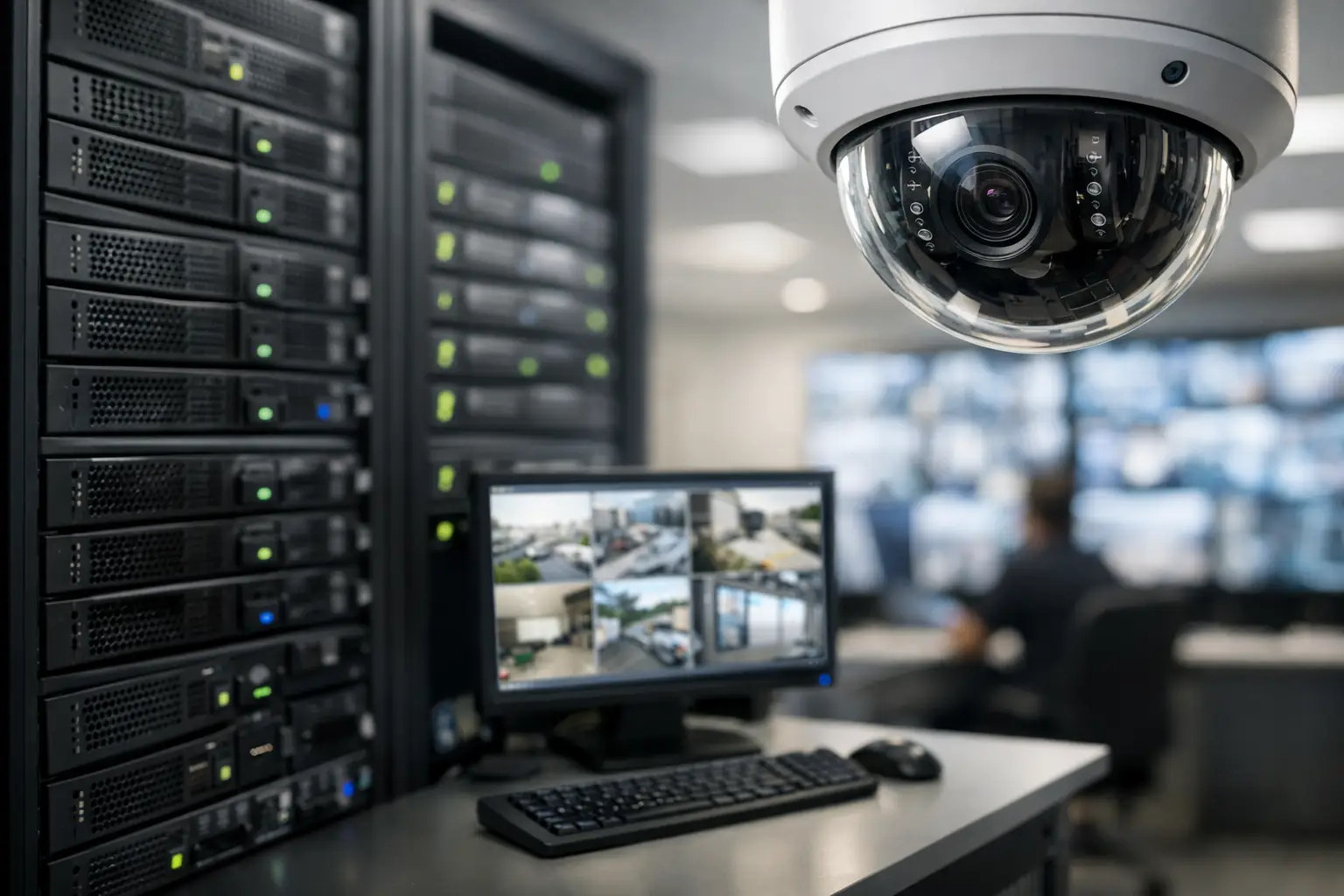
A CCTV server for enterprise security is rarely the part of the system that gets attention at bid stage. Yet it is usually the part that decides whether the project performs well after handover. Cameras, analytics, and network design can all appear correct on paper. Yet weak server sizing, poor storage planning, or the wrong recording platform will still create dropped frames, slow playback, and failed investigations. For Saudi government, infrastructure, and large commercial projects, server choice is an operational decision, not just an IT line item.
What a CCTV server has to do in enterprise environments
In a small deployment, an NVR may be enough. In an enterprise environment, the server has to support continuous recording, user access, analytics workloads, retention requirements, and future expansion without becoming a bottleneck. That changes the buying criteria immediately.
A proper enterprise server must handle sustained video ingest from dozens, hundreds, or thousands of streams while also supporting live view, playback, export, and health monitoring. If the project includes AI functions, the load changes again. Milesight AI cameras can reduce unnecessary alerts at the edge, with features such as TrueColor AI and false alarm reduction. However, the back-end still needs enough CPU, memory, and storage throughput to manage recording and operator access properly.
This is why enterprise buyers should separate three layers clearly: cameras, VMS, and infrastructure. Milesight covers the camera layer. ISS SecurOS covers the VMS and analytics layer. AETEK provides the PoE switching and network edge, including H-series outdoor switches, C-series indoor switches, D-series industrial switches, and long-distance PoE extenders up to 250 meters where site conditions demand it. Teams should then select the server layer based on workload, compliance, and storage behavior, not just on brand familiarity.
How to evaluate a CCTV server for enterprise security
The first question is not server model. It is architecture. Are you building a standalone recording system for one facility, a multi-site VMS deployment, or a centralized command environment with federated monitoring? ISS SecurOS Professional, Premium, Enterprise, and MCC are not interchangeable in real projects. A server that is acceptable for a single commercial tower may be the wrong fit for a campus, transport site, municipality, or border application.
Storage design is usually where projects either become stable or problematic. Continuous video recording creates predictable but heavy write workloads. The issue is not only storage capacity in terabytes. It is sustained write performance, rebuild behavior under disk failure, and playback responsiveness during incident review. Buyers who compare servers only on raw disk size often miss the point.
Purpose-built server platforms for surveillance
Rasilient and FIBRENETIX are relevant here because they exist specifically for surveillance workloads, not general office computing. Rasilient servers and forensic storage platforms are widely specified where frame integrity matters. Its NFD approach – No Frames Dropped – is important in government, oil and gas, and smart city environments where missing seconds can become a legal or operational problem. ApplianceStor 1U and 3U NVR platforms, PixelStor, and NFDCloud suit different deployment models depending on whether the project prioritizes on-premise recording, scale-out storage, or managed retention.
FIBRENETIX also fits enterprise CCTV server requirements where dedicated surveillance servers, NVRs, and recording storage are needed without forcing the project into a generic IT build. That matters when consultants want a CCTV infrastructure stack aligned to recording behavior rather than adapting a standard business server and hoping the VMS will compensate.
Dell PowerEdge servers and PowerVault storage remain valid options when the end user standardizes on Dell infrastructure or the project requires alignment with wider IT policy. In those cases, the discussion becomes more detailed. The server may be technically suitable, but the success of the deployment depends on correct VMS validation, storage tier planning, RAID selection, and network throughput. A Dell server is not automatically a surveillance server just because it is powerful.
Recording performance is about more than camera count
A common mistake in tender discussions is sizing the platform by number of cameras alone. Camera count is only the headline number. The real load depends on resolution, codec, frame rate, scene complexity, retention period, motion profile, analytics use, and concurrent client sessions.
For example, a site using Milesight 5MP or 4K cameras with low-light operation at 0.002 Lux and 140 dB WDR will create very different storage and processing demands than a basic stream profile in a controlled indoor setting. Add LPR workloads from Milesight LPR Pro Bullet Plus Camera or high-zoom PTZ traffic from 12X to 23X PTZ models, and the back-end assumptions change again. If operators need fast forensic search through multiple streams while live recording continues, the server and storage subsystem must be sized for that reality.
This is where VMS choice matters. ISS SecurOS can scale from standard recording to advanced analytics, facial recognition, behavior analysis, and large command-and-control environments. That flexibility is valuable, but it also means integrators should design the infrastructure for the intended SecurOS edition and feature set. Under-sizing the server at the start usually costs more later than specifying the right platform from day one.
Compliance is not a side issue
For many projects in Saudi Arabia, especially public sector, critical infrastructure, and Vision 2030 environments, compliance is part of technical qualification. A CCTV server for enterprise security needs assessment alongside the full system stack. NDAA and TAA requirements affect camera, networking, storage, and VMS decisions, not just procurement paperwork.
Milesight AI cameras are NDAA-compliant. AETEK PoE infrastructure is Taiwan-made and NDAA/TAA-compliant. That gives integrators and consultants a cleaner path when they need approved surveillance and network components for sensitive applications. On the server side, buyers should confirm platform suitability, origin requirements where applicable, and VMS compatibility before finalizing specifications.
This is also where channel matters. Authorized distribution reduces risk in ways that do not show on a spec sheet – firmware traceability, proper warranty support, model validation, and confidence that the quoted platform is the actual approved platform. For tender-driven projects, that matters as much as technical performance.
Centralized, edge, or hybrid server design
Not every project suits a centralized design. A city surveillance scheme, transport corridor, or large government network may benefit from central management, but some industrial and remote sites are better served by edge recording with controlled synchronization to a central platform. Bandwidth, latency, operational resilience, and cybersecurity policy all shape the answer.
A hybrid design is often the most practical. Local recording protects the site if the WAN link drops. Centralized VMS management through ISS SecurOS provides command visibility and incident review. Rasilient or FIBRENETIX storage can then match retention and evidence-handling needs without overbuilding every location.
The network layer also needs the same discipline. AETEK industrial and outdoor PoE switches are useful where surveillance devices sit in exposed cabinets, perimeter roads, or utility environments. Good server performance cannot compensate for unstable edge power or weak network distribution. Enterprise CCTV is a chain, and the server is only as reliable as the upstream design feeding it.
What procurement teams should ask before approval
A good server proposal should answer a few technical questions clearly. What is the validated camera load at the required bitrate and frame rate? How long is the retention period, and how did the team calculate storage? What happens during disk failure or rebuild? How many concurrent live and playback users does the design assume? Is the platform validated for the selected VMS version? Is the solution aligned with NDAA or TAA requirements where required?
If the proposal cannot answer those points, the issue is not pricing. The issue is risk.
For many enterprise projects, the safest route is to work with a distributor that understands the full stack rather than only one hardware category. Seven Sectors supports Saudi system integrators and procurement teams with authorized access to Milesight, AETEK, ISS, Rasilient, FIBRENETIX, Dell, HID, ITC, and Vanguard, which helps when the CCTV server discussion cannot be separated from VMS, PoE, access control, or evidence workflows.
The right server should disappear into daily operations. No dropped frames, no slow searches, no surprises during an incident. That is the standard enterprise buyers should hold from the start.
For a broader look at how VMS platforms fit into modern security architecture, see why VMS matters in modern security projects.
For a broader understanding of what VMS software does and how it fits into your infrastructure, see our guide: What Is Video Management System Software?
The key factors are sustained recording throughput (can it handle all cameras simultaneously at full frame rate?), storage capacity and retention, VMS compatibility, redundancy (RAID, hot-swap drives), and support. For Saudi enterprise projects, NDAA compliance and local support are also considerations. A purpose-built surveillance server will outperform a repurposed IT server on all of these.
A purpose-built surveillance server — like Rasilient or FIBRENETIX — is engineered for continuous high-bitrate video writes across many streams simultaneously. Standard IT servers prioritise mixed workloads and can drop frames under sustained CCTV load. Purpose-built servers use validated storage controllers, optimised firmware, and NFD technology to guarantee recording integrity.
Storage depends on camera count, resolution, frame rate, compression codec, and retention period. A rough guide: 1080p at 15fps with H.265, 30-day retention, needs approximately 30–40GB per camera per day. For 100 cameras with 90-day retention, that is several hundred terabytes. Seven Sectors provides project-specific storage calculations on request.
CCTV server pricing depends on camera count, storage capacity, redundancy level, and the VMS platform. Seven Sectors does not publish fixed prices — each project is quoted based on its specific requirements. Contact us with your camera count, retention period, and VMS preference to receive a project-specific proposal.
Purpose-built surveillance servers from Rasilient and FIBRENETIX are VMS-agnostic and validated with ISS SecurOS, Milestone XProtect, Genetec, and other major platforms. Dell PowerEdge servers also run VMS software when configured correctly. Seven Sectors advises on the right server-VMS pairing for your project scale and budget.
See the full Surveillance Storage & Servers overview for the complete Rasilient, Dell and Fibrenetix range.
Ready to discuss your project? Contact Seven Sectors or contact us directly on +966-012 229 3474.