
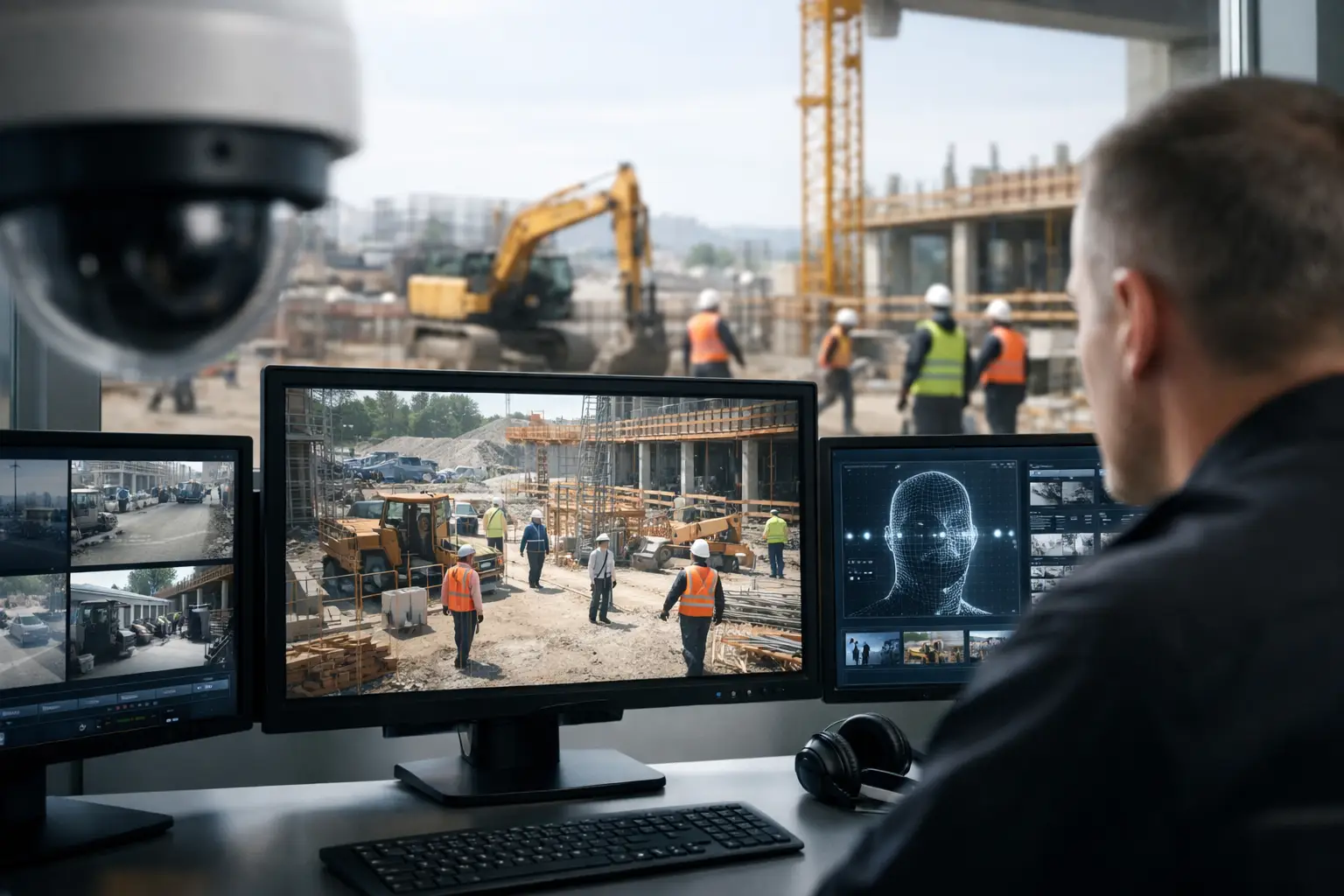
A control room can have hundreds or thousands of camera streams, but no operator can watch every scene with equal attention. AI video analytics for security changes the operational model: cameras and VMS platforms identify defined events, filter irrelevant motion, and present operators with incidents that require review. For government facilities, logistics yards, airports, industrial sites, and Vision 2030 developments, the value is not simply more cameras. It is faster, more defensible decision-making from the cameras already specified.
For system integrators and consultants, the key question is not whether to add AI. It is which analytics are operationally useful and where processing will occur. It is also what evidence must be retained and whether the full architecture meets project compliance requirements.
AI Video Analytics for Security Starts With a Use Case
Select analytics against the site risk and response workflow, not a feature checklist. A sterile-area perimeter may require intrusion detection, line crossing, loitering, and object removal alerts. A logistics facility may prioritize vehicle classification, queue monitoring, and license plate recognition. A public-facing government facility may need crowd density alerts, people counting, and rapid forensic search after an incident.
Each use case has a different tolerance for missed events and false alarms. At an exposed perimeter, wind-blown vegetation, shadows, insects, and vehicle headlights can create unnecessary notifications if the camera scene is poorly designed. In a controlled access lane, the analytic can be more narrowly defined and therefore more reliable. A consultant should specify the desired event, the operator response, the required response time, and the retention period before selecting camera models or server capacity.
Milesight AI CCTV cameras provide a practical camera-layer option for projects that need analytics at the edge. Its AI models can distinguish people and vehicles from general motion, allowing rules to focus on meaningful targets rather than every pixel change. Milesight identifies its AI filtering capability as reducing false alarms by up to 95 percent in suitable scenarios. Actual results depend on scene layout, lighting, mounting height, target size, and analytic configuration, so site conditions still matter.
Camera Placement Determines Analytic Accuracy
Analytics cannot correct an unsuitable field of view. A camera aimed too wide at a perimeter may detect a person but lack the pixel density needed for reliable classification or identification. A camera placed directly into low sun can produce glare that disrupts detection. In many tender documents, “AI camera” is treated as a specification item rather than a measurable performance requirement. That is a costly shortcut.
For entrances, loading gates, and roadways, Milesight LPR Pro Bullet Plus Camera models are relevant where license plate capture is part of the security workflow. Plate recognition requires controlled angles, suitable vehicle speed assumptions, and consideration of local plate formats. Teams should verify it during the project’s proof-of-concept stage rather than assumed from a general camera datasheet.
Low-light and high-contrast scenes require the same discipline. Milesight TrueColor AI cameras can support usable color images in difficult conditions. Applicable models reach down to 0.002 Lux and 140 dB WDR. However, lighting, reflective surfaces, headlight exposure, and scene motion must be evaluated at the actual deployment location. For large open areas, Milesight Q Series panoramic cameras can cover broad zones with 360-degree fisheye or 180-degree dual-sensor views. PTZ models with 12X to 23X optical zoom can support active verification. A PTZ is not a replacement for fixed detection coverage. It is most effective when an analytic alert or operator directs it to a point of interest.
Edge Analytics Versus Server Analytics
Where analytics run affects network design, licensing, storage, and system resilience. Edge analytics run in the camera, reducing unnecessary video events sent upstream and supporting localized detection. They are often well suited to person and vehicle classification, tripwire rules, and basic behavior alerts.
Server-based analytics can correlate information across more cameras and apply more advanced workflows within the VMS. ISS SecurOS is a VMS platform used for enterprise surveillance environments, with capabilities including license plate recognition, facial recognition, and behavior analytics. SecurOS Professional, Premium, Enterprise, and MCC editions allow a project team to match the platform to the required scale and command-center structure.
The best design is frequently a combination. Milesight cameras can filter routine motion at the edge, while ISS SecurOS manages alarms, evidence review, operator actions, and cross-site monitoring. For facial recognition and behavior analytics, procurement teams should define lawful use, access permissions, retention controls, audit requirements, and applicable authority approvals. These functions are powerful, but they demand governance as well as technical capacity.
Build the Architecture Around Evidence, Not Just Live Video
An alert is only useful if the corresponding video is available, searchable, and admissible for investigation. Storage sizing must account for camera count, resolution, frame rate, retention period, recording mode, RAID protection, and analytic metadata. A project that records continuously at high resolution has very different storage requirements from one using motion or event-based recording.
Rasilient surveillance servers and forensic storage are designed for high-demand video environments, including deployments where no frames dropped performance is required. Its VMS-agnostic approach can support platforms such as ISS and Milestone. For enterprise CCTV server and storage requirements, FIBRENETIX provides dedicated surveillance infrastructure, while Dell PowerEdge servers, Precision workstations, and PowerVault storage can be specified for VMS infrastructure requirements. These are distinct product paths, and they should not be treated as interchangeable without reviewing workload, retention, and redundancy requirements.
For investigations, metadata is as important as raw footage. Operators need to search for a person entering a defined zone, a vehicle moving in a prohibited direction, or activity during a particular time window. This reduces the labor of reviewing hours of footage after an incident. It also places greater importance on synchronized time, reliable recording, and consistent camera naming across the VMS.
PoE Infrastructure Is Part of Analytic Performance
AI cameras, PTZ units, heaters, illuminators, and long network runs can place substantial demands on the access network. AETEK is a PoE infrastructure manufacturer, not a camera manufacturer, and its switches should be considered when designing the power and network layer behind Milesight cameras.
For outdoor cabinets and exposed locations, AETEK H-series IP67 outdoor PoE switches can support protected field deployment. C-series switches are suited to indoor applications, while D-series industrial models address more demanding industrial environments. Where cable distances exceed standard Ethernet limitations, AETEK PoE Extenders can extend PoE connectivity up to 250 meters in appropriate designs.
The point is not simply to power a camera. The network must maintain available PoE budget, suitable uplink capacity, and fault isolation when multiple analytic cameras generate event traffic. PTZ cameras need allowance for peak power draw. Edge devices should be selected with clear environmental ratings. A network that is under-specified can cause reboots, packet loss, delayed video, or incomplete evidence precisely when an alarm occurs.
Compliance Must Be Verified Across the Stack
For Saudi government, critical infrastructure, and Vision 2030 project procurement, NDAA and TAA requirements often shape the approved equipment list. Procurement teams should verify compliance by product model and project requirement, not assume it because one item in a solution is compliant.
Milesight offers NDAA-compliant camera options, while AETEK provides Taiwan-made, NDAA/TAA-compliant PoE infrastructure. Procurement teams should review the VMS, server, storage, workstation, and access-control interfaces with the same discipline. Procurement teams should request current compliance documentation and confirm that selected models match tender language before final submittals.
This approach is especially relevant when the video system must integrate with HID access control, ITC public address or voice evacuation systems, and a centralized command environment. An AI alert can become more actionable when it is tied to a door event, an authorized credential, or a controlled public-address response. Integration should follow a clear operational scenario. Teams should add it because the scenario demands it, not merely because platforms support APIs.
Specify Measurable Outcomes Before Equipment
A credible AI surveillance specification defines measurable expectations: which targets must be detected, at what distance, in which lighting, with what acceptable alert rate, and how operators will verify and escalate an event. It should also identify the failure modes that matter, including network outages, storage exceptions, camera tampering, and power loss.
Seven Sectors is the authorized Saudi partner for Milesight, AETEK, ISS, Rasilient, FIBRENETIX, Dell, HID, ITC, and Vanguard solutions. For integrators and procurement teams, the advantage is a coordinated product stack from a specialized local source. That means attention to compliance, availability, and project performance.
The right AI deployment gives operators fewer distractions and better evidence, while preserving the engineering discipline that complex sites require. Contact Seven Sectors at info@7sectors.com or use the website’s Get Quotation form for pricing and availability.
nnFrequently Asked Questions — AI Video Analytics for Security Projects
nnAI video analytics uses deep learning to classify objects — people, vehicles, animals — before generating an alert, rather than reacting to any motion. Milesight cameras with TrueColor AI achieve up to 95% false alarm reduction compared to basic motion detection. This means operators receive fewer irrelevant notifications and can focus on real incidents.
Milesight AI cameras support on-camera analytics including intrusion detection, line crossing, loitering, object removal, vehicle classification, crowd density, and license plate recognition. Seven Sectors supplies the full Milesight AI range — Q Series, Pro Series, Mini, Panoramic, PTZ, and dedicated LPR cameras — to system integrators across Saudi Arabia.
Yes. ISS SecurOS integrates with Milesight AI cameras and supports analytics event handling, alarm escalation, and forensic search. ISS SecurOS also has its own AI modules — including SecurOS FaceX for facial recognition and SecurOS Auto/Motus for LPR — that operate alongside or independent of camera-side analytics. Seven Sectors supplies both platforms.
Perimeter sites typically benefit from intrusion detection, line crossing, and vehicle classification. Access-controlled zones use facial recognition, LPR, and people counting. Logistics and construction environments use queue monitoring and object detection. The correct analytics set depends on the specific risk, site layout, and operator response workflow — not a standard feature list.
Milesight AI camera pricing depends on model, resolution, analytics capability, and project volume. Seven Sectors does not publish list prices. Contact us with your camera schedule and project scope for a project-specific quotation. We supply system integrators, consultants, and procurement teams across the Kingdom.
Ready to discuss your project? Contact Seven Sectors or contact us directly on +966-012 229 3474.