
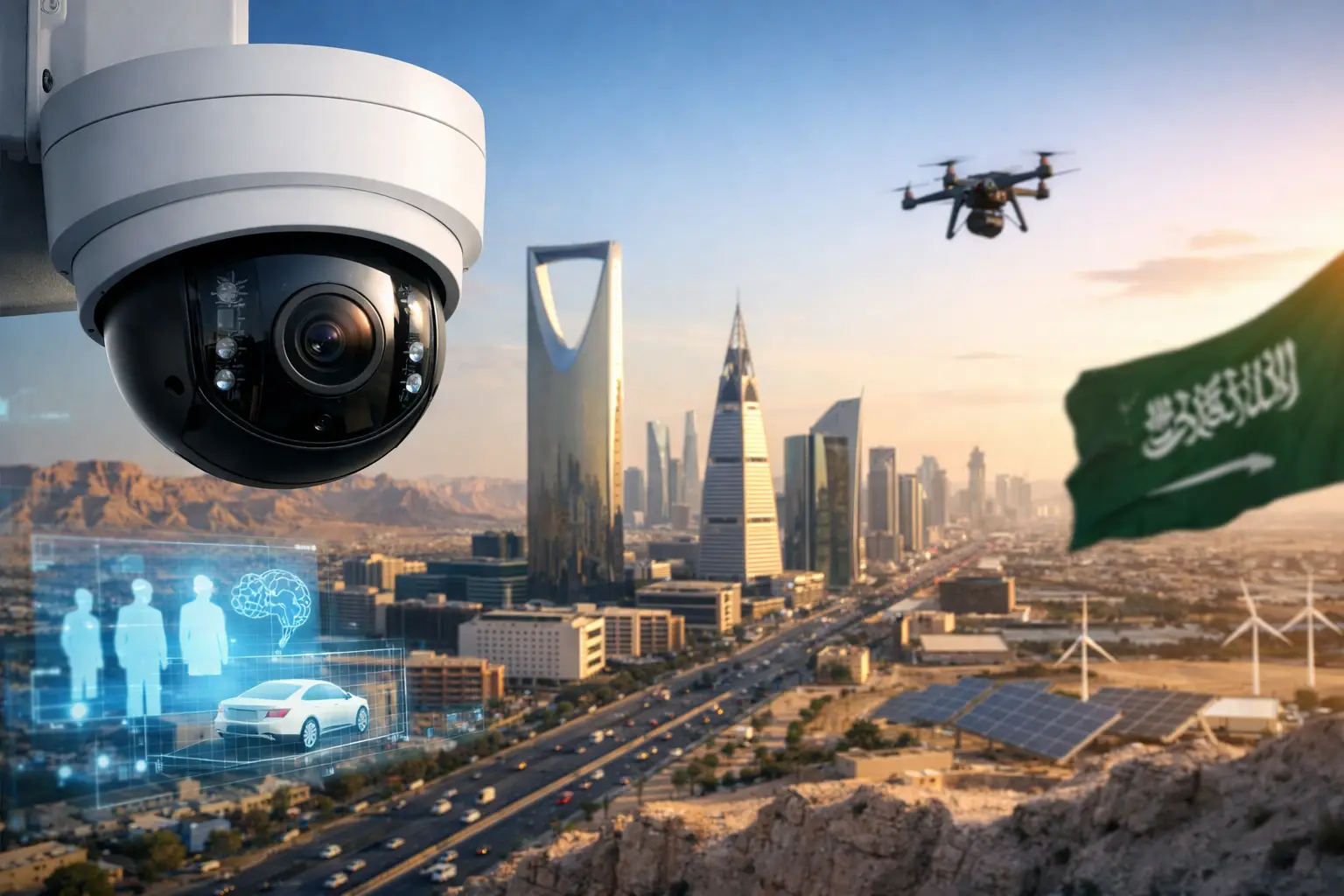
A Milesight NDAA compliant AI camera Vision 2030 Saudi Arabia specification is not simply a camera substitution exercise. This applies to government facilities, transport corridors, industrial sites, and giga-project packages. The camera must satisfy procurement requirements. It must also deliver usable evidence in extreme light, heat, dust, and large-scale operational environments. The right selection starts with the risk scenario. Then comes the required analytic outcome, and the infrastructure that will carry and retain the video.
Milesight AI cameras give system integrators and consultants an NDAA-compliant option. This matters where supply-chain assurance, image performance, and analytics accuracy must be considered together. For Saudi project teams, this matters most when a tender requires traceable compliance. At the same time, the camera must not sacrifice low-light coverage, wide-area scene awareness, or integration flexibility.
Why Milesight NDAA-Compliant AI Cameras Matter for Vision 2030
Vision 2030 developments are creating security requirements broader than conventional perimeter CCTV. A site may need vehicle control at a logistics gate. It may need people-counting at a public venue, intrusion detection along an exposed boundary, or forensic video from a command center. These are different use cases. They should not be forced into one generic fixed-camera specification.
NDAA compliance is a material procurement factor for many public-sector and critical-infrastructure opportunities. It helps procurement teams avoid restricted surveillance components. It also gives consultants a clearer basis for approving equipment within a compliance-led design. However, NDAA compliance should be verified at the specific product and supply level required by the project. It does not replace a proper technical evaluation of image quality, firmware policy, cybersecurity requirements, VMS compatibility, and support documentation.
Milesight is particularly relevant where an integrator needs AI analytics at the edge. Rather than sending every movement event to an operator, the camera can classify people and vehicles. It can then focus alarms on defined security targets. Milesight states that its AI technology can reduce false alarms by up to 95% in applicable scenarios. Actual results depend on scene design, rule configuration, camera angle, lighting, weather, and the quality of the initial commissioning by the appointed integrator.
Start With the Security Outcome, Not the Camera Model
A common tender mistake is specifying camera resolutions and quantities before deciding what the system must detect, verify, identify, or investigate. A 4K camera may be useful at a gate or loading zone. But more pixels do not correct a poor mounting height, backlight, obstructed field of view, or insufficient retention capacity.
For a perimeter, the primary goal is often reliable detection and early alarm. In that case, Milesight AI-based human and vehicle classification can help. It reduces alarms from general motion caused by shadows, vegetation, or small animals. The camera should be positioned around the expected approach path, not simply pointed across the longest visible distance.
At entrances and service roads, the requirement may shift to vehicle evidence and license plate capture. Milesight LPR Pro Bullet Plus Camera models should be assessed where plate recognition is a defined operational requirement. Plate-capture performance is affected by vehicle speed, lane discipline, headlight glare, plate format, mounting angle, and illumination. A consultant should ask for the intended capture lane and traffic conditions before accepting an LPR camera as a standard perimeter device.
For public areas, concourses, campuses, and large retail or mixed-use spaces, panoramic coverage can reduce blind spots. It can also simplify coverage of open zones. Milesight Q Series panoramic cameras offer 360-degree fisheye and 180-degree dual-sensor options. They are useful when a single mounting point can cover a broad scene. However, they are not a replacement for cameras placed to deliver facial or evidential detail at key access points.
Image Performance for Saudi Operating Conditions
Saudi deployments regularly face high contrast, intense sunlight, nighttime darkness, airborne dust, reflective surfaces, and long exterior sight lines. Camera selection must account for these conditions at the lens and sensor level.
Milesight TrueColor AI cameras are relevant for low-light environments. Maintaining color detail in these conditions can improve incident interpretation. 0.002 Lux sensitivity and 140 dB WDR address two common challenges: scenes with limited available light, and entrances where bright exterior light meets a darker interior or shaded zone. The practical question is whether the scene needs color evidence, motion clarity, or both. In some locations, controlled supplemental illumination and a carefully selected lens produce a better result than relying only on a low-light specification.
PTZ cameras also have a specific role. Milesight PTZ models with 12X to 23X optical zoom can support active observation of roads, yards, waterfronts, and extensive public areas. They work best as a complement to fixed cameras and analytics, not as the only means of coverage. A PTZ can follow an event, but it cannot preserve detail in every direction while it is looking elsewhere. Fixed AI cameras provide the persistent alarm layer. PTZ cameras provide operator-directed verification and tracking.
Design the Network and Storage Around the Video Load
An AI camera specification is incomplete if it ignores PoE power, uplink capacity, network resilience, and video retention. Higher-resolution streams, multi-sensor panoramic cameras, and PTZ units can place substantial demand on switching and recording infrastructure. The solution should be calculated from actual bit rates, frame rates, codec settings, recording rules, and retention obligations, rather than from a generic per-camera storage allowance.
AETEK supports this layer as a PoE infrastructure brand, not a camera brand. Its range includes H-series models, indoor C-series models, industrial D-series models, and Ceiling PoE Switches. For distant field devices, AETEK PoE Extenders can extend PoE transmission up to 250 meters where a suitable cable path and power budget have been confirmed.
This distinction matters on distributed sites such as utility compounds, port facilities, construction zones, and large hospitality developments. A camera may meet the performance specification, but unstable power delivery or an undersized uplink can create dropped streams and unreliable evidence. Network equipment should be selected based on environmental enclosure requirements, total PoE load, surge protection strategy, fiber topology, and maintenance access.
For recording, Milesight cameras can be paired with a VMS architecture that fits the scale and operational model of the project. ISS SecurOS is relevant for deployments requiring enterprise VMS capabilities, centralized management, LPR, facial recognition where permitted and specified, and behavior analytics. Storage should be engineered for the required retention period and recording mode. Rasilient NFD storage is suited to environments where no-frames-dropped performance and forensic reliability are central requirements. FIBRENETIX and Dell platforms can support enterprise CCTV server and storage architectures according to the approved VMS design.
A Practical Specification Framework for Consultants
Before releasing a camera schedule, procurement and design teams should document several decisions in the project file:
- The security objective for each scene: detection, verification, identification, LPR, people counting, or incident investigation.
- The required evidence window, including daytime, nighttime, backlight, dust, and vehicle-light conditions.
- The analytics rule, alarm routing, VMS event handling, and who is expected to respond to an alert.
- The NDAA/TAA requirement, product documentation, approved-country considerations, and tender-specific compliance language.
- The power, switching, bandwidth, server, and storage calculations needed to meet the retention requirement.
These points prevent a frequent failure mode: procuring capable hardware without an operational path from camera event to verified response. AI analytics reduce noise only when alarm rules are tuned to the actual site. A construction gate, a metro-adjacent perimeter, and a government office entrance each need different target sizes, intrusion zones, schedules, and escalation procedures.
Selecting the Right Milesight Series
Milesight Pro and Mini Series cameras are practical options for conventional fixed-camera coverage. They suit projects where form factor, image quality, and AI classification are required. Panoramic Q Series models should be considered for broad open areas. PTZ cameras suit long-range observation and active monitoring. The LPR Pro Bullet Plus Camera is intended for controlled vehicle-entry and road-use cases. Milesight 5G Series cameras may be relevant where a project requires cellular connectivity. Their use should be evaluated against carrier coverage, data policy, cybersecurity controls, and the long-term operating cost of the connection.
The best answer is often a mixed camera schedule. For example, a critical entrance can combine a fixed overview camera, a dedicated LPR camera, and access-control events from HID Signo readers. This produces clearer evidence than asking one camera to cover every function. At a perimeter, fixed AI cameras can generate qualified alerts while a PTZ is assigned for live verification.
Seven Sectors supports Saudi system integrators, consultants, and procurement teams as an authorized partner for compliant security infrastructure. We help them source Milesight AI camera selections alongside the required PoE, VMS, and storage components.
For a Vision 2030 package, request camera recommendations against real scene drawings, mounting locations, and operational requirements. That is where an NDAA-compliant Milesight camera schedule becomes a dependable surveillance design rather than a list of part numbers.
See how these cameras fit into a full NEOM security and AV infrastructure package.
Frequently Asked Questions
What does NDAA compliance mean for AI cameras in Saudi Vision 2030 projects?
NDAA Section 889 prohibits the use of cameras manufactured by certain companies — specifically Huawei, ZTE, Hikvision, Dahua, and Hytera — in projects with US federal funding or supply-chain requirements. Saudi Vision 2030 giga-projects and government facilities increasingly apply NDAA compliance requirements in tenders. Milesight cameras are NDAA-compliant: they are not on the prohibited list.
Which Milesight AI camera series are recommended for government and giga-project procurement?
For government and large-scale outdoor Saudi sites, the Milesight Q-Series and Pro Series offer AI analytics including human/vehicle detection, perimeter intrusion, and crowd density. For wide-area coverage, the Panoramic Series (360-degree fisheye, 180-degree dual-sensor) reduces camera counts. For perimeter and traffic surveillance, the PTZ Series (12X–23X) provides pan-tilt-zoom with AI tracking. All series are NDAA-compliant.
How does Milesight AI reduce false alarms compared to standard motion detection?
Milesight uses deep-learning AI to classify detected objects as humans or vehicles before triggering an alarm. This filters out false alarms caused by animals, wind-blown debris, lighting changes, and reflections — which are common in Saudi outdoor environments. The result is a 95% reduction in false alarms compared to pixel-based motion detection, improving operator response quality.
Can Milesight cameras handle outdoor Saudi conditions — extreme heat, dust, and direct sunlight?
Yes. Milesight outdoor cameras are rated IP67 or IP66 for dust and water ingress. The relevant series support operating temperatures up to 60°C and are tested for high-humidity environments. WDR (Wide Dynamic Range) up to 140dB handles the strong contrast between Saudi sunlight and shaded areas in a single frame. For extreme-exposure installations, consult Seven Sectors on model selection and mounting guidance.
How do I get a Milesight NDAA compliant camera quote for a Saudi project?
Contact Seven Sectors with your camera count, site type, required AI analytics, VMS platform, and compliance requirements. We supply Milesight across Saudi Arabia from Jeddah and can provide NDAA compliance documentation for tender submissions alongside SAR pricing and lead times.
Ready to discuss your project? Contact Seven Sectors or contact us directly on +966-012 229 3474.