
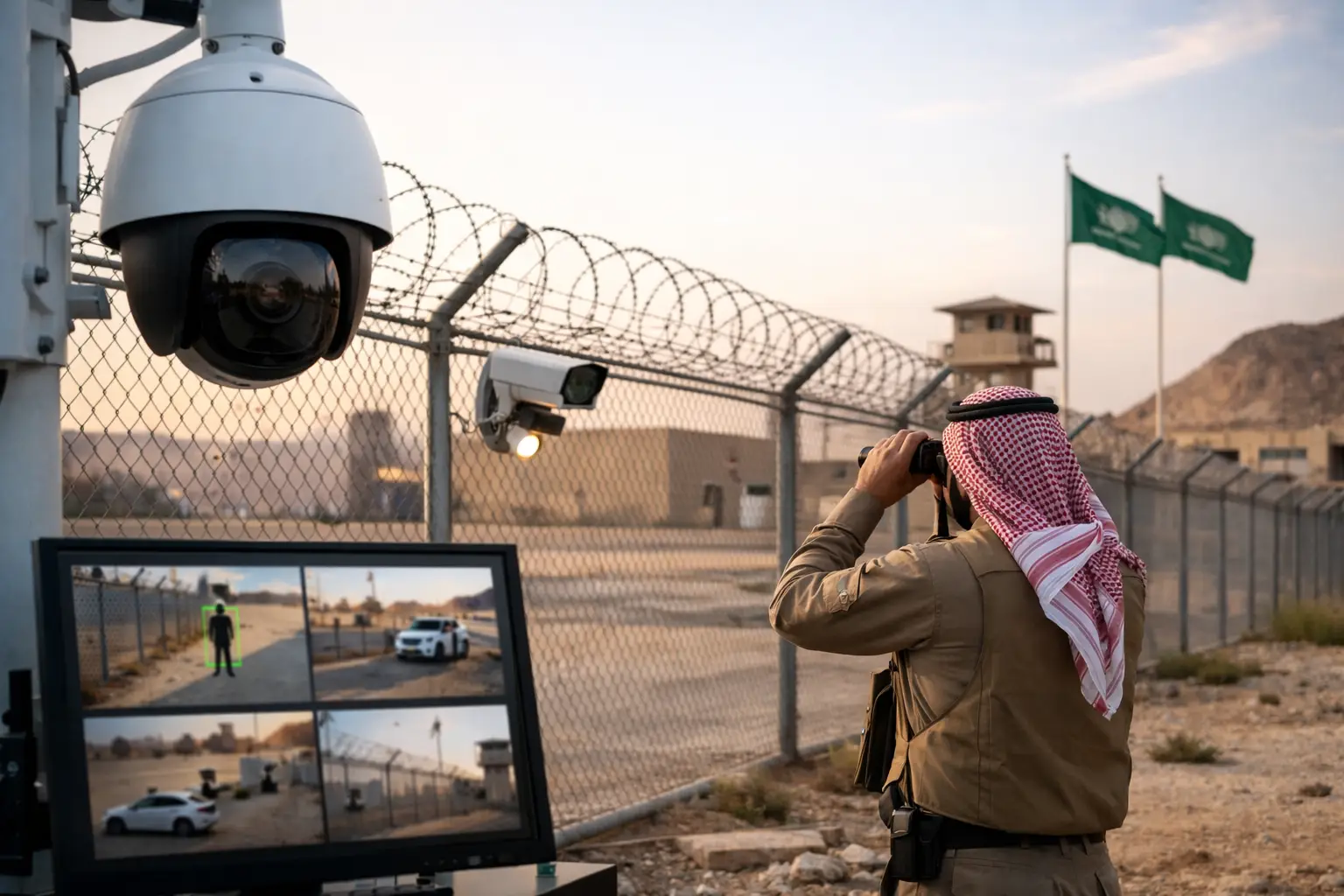
A perimeter alarm at a logistics yard in Saudi Arabia usually fails for one of two reasons – too many false alerts at night, or detection that comes too late to matter. That is exactly where ai video analytics perimeter detection saudi commercial sites has become a specification issue rather than a nice-to-have feature. For integrators and consultants, the real question is not whether AI belongs at the perimeter. It is which camera, network, and recording stack will hold up in heat, dust, glare, and long operating hours without creating nuisance events for guards and control rooms.
Why AI video analytics perimeter detection matters on Saudi commercial sites
Commercial perimeter risk in Saudi Arabia is rarely limited to a simple fence line. Warehouses, business parks, ports, distribution hubs, utility compounds, mixed-use developments, and large parking areas all have different edge conditions. Some sites need early warning before an intruder reaches the building envelope. Others need vehicle and pedestrian filtering near loading bays, service roads, or restricted yards.
Traditional motion detection struggles in these environments. Headlights, shadows, dust movement, heat shimmer, and low-light noise can all trigger alarms that operators stop trusting. That is why Milesight AI cameras are relevant here. Their AI-based human and vehicle classification aims to reduce nuisance triggers, and the brand states false alarm reduction up to 95% in suitable deployments. For perimeter work, that difference matters more than headline resolution.
A consultant specifying perimeter analytics for Saudi commercial sites also has to think beyond the camera. Detection quality depends on scene design, lens choice, mounting height, illumination, bit rate, storage behavior, and VMS rule logic. If one part of the chain is weak, the site may have analytics on paper but poor operational performance.
Building the right AI video analytics perimeter detection stack
For most Saudi commercial projects, the practical stack starts with Milesight AI CCTV cameras as the primary detection layer. The brand is a strong fit where integrators need NDAA-compliant options and dependable low-light performance. Models with TrueColor AI are particularly useful for perimeter edges with limited ambient lighting. Meanwhile, PTZ models in the 12X to 23X range can support larger compounds that need active verification after a fixed camera alarm.
For wider scenes, panoramic coverage can help reduce blind spots. Milesight panoramic options, including 360 fisheye and 180 dual-sensor formats, can be useful at corners, forecourts, and open circulation spaces. That said, panoramic views are not always the first choice for long fence runs. Pixel density at the actual intrusion line still decides whether analytics will classify targets consistently. In many cases, a properly positioned fixed bullet or turret camera gives more reliable perimeter rules than a single panoramic camera covering too much ground.
PoE and recording layers for AI video analytics perimeter detection
PoE infrastructure is the next issue, especially on larger sites or where field cabinets are spread out. AETEK is relevant here as the network backbone, not as a camera brand. Its outdoor H-series PoE switches with IP67 protection are well suited to perimeter cabinets and exposed edge locations. In addition, PoE extenders up to 250 meters can help where camera points exceed standard Ethernet distance. This matters on Saudi commercial sites with long boundary walls, remote gates, and detached utility areas where redesigning civil routes is not realistic.
Once analytics events are generated, recording and event handling must stay stable under load. ISS SecurOS is a strong option when the project requires advanced VMS behavior, multi-site management, or integration into larger control room workflows. For projects where retention, forensic search, and frame integrity are critical, Rasilient surveillance servers and forensic storage bring clear value. Its NFD approach – No Frames Dropped – is especially relevant when clients expect event-based investigation to stand up to scrutiny after an incident. Depending on the project standard, FIBRENETIX or Dell infrastructure may also be specified for surveillance compute and storage.
Camera placement decides whether analytics work
The biggest mistake in ai video analytics perimeter detection saudi commercial sites is assuming AI will compensate for poor scene design. It will not. If installers mount a camera too high, the target becomes too small at the detection line. When the angle is too steep, classification quality drops. If the camera faces direct sunrise or sunset for part of the day, the rule may perform differently at different hours.
For commercial sites, it is usually better to create intentional detection zones rather than treating the full scene as active. A fence line, gate approach, service corridor, or vehicle entry lane should be defined around the security intent. Are you trying to detect a person crossing into a restricted yard, a vehicle stopping at an unusual point, or movement after business hours in a loading zone? Each requires a different rule structure.
Milesight cameras with strong low-light capability, including models rated down to 0.002 Lux and up to 140 dB WDR in relevant series, are useful where perimeter scenes combine darkness with bright entrance lighting or headlight flare. But even with good imaging, scene discipline still matters. Bushes moving into the rule area, reflective fencing, and unstable poles all affect performance.
False alarms are not just a camera problem
When end users complain that perimeter analytics do not work, the issue is often workflow rather than detection. An alarm that reaches the VMS without context is just another pop-up. A usable event should trigger the right clip, the right camera view, and the right escalation path.
This is where ISS SecurOS can add value for larger commercial or semi-government environments. Instead of simply logging a tripwire event, the system can support more structured event handling across operator workstations and command centers. The exact design depends on site risk, but the principle is simple – analytics should shorten response time, not add operator fatigue.
On the storage side, frame loss can undermine confidence in the entire solution. A clean event with missing seconds before or after the trigger is a common frustration on underbuilt systems. That is why server and storage specification belongs in perimeter design, not an afterthought. Rasilient, FIBRENETIX, and Dell all enter the conversation here depending on project requirements, scale, and preferred VMS architecture.
Compliance and procurement are part of the specification
For many Saudi commercial and government-linked projects, procurement teams now ask earlier about NDAA and TAA positioning, especially on projects influenced by Vision 2030 standards or international stakeholder requirements. That affects camera selection, network hardware choices, and back-end infrastructure conversations from the beginning.
Milesight offers NDAA-compliant camera options that fit this procurement environment. AETEK also matters for buyers looking for Taiwan-made PoE infrastructure with NDAA/TAA-compliant positioning. For consultants and contractors bidding into major developments, that reduces downstream friction during technical submittals and approval stages.
This is also where working with an authorized Saudi partner matters. Product availability, model matching, technical clarification, and compliance documentation are not side issues on active tenders. They often decide whether a package moves quickly or gets delayed in review.
Where perimeter analytics fit best – and where they need backup
Perimeter analytics are strongest when the site has defined edges, predictable approach paths, and clear rules of engagement. Industrial yards, logistics compounds, commercial campuses, and restricted parking structures are good examples. In these settings, AI can give earlier visibility than relying on door contacts, guards, or post-incident review.
But there are trade-offs. Highly crowded frontages, public-facing retail edges, and mixed pedestrian zones may create too much legitimate movement for pure perimeter rules to be efficient. In those cases, analytics still help, but the design may need layered logic with access control from HID at specific entry points or selective PTZ verification rather than blanket intrusion rules. The best answer depends on how controlled the edge really is.
Large sites also need to think in zones. A front boundary facing public traffic is different from a rear service yard. An executive parking entrance is different from a utility fence. One analytics profile across the whole site usually leads to compromises that satisfy nobody.
Choosing the right partner for Saudi commercial projects
For system integrators, consultants, and procurement teams, the value is not just sourcing a camera. It is sourcing a perimeter-ready stack that makes technical and commercial sense in Saudi conditions. That means Milesight AI cameras for classification and low-light performance, AETEK PoE infrastructure for field resilience and longer edge runs, and the right VMS and storage layer through ISS, Rasilient, FIBRENETIX, or Dell based on project scale.
Seven Sectors supports that process as an authorized Saudi partner for these brands, with a trade-focused approach that fits submittals, BOQ alignment, and project-driven supply requirements. That is particularly useful when a perimeter package needs to meet both performance expectations and compliance requirements without drifting into generic, mismatched hardware.
A good perimeter system does not start with the promise of AI. It starts with a clear intrusion objective, the right Milesight camera at the right distance, stable AETEK-powered connectivity, and recording infrastructure that preserves the event when it matters most.
For a broader look at implementing AI video analytics across security project types, see our guide to AI video analytics for security projects in Saudi Arabia.
Frequently Asked Questions
What is AI video analytics perimeter detection and how does it work?
AI video analytics perimeter detection uses deep-learning algorithms running on or near the camera to classify objects crossing a defined boundary as human, vehicle, or other. Unlike traditional motion detection which triggers on any pixel change, AI classification filters out false triggers from wind, dust, heat shimmer, and lighting changes. The result is alerts tied to real intrusion events rather than environmental noise.
How much does AI video analytics reduce false alarms at Saudi commercial sites?
Milesight AI cameras state false alarm reduction of up to 95% in suitable deployments compared to standard motion detection. Actual reduction depends on scene design, mounting height, illumination, and correct AI rule configuration. Seven Sectors advises on scene setup to maximize detection accuracy from the outset.
Which cameras support perimeter AI analytics for Saudi Arabia projects?
Milesight AI cameras are the recommended choice for perimeter analytics on Saudi commercial and industrial sites. Key models include the Q Series for standard perimeter coverage, PTZ cameras with up to 23X zoom for wide-area monitoring, and the 5G Series for remote sites without fixed connectivity. All run deep-learning human and vehicle classification at the edge.
What VMS do I need to receive and manage AI perimeter alerts?
Any ONVIF-compatible VMS can receive basic event triggers from Milesight AI cameras. For full analytics management, rule configuration, alert workflow, and multi-site oversight, ISS SecurOS is the recommended platform. Seven Sectors integrates Milesight cameras with ISS SecurOS to deliver a complete perimeter detection solution.
How much does an AI perimeter detection system cost in Saudi Arabia?
System cost depends on perimeter length, scene count, camera model selection, VMS edition, server sizing, and installation scope. Seven Sectors provides a no-obligation technical scope and pricing estimate once we understand the site layout and detection requirements. Contact us with a site plan or perimeter description to start the process.
Ready to discuss your project? Contact Seven Sectors or contact us directly on +966-012 229 3474.