
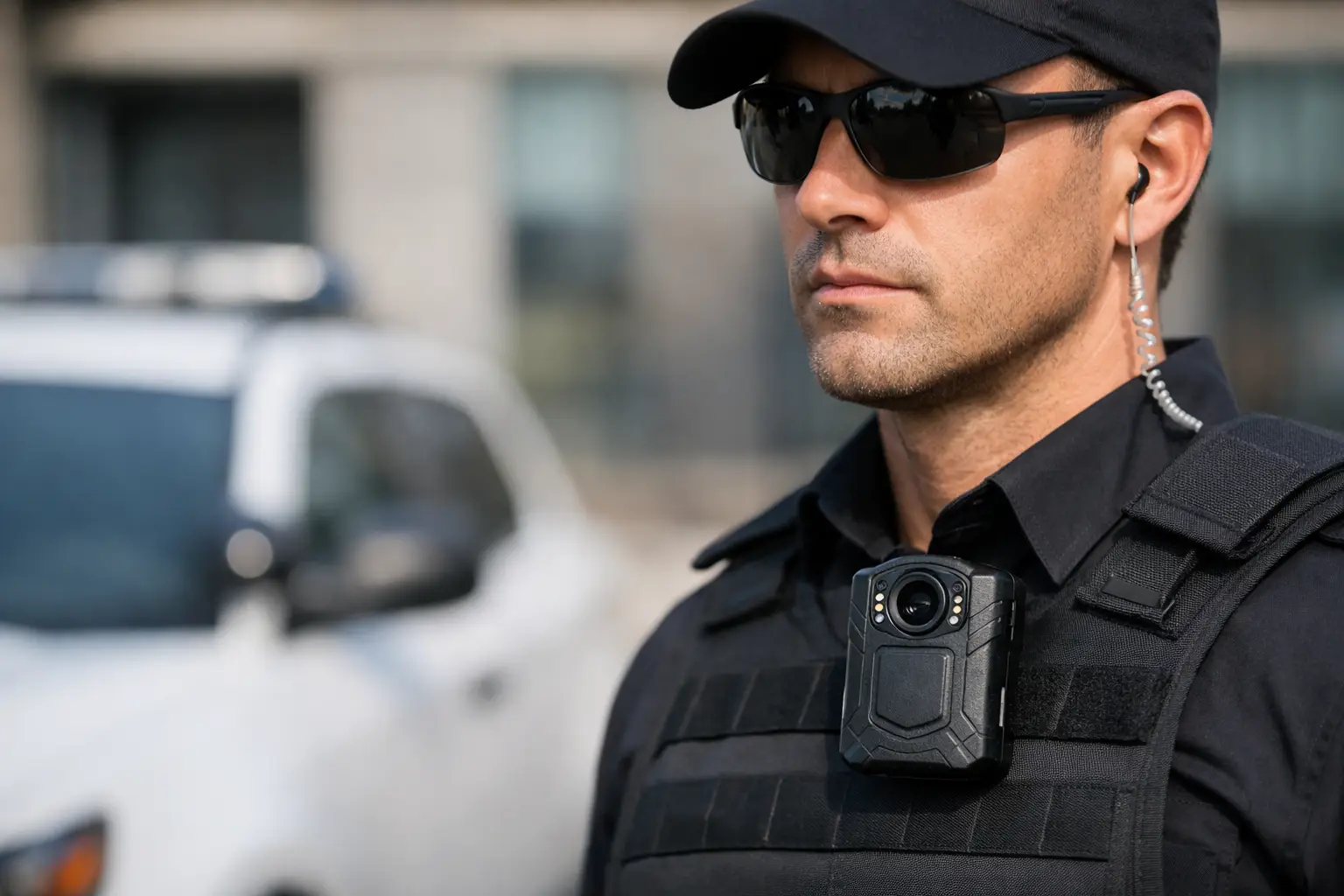
For full specifications on the Vanguard BWC-103W hardware and its paired evidence management platform, see our Vanguard BWC-103W Evidence Management guide.
security guards is no longer a niche add-on for high-risk sites. It has become a practical requirement in many projects where incident documentation, staff accountability, and faster evidence review directly affect client satisfaction. For integrators and procurement teams, the real question is not whether body-worn cameras have value. It is which specification, workflow, and management platform make sense for the site, the budget, and the operator.In the Saudi market, that decision is increasingly tied to project performance. Commercial towers, residential compounds, logistics sites, hospitality venues, and public-facing facilities all place pressure on security teams to document incidents accurately and respond professionally. A body-worn system can help meet that need, but only if it is selected as part of a wider operational design rather than purchased as a standalone device.Why a body worn camera for security guards matters
For security teams, recorded video changes how incidents are handled. Verbal disputes, trespassing events, access control conflicts, and response actions can be reviewed with far more clarity when there is first-person footage. This helps reduce ambiguity for supervisors, clients, and investigators.For integrators, the value is broader. Body-worn cameras can strengthen a proposal by adding a mobile layer of evidence capture to a fixed surveillance design. In locations where static CCTV has blind spots, frequent patrol routes, or highly dynamic activity, wearable recording fills an operational gap that fixed cameras cannot always cover.There is also a deterrence factor. Guards wearing visible cameras often see better public behavior during interactions, especially in visitor management, retail-adjacent environments, parking areas, and front-of-house security posts. That benefit is difficult to measure in advance, but many end users recognize it quickly after deployment.Still, body-worn cameras are not automatically the right fit for every contract. If the client lacks a clear policy for activation, storage, evidence retrieval, and privacy handling, the system may create friction rather than value. The device matters, but the workflow matters more.What buyers should evaluate first
The first step is understanding the operational model. Some clients want continuous recording during a full shift. Others only want event-based recording triggered during patrols, incidents, or dispatch instructions. This decision affects battery sizing, storage capacity, and data transfer requirements.Mounting style should also be considered early. Uniform design, climate conditions, and daily movement all affect camera stability and usability. A camera that works well on a structured tactical vest may perform poorly on lighter security uniforms if the mounting accessory is not matched properly.Video quality is another area where more is not always better. High resolution sounds attractive, but it increases storage load and transfer time. In many guarding environments, reliable 1080p video with usable low-light performance is more practical than pushing for higher resolution that strains the back-end system without adding meaningful evidentiary value.Audio capture deserves equal attention. In many incidents, spoken exchange is just as important as video. A camera with weak microphone performance can limit the usefulness of footage, especially in windy outdoor areas, busy lobbies, or industrial sites with background noise.Core features that affect project success
A body worn camera for security guards should be judged on field reliability first. Battery life, storage endurance, recording stability, and ease of use under pressure will affect real adoption more than a long feature list.Pre-record and post-record functions can be very useful in incident work. These settings help capture the moments immediately before and after manual activation, which often provide the context needed during an investigation. Without that context, footage may show only the middle of an event.Low-light performance is important for perimeter patrols, parking zones, warehouses, and night shifts. Buyers should look beyond simple marketing claims and consider whether footage remains identifiable in realistic site conditions. Good image tuning and practical sensor performance are more valuable than exaggerated specifications.Tamper resistance also matters. Secure file protection, audit trails, and controlled user access help preserve evidentiary integrity. If end users can alter, delete, or transfer footage without proper authorization, the system becomes harder to defend in internal reviews or formal investigations.Docking and charging design can have a major operational impact. On multi-guard deployments, a well-designed docking workflow saves time at shift handover and reduces the risk of missing footage uploads. For some clients, this is more important than a minor difference in camera specifications.The back-end platform is where value is won or lost
Many buyers focus heavily on the camera and underestimate the importance of evidence management. In practice, the back-end platform often determines whether the project runs smoothly after installation.Footage needs to be uploaded, indexed, retained, and retrieved without creating unnecessary workload for supervisors. A platform that supports role-based access, case tagging, audit logs, and controlled export is far easier to manage than an informal file-handling process. This is especially relevant for enterprise clients, regulated sites, and facilities with frequent incident reporting.Storage architecture should be discussed early. Some clients prefer local docking and on-premise control. Others are open to hybrid or cloud-connected workflows if compliance and IT policy allow it. There is no universal answer. What matters is aligning the retention model with the client’s legal, operational, and budget requirements.Integration potential should not be ignored. In some projects, body-worn footage may remain a separate evidence stream. In others, there is real benefit in aligning it with video management, dispatch workflows, or incident reporting systems. The stronger the operational process, the more useful the recorded data becomes.Deployment challenges that should be addressed upfront
User adoption is one of the biggest risks in any body-worn camera project. If guards find the device uncomfortable, difficult to operate, or unclear in terms of recording rules, usage quality will vary from shift to shift. That weakens the system and creates inconsistency in evidence capture.Training should cover more than button functions. Guards need clear instruction on when to record, how to announce recording where required, how to handle sensitive interactions, and what to do if a device fails during duty. Supervisors also need procedures for review, escalation, and chain-of-custody handling.Privacy and policy are equally important. Not every area or interaction should be recorded in the same way. Residential environments, staff areas, and certain visitor-facing scenarios may require stricter controls. Integrators who raise these questions early demonstrate technical maturity and reduce future disputes.Environmental conditions in Saudi Arabia should also influence specification decisions. Heat, dust, and long outdoor shifts can affect wearable device performance. Buyers should prioritize proven hardware quality and charging discipline rather than assuming all body-worn cameras will perform equally in demanding site conditions.Where body-worn cameras fit best
The strongest use cases are usually sites where guards have frequent public interaction, mobile patrol responsibility, or incident response duties beyond a static post. Residential compounds, mixed-use developments, hospitality properties, logistics hubs, industrial facilities, transport environments, and municipal projects often benefit from wearable evidence capture.They are also useful where client expectations are high and dispute resolution needs to be fast. Property managers and operators increasingly want documented timelines for complaints, enforcement actions, and escalation events. Body-worn footage supports that requirement in a way written reports alone cannot.That said, not every contract needs full deployment across all guards. In some cases, assigning cameras to patrol supervisors, rapid response personnel, or front-line teams is the better commercial choice. Selective deployment can improve budget control while still delivering operational value.How to buy with fewer mistakes
The best projects start with a site-specific assessment, not a catalog comparison. Define the shift model, recording policy, retention expectations, charging process, review workflow, and supervisory responsibility before choosing devices. Once those basics are clear, camera selection becomes far more precise.It is also worth evaluating support capability from the supply side. Firmware management, replacement handling, accessory availability, and platform guidance all affect long-term success.Vanguard BWC-103W: The Body-Worn Camera Seven Sectors Distributes in Saudi Arabia
For projects in Saudi Arabia, Seven Sectors supplies the Vanguard BWC-103W body-worn camera system. Vanguard is a specialist body-worn camera brand, and the BWC-103W is designed for professional security and law enforcement deployments where reliability, evidence integrity, and operational continuity are non-negotiable.The BWC-103W is paired with a full evidence management platform, which addresses one of the most common shortfalls in body-worn camera deployments: managing footage after it has been captured. The platform provides controlled access, audit trails, and structured storage so that footage remains retrievable, defensible, and properly governed — from the moment of upload through to review and formal reporting.For integrators specifying a complete body-worn camera solution in Saudi Arabia, the combination of the Vanguard BWC-103W hardware and its evidence management platform provides a single-source, end-to-end system from a specialist manufacturer. This removes the risk of combining a generic recording device with a mismatched third-party platform — a setup that frequently creates problems at the evidence management stage.Seven Sectors is an authorized distributor of Vanguard body-worn cameras in Saudi Arabia. For specifications, demonstration units, and project support, contact us directly.For integrators, working with a distributor that understands both the product category and the realities of project delivery in Saudi Arabia can reduce delays and protect margins.A body-worn camera system should be sold as an operational solution, not just a hardware line item. That is where buyers see lasting value, and that is where stronger projects are won.When the right device, policy, and evidence workflow come together, body-worn cameras do more than record incidents. They help security teams work with more confidence, give clients clearer visibility, and turn a basic guarding contract into a more accountable security operation.Ready to discuss your project? Contact Seven Sectors or contact us directly on +966-012 229 3474.