Why use VMS instead of managing cameras separately?
Managing surveillance device by device looks acceptable on small sites, but it creates problems quickly in commercial, industrial, and government deployments. Different camera interfaces, inconsistent user permissions, fragmented recording rules, and difficult evidence export all add operational risk. A proper VMS centralizes those functions.With ISS SecurOS, for example, cameras, analytics, alarms, maps, operator permissions, and investigation workflows are managed within one platform. That matters when a project includes Milesight AI cameras in perimeter zones, HID access control events at entry points, and centralized storage on Rasilient, FIBRENETIX, or Dell infrastructure. Instead of treating each subsystem as an island, the VMS provides the control layer that ties them together.This is also where scale matters. ISS operates in more than 50 countries and supports deployments at serious enterprise scale, including large transportation and border environments. In Saudi projects, that level of maturity is relevant because many sites are not static. A campus may start with one block and expand to multiple phases. A logistics site may add LPR lanes later. A government facility may begin with standard recording and then require facial recognition or behavior analytics after handover. A VMS built for expansion protects that roadmap better than a collection of disconnected device tools.The real operational value of a VMS
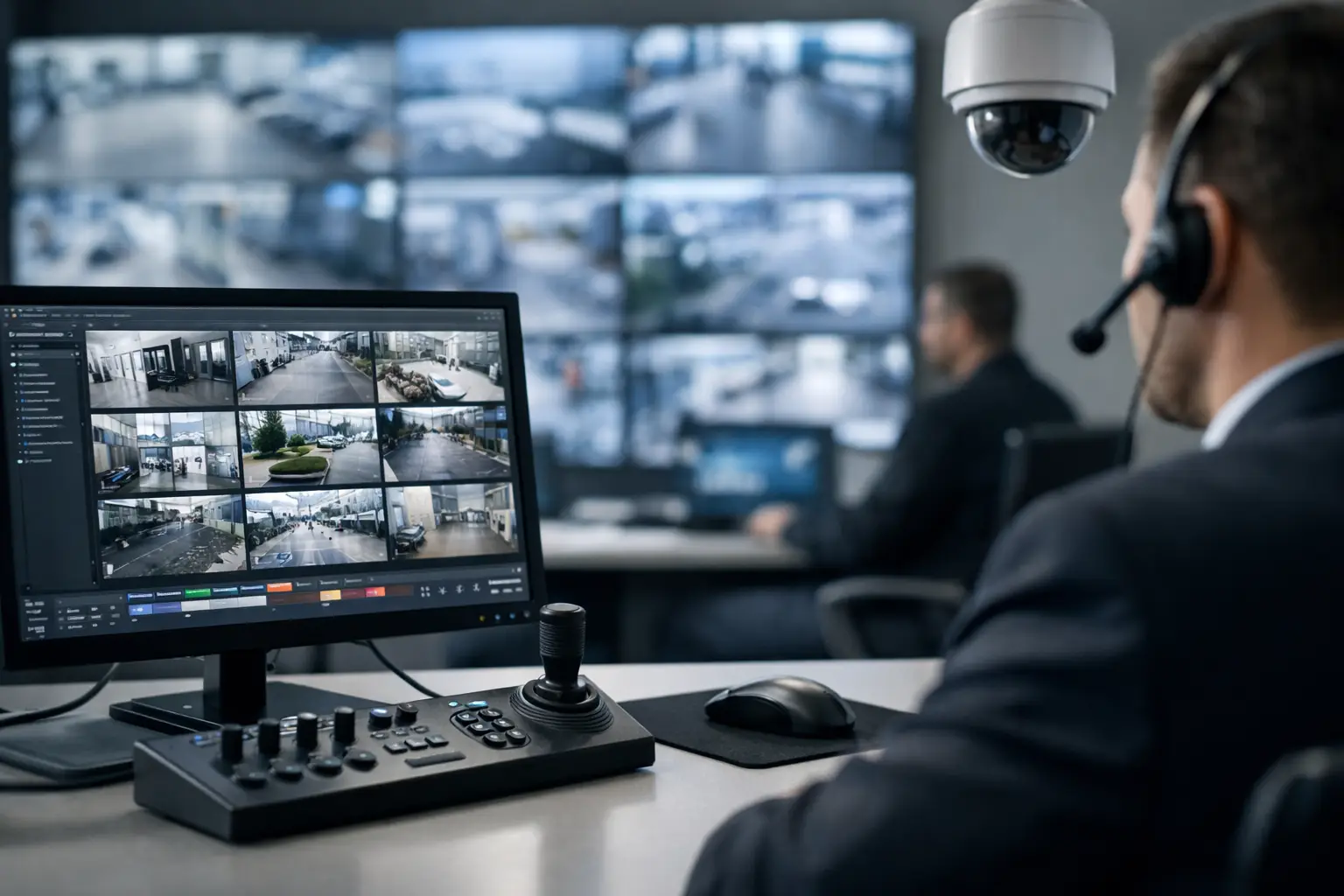
The strongest reason to use a VMS is not that it displays live video. Every camera can already do that. The value is in how it improves operator response, investigation speed, and system consistency.When an alarm occurs, operators should not waste time switching between software platforms, searching camera names manually, or checking whether the recorder for that zone is online. A VMS can present event-driven video, linked cameras, maps, and alarm workflows in one place. On a larger site, those seconds matter.This becomes more important when advanced analytics are part of the design. Milesight AI cameras can reduce false alarms significantly in the field, but analytics still need event handling, escalation logic, user workflows, and archive search tools around them. A camera can detect a human or vehicle event. The VMS determines how that event reaches the operator, what cameras open automatically, which permissions apply, and how the footage is retained and exported.That is why use VMS is really a question about operations, not just software licensing. If the site depends on people responding to events, reviewing incidents, and producing evidence, the VMS is part of the security procedure itself.Why use VMS for multi-brand and phased projects?
Many projects across Saudi Arabia are not built around a single manufacturer from day one to day ten. Specifications evolve, legacy devices remain in some phases, and procurement conditions can change between packages. A VMS with broad device support gives consultants and integrators more room to build practical solutions without locking the entire project to one camera ecosystem.ISS SecurOS is especially relevant here because it is not limited to one device family. In a real project, that flexibility can help combine Milesight AI cameras for intelligent surveillance, AETEK PoE infrastructure for reliable network edge power, and enterprise storage platforms such as Rasilient or Dell for retention and performance requirements. If a project later adds body-worn video workflows through Vanguard or access control events through HID, the value of an open management layer becomes even clearer.The trade-off is that open-platform VMS design still requires disciplined compatibility review. Not every integration delivers the same feature depth. Some cameras may support full metadata and event triggers, while others only provide basic stream management. That is why procurement teams should evaluate the actual required functions, not just whether a device appears on a compatibility list.Storage, performance, and evidence handling
A VMS choice directly affects storage architecture. This is often underestimated during tender review, then becomes a problem during FAT or after the first retention audit. Recording policies, failover design, archive movement, user access, and playback concurrency all depend on the VMS behavior.In higher-load environments, the recording layer must be matched properly with surveillance storage and server infrastructure. Rasilient is well suited for this conversation because its surveillance platforms are designed around video performance, including No Frames Dropped architecture. FIBRENETIX and Dell also play an important role where enterprise compute, storage scaling, or standardization requirements drive the server stack. The VMS sits above that infrastructure and determines how effectively those resources are used.A weak design often focuses on raw camera count only. A better design looks at bitrate, codec, frame rate, analytics metadata, user playback demand, export volume, and fault tolerance. A VMS should support those requirements without creating operational bottlenecks. If a site records continuously from high-resolution Milesight cameras, uses analytics extensively, and expects simultaneous investigations from multiple operators, server and storage planning must be aligned from the start.Evidence export is another area where the VMS matters. In regulated or sensitive environments, footage is not useful unless it can be located quickly, exported clearly, and handled with proper user controls. That requirement is common in government, transportation, and critical infrastructure settings.Compliance, governance, and procurement confidence
For many public sector and Vision 2030-linked projects, the VMS discussion is not only technical. It also touches compliance and source confidence. NDAA and TAA considerations increasingly shape product selection, especially where government standards, foreign sourcing rules, or long-term project governance are involved.ISS, Milesight, and AETEK all fit into this conversation because compliance cannot be isolated to one part of the surveillance stack. Cameras, PoE switching, recording infrastructure, and management software all influence approval risk. A compliant VMS strategy is easier to defend in procurement than a patchwork system built around questionable components.This is one reason authorized distribution matters. Procurement teams and integrators need a verified local source that can support product availability, documentation, and brand-backed channel alignment. For the Saudi market, Seven Sectors serves as the authorized distributor for ISS and other international brands in the security stack, which reduces uncertainty during specification and supply stages.When a VMS may be more than you need
Not every project needs the same VMS level. A small standalone site with limited cameras and no integration requirements may operate adequately on a simpler platform. If there is no central command function, no analytics workflow, no multi-site growth plan, and no evidence management pressure, a full enterprise VMS may be excessive.But that is not the typical profile for the projects most integrators and consultants are dealing with now. Multi-building developments, logistics hubs, industrial facilities, campuses, government compounds, and giga-project packages usually need centralized control, structured permissions, and future integration paths. In those cases, avoiding a proper VMS can save budget at the beginning and create operational cost later.The better question is not whether the site has cameras. It is whether the site has surveillance operations. If it does, the VMS deserves early design attention.Why use VMS as part of a full security stack?
A surveillance project performs best when each layer is chosen for its job. Milesight handles image quality and AI detection. AETEK supports the network edge with PoE switching and long-distance extension options, including 250-meter PoE extenders where layout requires it. Rasilient, FIBRENETIX, and Dell support recording and storage infrastructure. HID connects identity and access events. ISS SecurOS sits across that environment and turns it into a managed system rather than a collection of parts.That distinction is what separates a device purchase from a project-ready platform. Cameras capture images. Servers retain data. Switches keep endpoints connected. The VMS decides how the whole system behaves under real operating conditions.If you are evaluating a project where response time, evidence handling, system growth, and compliance all matter, asking why use VMS is the right question. The useful answer is simple: because surveillance only becomes operationally valuable when the video, events, users, and infrastructure are managed as one system.Ready to evaluate your options? Our detailed VMS Software Guide walks through key criteria for selecting the right platform for Saudi projects.
A VMS centralizes camera management, recording, search, and analytics on a single platform — replacing ad-hoc NVR arrangements that cannot scale. For Saudi projects where sites span large areas, have multiple access points, or must meet government audit requirements, a VMS is the operational backbone that makes security teams effective rather than reactive.
A standalone NVR records from a fixed camera set and offers basic playback. A VMS is software-defined, runs on servers or cloud infrastructure, scales to thousands of cameras, integrates with access control and analytics, and provides centralised management across multiple sites. For enterprise or project-scale deployments, a VMS is the right choice.
Yes. Modern VMS platforms like ISS SecurOS support AI analytics modules including LPR (SecurOS Auto), facial recognition (SecurOS FaceX), behaviour analytics, and perimeter detection. These modules enable smart city applications — traffic management, crowd monitoring, safe city command centres — that Saudi Vision 2030 giga-projects increasingly require.
A VMS reduces the headcount needed to monitor large camera networks by using AI to filter alerts — operators only see events that matter. Centralised search cuts incident review time from hours to minutes. Integration with access control eliminates duplicate data entry. These efficiencies directly reduce staffing costs and response times.
Seven Sectors is the authorized Saudi partner for ISS (Intelligent Security Systems) and its SecurOS VMS platform. We supply SecurOS Professional, Premium, Enterprise, and MCC editions alongside ISS-validated Rasilient server hardware. Contact us for project-specific licensing and hardware sizing.
Ready to discuss your project? Contact Seven Sectors or contact us directly on +966-012 229 3474.