
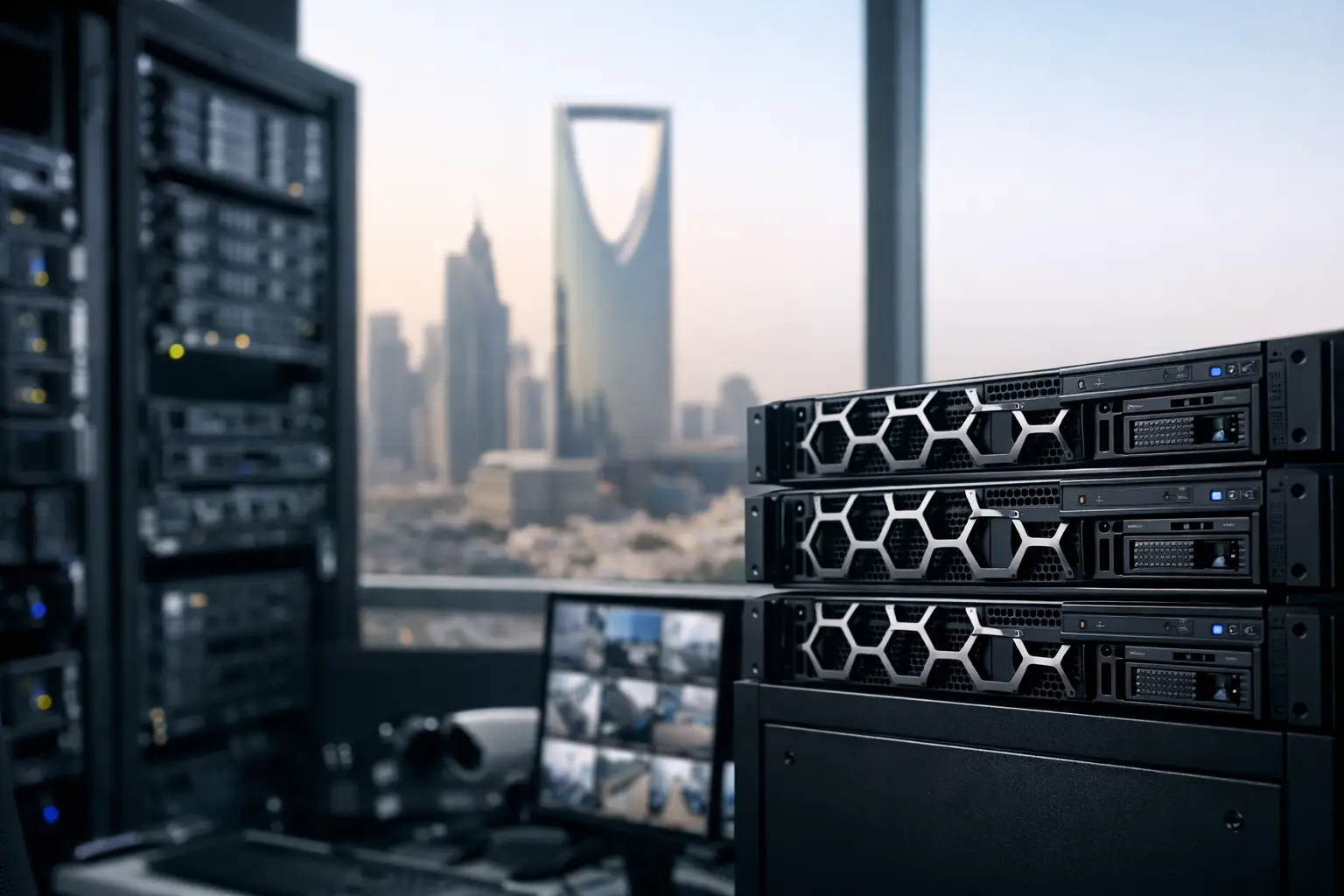
Saudi hospitals are under pressure to modernize command-center infrastructure as surveillance, access control, and clinical systems all converge onto the same IT backbone. Dell PowerEdge servers give hospital IT teams and system integrators enterprise-grade compute for VMS platforms and command center infrastructure, sized to handle continuous 24/7 video processing and multi-building access control loads without the downtime a hospital environment cannot tolerate. As Saudi healthcare projects scale under Vision 2030, the server layer behind the cameras and access readers has become a specification line item in its own right, not an afterthought bolted on after the security design is finished. This guide covers why hospitals need dedicated server infrastructure, what Dell’s PowerEdge and PowerVault lines bring to the table, and what to plan for when specifying compute for a healthcare security deployment.
Why hospitals in Saudi Arabia demand server infrastructure
A hospital campus typically runs hundreds of cameras across wards, entrances, pharmacies, and parking structures, plus access control at restricted areas like operating theatres, medication stores, and records rooms. All of that video and access data has to be processed, stored, and made searchable by a VMS platform running on real server hardware, not a repurposed desktop tucked into a server closet. Downtime is not an option in a clinical environment, where a failed access control server can lock staff out of a restricted ward or, worse, fail to lock one when it should.
Saudi healthcare procurement, particularly for MOH and public hospital projects, increasingly specifies enterprise server hardware with documented reliability, remote management, and vendor support commitments as part of the technical submittal. That pushes integrators away from white-box servers toward established enterprise platforms that come with predictable lifecycle support and spare-parts availability inside the Kingdom.
Hospitals also tend to expand incrementally, adding wings, clinics, and parking structures over years rather than building everything at once. Server infrastructure that cannot scale cleanly forces a rip-and-replace every time the camera or reader count grows, which is exactly the kind of disruption a live hospital campus cannot easily absorb.
Beyond video and access control, hospital command centers increasingly consolidate alarm monitoring, visitor management, and building automation dashboards onto the same operations floor. Server infrastructure that can host several of these applications reliably, without one workload degrading another during peak load, gives facilities teams a single point of accountability instead of a rack full of mismatched hardware from different projects and different eras.
Dell PowerEdge and PowerVault: what they actually do
Dell’s PowerEdge server line is built for exactly this kind of always-on enterprise workload, providing the compute and redundancy needed to run VMS software, access control management platforms, and command center applications reliably around the clock. PowerVault storage arrays extend that with dedicated capacity for the video retention periods hospitals are typically required to maintain for compliance and incident review, while Precision workstations serve control-room operator stations where security staff need to view and manage live feeds without lag.
For a hospital deployment, the practical benefit is a server platform that integrators can size predictably against camera count, retention days, and access control database load, with redundant power supplies and hot-swappable drives that keep the system running through routine hardware maintenance rather than requiring scheduled downtime.
Key capabilities
- Enterprise-grade compute sized for continuous VMS and access control processing loads
- Redundant power and hot-swappable storage to minimize planned and unplanned downtime
- Scalable storage capacity to match hospital-grade video retention requirements
- Remote management tooling for IT teams supporting multi-building campuses
- Documented enterprise support and lifecycle commitments suited to public procurement
Deployment considerations for hospital sites
Server room planning for a hospital needs to account for clinical-grade uptime requirements from day one, including UPS backup, environmental cooling, and physical access restrictions to the server room itself, since it now holds infrastructure as operationally critical as many clinical systems. Integrators should size compute and storage against camera count, resolution, and retention days early, because hospitals frequently underestimate how much footage a busy emergency department or main entrance generates over a 90-day retention window.
Redundancy planning also matters more in a hospital than almost any other vertical covered in this series. A single point of failure in the server layer that takes down access control to a restricted pharmacy or medication store is a patient-safety issue, not just an IT inconvenience, so failover and backup power should be part of the initial design rather than a later addition.
Phased hospital construction is common in Saudi Arabia, with new wings or outpatient buildings added after the main campus opens. Specifying server capacity with room to grow, rather than sizing exactly to day-one requirements, avoids a disruptive infrastructure upgrade once the next phase comes online.
Power and cooling budgets deserve early attention too. A hospital’s main server room is often shared with other clinical IT systems, and adding a dense VMS and access control server stack without confirming available rack power and HVAC capacity is a common source of late-stage project delays. Coordinating this with the hospital’s facilities and biomedical engineering teams, not just the IT department, avoids surprises when the equipment actually arrives on site.
How this fits alongside surveillance and VMS platforms
Server hardware is only useful when paired with the right software and camera layer above it. VMS platforms like ISS SecurOS run on this Dell server infrastructure to manage live monitoring, analytics, and long-term video search across a hospital campus, while purpose-built surveillance storage can complement PowerVault for sites with especially heavy retention requirements. It’s worth noting that Dell server infrastructure and Fibrenetix surveillance storage are separate product lines suited to different parts of a project: Dell servers typically run the VMS and command center applications, while dedicated surveillance storage platforms are sized specifically around continuous video-write workloads.
Compliance, support and sourcing in the Kingdom
Seven Sectors Trading Co. is an authorized partner supplying Dell server infrastructure to system integrators and consultants working on Saudi healthcare and command-center projects. That means technical submittals for hospital projects are backed by genuine Dell hardware and documentation, with local support that understands how the server layer fits into a VMS and access control deployment rather than treating it as generic IT hardware.
For MOH and public hospital tenders, where compliance documentation and vendor accountability are scrutinized closely, working with a Jeddah-based authorized partner who can turn around technical specifications and sizing recommendations quickly helps keep procurement timelines on track.
FAQ
Why not just use a standard IT server for hospital VMS and access control?
Standard IT servers are not typically sized or configured for the continuous, high-throughput write loads that video surveillance and access control databases generate around the clock. Enterprise platforms built for this workload, with redundant components and documented reliability, reduce the risk of downtime in an environment where server failure has patient-safety consequences.
How much server capacity does a hospital campus typically need?
It depends on camera count, resolution, and required retention days, plus access control database size across the campus. We recommend sharing your camera and door count with us so we can put together a sizing recommendation specific to your project.
Can this infrastructure scale as the hospital adds new buildings?
Yes, PowerEdge and PowerVault platforms are designed to scale incrementally, which suits the phased construction common on Saudi hospital campuses. Planning initial capacity with growth headroom avoids a disruptive replacement when the next phase comes online.
Specifying server infrastructure for a hospital or healthcare campus security project in Saudi Arabia? Request a technical recommendation from Seven Sectors and we will help you size the right Dell server and storage architecture before your technical submittal is finalized.
See the full Surveillance Storage & Servers overview for the complete Rasilient, Dell and Fibrenetix range.
Ready to discuss your project? Contact Seven Sectors or contact us directly on +966-012 229 3474.