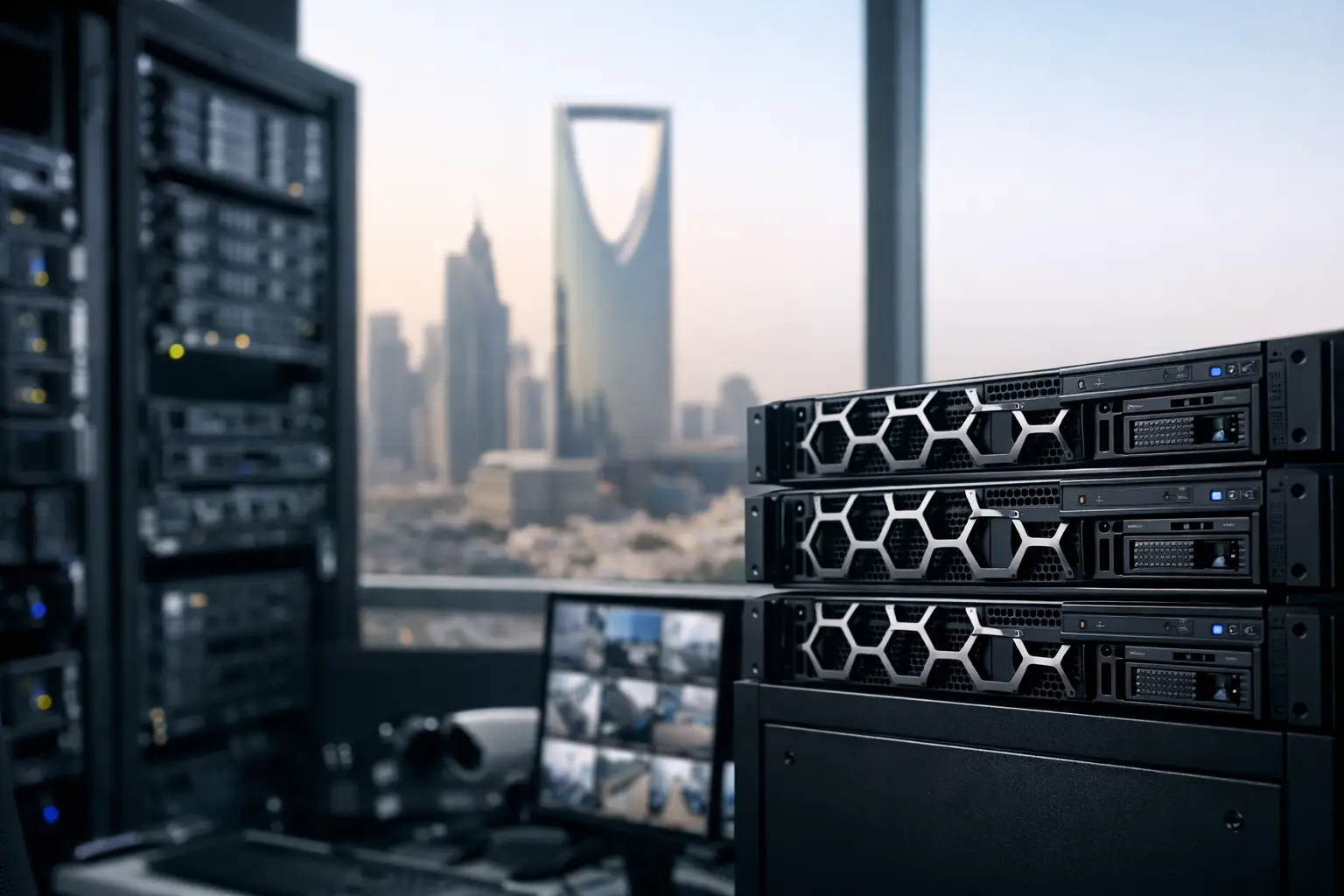
A Dell PowerEdge server VMS video surveillance infrastructure Saudi Arabia project is rarely limited by camera count alone. The real constraint is the combined demand of recording, live viewing, AI analytics, retention policy, failover, and operator response. System integrators and consultants work on government facilities, industrial sites, airports, logistics hubs, and Vision 2030 developments. For them, a PowerEdge platform must serve as a measured VMS foundation, not a general-purpose IT server.
Dell PowerEdge servers provide the compute foundation for VMS environments where predictable performance, supportability, and scale matter. The correct platform depends on the selected VMS, camera stream profile, and storage architecture. It also depends on the operational requirement for the site after handover.
Why Dell PowerEdge Fits VMS Infrastructure in Saudi Arabia
Video surveillance creates a workload unlike ordinary office applications. A VMS server may ingest hundreds of simultaneous streams continuously and retain footage for weeks or months. It may also serve multiple live clients and run analytics on selected channels. If one part of that chain is too small, problems follow. Expect lost frames, delayed playback, overloaded storage, or a poor operator experience.
Dell PowerEdge rack servers fit this environment well. They offer a standardized enterprise server platform for VMS recording, management, analytics, and client services. You can assign PowerEdge models according to the job rather than forcing them into a single role. A dedicated recording server has different priorities from an enterprise management server or a workstation serving a security command center.
For Saudi projects, this separation is particularly useful. A municipal command center may need central management across multiple facilities. Each remote facility, meanwhile, needs local recording continuity. An oil and gas site may prioritize retention, controlled access to evidence, and network resilience. A commercial development may require efficient expansion as teams commission new phases, parking areas, and retail zones.
Start With the VMS Workload, Not the Server Model
The common procurement error is starting with a server part number. The correct starting point is the VMS workload. Before selecting a Dell PowerEdge configuration, define the cameras, streams, retention period, viewing demand, analytics, and recovery expectations.
Recording Load Is More Than Camera Quantity
Camera count is only a preliminary figure. A 200-camera deployment can have radically different requirements depending on resolution, codec, frames per second, scene activity, and recording mode. Continuous 4K recording produces a different storage and network profile than event-based recording from lower-resolution cameras.
Milesight AI cameras can reduce unnecessary alarms through built-in AI classification. Even so, you still need to calculate recording bitrate. For example, many projects select TrueColor AI cameras for low-light scenes to preserve usable evidence at night. You still need to translate the resulting stream configuration, recording policy, and camera placement into real storage capacity and server throughput.
Use the VMS vendor’s sizing method and validate it against the actual camera stream parameters. Allow capacity for growth, firmware changes, and additional users. Projects rarely remain at their original camera count.
Management, Recording, and Analytics Need Different Resources
In an ISS SecurOS deployment, different hardware roles carry different jobs. Management, recording services, operator clients, and analytics workloads can each sit on separate servers. Evaluate SecurOS Professional, Premium, Enterprise, and MCC environments against the operational scope of the project, not simply the number of cameras.
A single Dell PowerEdge server can suit a smaller localized deployment. At larger sites, separating recording from management services helps protect the platform from contention. If the project requires facial recognition, LPR, behavioral analytics, or high-demand investigation workflows, allocate compute resources specifically for those functions. Do not assume that spare CPU capacity on a recording server is automatically sufficient for analytics.
This is an area where the project requirement matters. A warehouse with limited live viewing may prioritize retention and reliable recording. A city command center runs multiple operator positions, video walls, and incident investigations. It will place greater demand on management, client access, and database performance.
Selecting the Right Dell PowerEdge Architecture
Integrators typically consider Dell PowerEdge rack servers such as the R660 and R760 families for data-center-style VMS deployment. They suit projects that need expansion room and easy service access. Processor capacity, memory, storage bays, RAID design, network interfaces, and the VMS vendor’s approved architecture drive the practical selection.
A compact server with limited internal drive capacity may work well for management or smaller recording loads. A higher-density chassis may be more appropriate where local recording storage is a key part of the design. However, loading a server with drives is not automatically the best answer. As retention requirements rise, an external storage strategy can provide better scalability and clearer separation between compute and video data.
Dell PowerVault storage can support this approach when a project requires centralized or expanded surveillance storage alongside PowerEdge compute. The choice between internal, direct-attached, and shared storage should consider retention duration and future camera growth. Weigh rebuild times, maintenance windows, and the consequences of a storage failure as well.
For critical environments, the question is not only how much storage the design needs. It is how the system behaves when a drive, server, network path, or site connection fails.
Build Resilience Into the Requirement
Specify resilience early, especially for border, industrial, transport, government, and smart-city applications. Redundant power supplies, RAID protection, and dual network paths belong in the infrastructure requirement. So do spare capacity and documented recovery procedures.
There are trade-offs. RAID protection improves fault tolerance but reduces usable capacity. Redundancy can increase cost and rack space. Centralized storage can simplify administration but may introduce dependency on the data-center network. Local recording supports site autonomy but can create more distributed assets to maintain.
Sometimes no-frame-loss recording is a contractual requirement. In that case, a specialist surveillance storage platform such as Rasilient may be the better fit for the recording tier. Rasilient’s NFD approach and VMS-agnostic position can complement this architecture. Dell PowerEdge servers then perform VMS management, application, or analytics roles. The right choice depends on the VMS design and the project’s evidence, retention, and availability obligations.
Network Design Still Determines Video Performance
A PowerEdge server cannot correct an undersized surveillance network. Plan video traffic from camera edge to recording server. Include PoE access switching, uplinks, aggregation, VLAN design, and remote-site connectivity.
AETEK PoE switches belong at the camera-network layer, not the server layer. For outdoor cameras and perimeter deployments, AETEK H-series IP67 PoE infrastructure supports harsh field conditions. Conventional indoor switches are unsuitable there. In indoor cabinets and telecom rooms, C-series switches can serve camera connectivity, while D-series products address industrial applications. AETEK PoE extenders can carry PoE and network connectivity up to 250 meters where a standard copper run is not enough.
Match the infrastructure path to the camera design. A high-resolution Milesight panoramic camera, PTZ, or LPR Pro Bullet Plus Camera creates a heavier bandwidth profile. A standard fixed camera does not. Size uplinks for aggregate traffic and future growth, not just the nominal speed of individual edge ports.
Compliance and Procurement Controls
For government and Vision 2030 projects, product origin, cybersecurity policy, approved vendor status, and compliance documentation often influence the technical decision. Identify NDAA/TAA requirements at tender stage, before cameras and network products enter a bill of quantities.
Milesight AI cameras and AETEK PoE infrastructure are available in NDAA-compliant options relevant to security procurement. Review the server and storage specification separately against the exact tender requirements, customer standards, and VMS compatibility documentation. Compliance is not a label you can apply to an entire system without checking each component and its intended use.
This discipline also protects the integrator. A technically capable camera or server that the client cannot accept creates avoidable replacement risk late in the project.
A Practical Specification Path for Integrators
A reliable Dell PowerEdge VMS specification starts with verified inputs. These include the camera schedule, stream settings, retention period, VMS edition, analytics scope, simultaneous users, and availability target. Then define server roles, calculate storage using real bitrates, confirm network capacity, and document the failover or recovery plan.
Do not overlook physical requirements. Confirm rack space, power circuits, cooling, access for drive replacement, and support coverage at the deployment location. For projects spanning Riyadh, Jeddah, the Eastern Province, or remote giga-project zones, plan logistics and replacements early. They deserve the same attention as processor and storage figures.
Seven Sectors supports Saudi system integrators and procurement teams with Dell PowerEdge VMS infrastructure. This sits alongside ISS SecurOS, Milesight AI cameras, AETEK PoE networking, and surveillance storage options. The objective is straightforward: supply a compatible, project-appropriate stack that gives the integrator confidence at submission, delivery, and expansion stages.
A surveillance platform earns trust when it keeps recording during a busy incident and retrieves evidence without delay. It should also hold clear capacity for the next project phase. That is the standard a Dell PowerEdge VMS infrastructure should meet.
Frequently Asked Questions
Why use Dell PowerEdge servers for VMS video surveillance in Saudi Arabia?
Dell PowerEdge provides a standardized, supportable enterprise server platform for VMS recording, management, analytics, and command center client services. For Saudi projects with long operational lifespans, multi-year support contracts, and mixed workloads, the combination of Dell serviceability, broad VMS compatibility, and scalable rack configurations makes PowerEdge a reliable foundation for surveillance infrastructure.
Which Dell PowerEdge models are best suited for VMS deployments?
Model selection depends on the VMS role: a dedicated recording server has different CPU and storage requirements from a central management server or an analytics server. PowerEdge R-series rack servers cover the mainstream recording and management roles; higher-spec configurations with GPU options suit AI analytics workloads. Seven Sectors can size the correct PowerEdge model for your VMS platform and camera estate.
Does Dell PowerEdge work with ISS SecurOS, Milestone XProtect, and other VMS?
Yes. Dell PowerEdge servers are hardware-agnostic and run any Windows-based VMS platform including ISS SecurOS, Milestone XProtect, Genetec, and Avigilon. The correct operating system, RAID configuration, and driver set depend on the VMS version; Seven Sectors can advise on validated configurations for KSA projects.
How is Dell PowerEdge different from FIBRENETIX and Rasilient surveillance servers?
Dell PowerEdge is a general-purpose enterprise server platform that adapts well to VMS workloads. FIBRENETIX and Rasilient are purpose-built specifically for video surveillance recording: they optimize storage controllers, RAID profiles, and system firmware for continuous video write performance. For a project needing maximum recording reliability or forensic-grade evidence guarantees, purpose-built surveillance servers add measurable value. For command center compute and analytics layers, PowerEdge is often the right choice.
Can Seven Sectors supply Dell PowerEdge servers and provide after-sales support in Saudi Arabia?
Yes. Seven Sectors supplies Dell PowerEdge servers and Precision workstations for VMS and command center infrastructure projects across Saudi Arabia. We assist with system specification, configuration advice, and local procurement support. Contact us with your VMS platform, camera count, and site requirements for a recommendation and quote.
See the full Surveillance Storage & Servers overview for the complete Rasilient, Dell and Fibrenetix range.
Ready to discuss your project? Contact Seven Sectors or contact us directly on +966-012 229 3474.