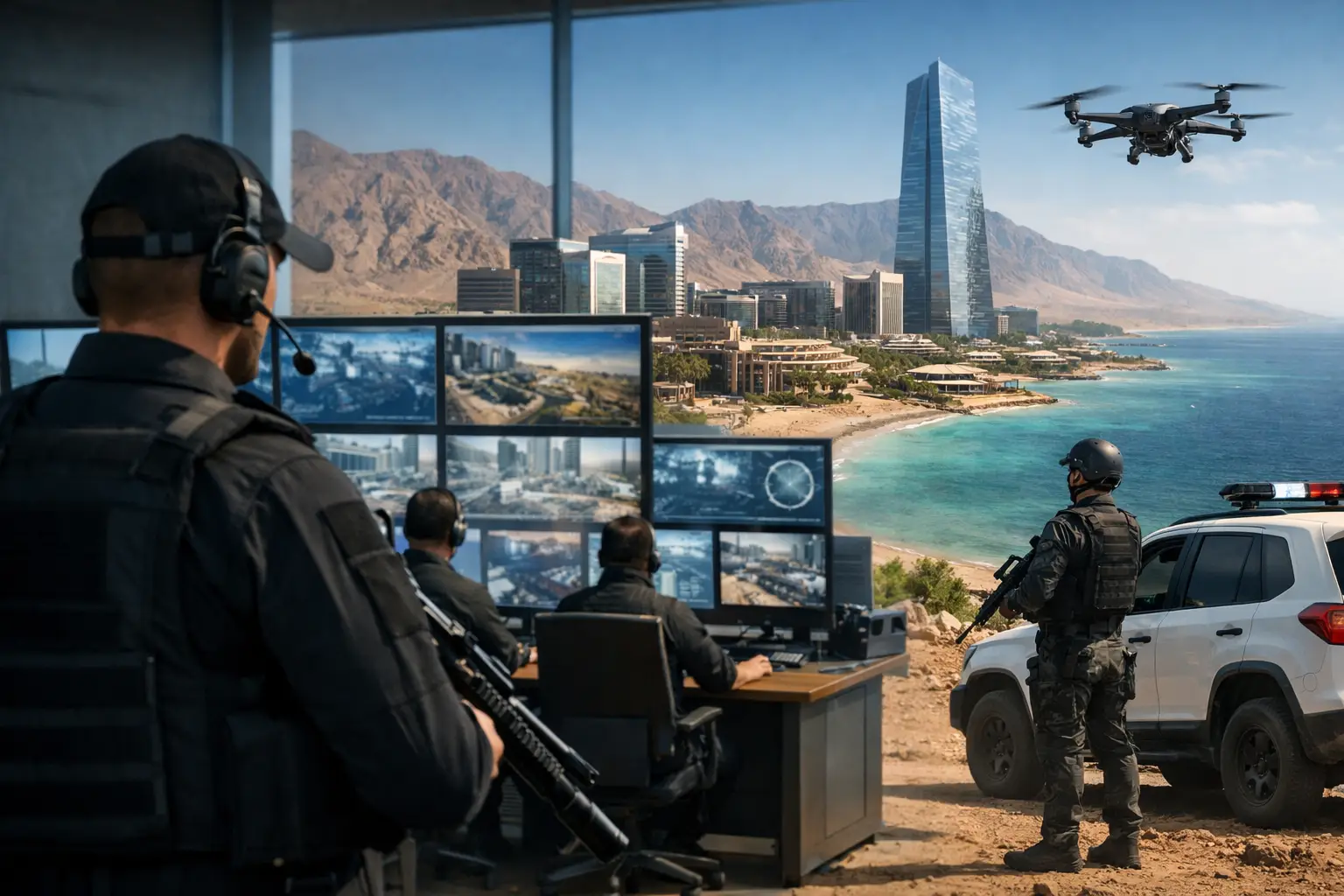
When a consultant writes a package for NEOM or the Red Sea Project, the real problem is rarely one device category. The challenge behind any giga project security solution NEOM Red Sea Saudi Arabia requires is how to build a surveillance stack that stays compliant and scales cleanly. The stack must also perform across long distances, harsh weather, and multi-contractor delivery. For most packages, the strongest starting point is not a generic security bill of materials. It is a video-led architecture built around Milesight AI cameras, then supported by the right PoE, VMS, access, and storage layers.
Why Milesight AI cameras fit giga project requirements
For giga projects, camera selection is no longer about basic image capture. It is about what the camera can reduce, verify, and classify before the operator ever looks at an event. Milesight AI cameras are a strong fit in this environment. They address two common project pressures at once – false alarms and low-light performance.
In perimeter, logistics, hospitality, and mixed-use environments, nuisance alarms quickly overwhelm guard teams and command centers. Milesight’s AI processing reduces false alarms by up to 95%. That matters when analytics drive response workflows rather than simple recording. The difference shows up in real deployments. Wind, light variation, and repeated non-threat movement can otherwise make analytics unreliable.
Low-light conditions are the second issue. Coastal developments, remote utility zones, roadways, and service areas do not always have ideal lighting. Milesight models with TrueColor AI, 0.002 Lux sensitivity, and up to 140 dB WDR give specifiers more room here. As a result, they can maintain usable evidence quality in difficult scenes. That does not mean every camera should be a premium analytics model. It means specifiers can assign critical scenes the right sensor and AI profile instead of overbuilding every location.
Giga project security solution for NEOM Red Sea sites starts with scene type
The mistake in many large tenders is specifying one camera family across all zones. A giga project security solution for NEOM Red Sea sites should separate use cases first, then match the Milesight product line to the operational need.
For wide-area public realm monitoring, Milesight Q Series panoramic options make more sense than forcing multiple fixed cameras into a single scene. The 360 fisheye and 180 dual panoramic models suit operators who need broad coverage with fewer mounting points. For example, they work well in plazas, arrival areas, and open circulation spaces.
For long-range tracking, PTZ selection matters more than headline zoom alone. Milesight PTZ cameras in the 12X to 23X range are suitable where operators need guided verification. In addition, they pair naturally with an AI trigger from a fixed perimeter or panoramic camera. The trade-off is simple: PTZs are excellent for active monitoring, but they should not replace fixed evidentiary coverage. On giga projects, they work best as part of a layered view, not as the only view.
Vehicle access roads, service gates, and restricted entries call for Milesight LPR Pro Bullet Plus cameras rather than general-purpose bullets. If a package requires dependable plate capture instead of broad situational awareness, specify a dedicated LPR camera. Do not hope a standard camera can satisfy both tasks.
For compact indoor rooms, back-of-house spaces, and constrained architectural areas, the Pro and Mini Series are usually easier to integrate. They do this without compromising image quality. This is especially relevant in hospitality, cultural, and high-finish environments where visible hardware size can become a design issue.
The camera layer only works if the PoE layer is built correctly
Large projects often understate network edge design during early budgeting. That creates avoidable risk later. Milesight cameras need a power and connectivity foundation that survives outdoor conditions, cabinet heat, long cable runs, and phased expansion. This is where AETEK becomes central.
AETEK is not a camera brand. It is the PoE infrastructure layer that makes field devices dependable. For outdoor roadside cabinets, utility areas, and exposed edge locations, AETEK H-series outdoor PoE switches with IP67 protection are the obvious fit. In indoor telecom and security rooms, C-series models cover standard commercial requirements. Meanwhile, D-series switches are the better choice for industrial conditions where vibration, temperature, or enclosure conditions are less forgiving.
On giga projects, distance is often the hidden design constraint. Standard Ethernet assumptions break down quickly across car parks, perimeter roads, temporary compounds, and remote service buildings. AETEK PoE Extenders supporting up to 250 meters can solve specific reach problems without forcing immediate fiber redesign in every case. That said, extenders are not a blanket answer. For heavily loaded or future-dense zones, it is still better to assess whether fiber backhaul deserves priority. Stretching copper beyond the comfortable norm is rarely worth it.
VMS and storage must match command center reality
A high-spec camera system will disappoint quickly if the management and storage layer is undersized. For any giga project security solution NEOM Red Sea Saudi Arabia teams evaluate, select video management around scale, event handling, and forensic workflow. A basic camera count is not enough.
ISS SecurOS is a serious option for projects that expect analytics, centralized monitoring, and long-term expansion. ISS offers Professional, Premium, Enterprise, and MCC options. Therefore, consultants and integrators have room to align the platform to project size and command structure. ISS also has experience in large-scale and border-related Middle East deployments, which is relevant here. Saudi giga projects do not need a VMS that only works well in small commercial environments.
Storage design should also be realistic. If the camera strategy includes AI analytics, high-resolution recording, and long retention windows, generic IT storage planning is usually not enough. Rasilient is well suited where forensic integrity matters, especially with its NFD – No Frames Dropped – architecture. In investigations, missing frames are not a technical footnote. They can become the reason a timeline fails.
FIBRENETIX and Dell also have a place depending on procurement standards, IT alignment, and application architecture. FIBRENETIX fits enterprise surveillance infrastructure requirements well. Dell PowerEdge servers, Precision workstations, and PowerVault storage often win where broader enterprise standardization is part of the package. The right answer depends on whether the client wants surveillance-optimized infrastructure first, or enterprise IT harmonization first.
Access control and public address should not be treated as separate conversations
On Vision 2030 projects, security packages are increasingly operational packages. That means video rarely stands alone. Consider HID access control and ITC communication systems early, especially where the project includes controlled movement, incident response, and public guidance.
HID Signo readers are a practical fit for modern access deployments. They support NFC, Bluetooth, and RFID, along with mobile credential strategies. In mixed-use giga developments, that flexibility matters. Some operators want smart cards for staff, mobile credentials for selected users, and a migration path without replacing every reader later.
For transport nodes, venues, public zones, and command-led evacuation scenarios, ITC fills a different but equally important role. Their IP PA ranges, voice evacuation systems such as the 6000, 6100, and 6200 series, and line array options cover these environments. In such spaces, intelligible communication is part of life safety and operations. Security consultants sometimes split these discussions too late. In practice, event workflows, lockdown logic, and public messaging often intersect.
Compliance is not a paperwork issue
For government, semi-government, and strategic infrastructure procurement, NDAA and in some cases TAA alignment are not box-ticking exercises. They influence approved vendor lists, tender acceptance, and long-term project risk. That is one reason Milesight, AETEK, and HID are consistently stronger conversations in this market than non-compliant alternatives.
The commercial point is straightforward. Re-specifying a package after compliance review costs time, design hours, and confidence. It is far better to start with approved pathways. For consultants and procurement teams working under compressed tender schedules, that alone can prevent unnecessary delays.
What procurement teams should ask before locking the package
The right question is not, “Which camera brand is best for Saudi giga projects?” The better question is, “Which combination of camera, PoE, VMS, storage, and access layers best matches this site’s operating model?” A luxury destination, a logistics corridor, and a government operations zone may all sit within the same master development. However, they do not need the same security stack.
That is why project teams should test every package against five realities. These are image performance in low light, alarm quality, network edge survivability, storage integrity, and procurement compliance. If one of those is weak, the whole solution becomes harder to defend later.
As the authorized Saudi partner for these international brands, Seven Sectors supports consultants, integrators, and procurement teams that need a locally accountable source. That covers Milesight AI cameras, AETEK PoE infrastructure, ISS VMS, HID access control, ITC communication systems, and surveillance storage platforms. For NEOM, Red Sea, and other giga project environments, the right path is usually not more products. It is a cleaner technical fit between them.
Teams that specify well today build projects that stay manageable five years from now. Camera counts increase, operators change, and evidence standards get stricter.
Government and giga-project procurement in Saudi Arabia increasingly requires NDAA-compliant hardware. Learn what that means for your procurement process: NDAA-Compliant Security System Procurement in KSA.
Frequently Asked Questions
What security products are suitable for NEOM, Red Sea Project, and other Saudi giga projects?
The recommended stack for giga projects starts with Milesight NDAA-compliant AI cameras for surveillance coverage, AETEK outdoor PoE switches (IP67 H-Series) for network power across large sites, ISS SecurOS Enterprise VMS for centralized management across multiple zones and contractors, Rasilient or FIBRENETIX servers for forensic-grade recording, and HID access control for restricted areas and staff access. Seven Sectors supplies the full stack from a single authorized partner in Saudi Arabia.Are the products Seven Sectors supplies NDAA compliant for giga-project procurement?
Yes. The core brands Seven Sectors supplies are fully NDAA compliant: Milesight cameras (Taiwan-designed), AETEK PoE infrastructure (Taiwan-manufactured, TAA compliant), HID access control (ASSA ABLOY group), and Vanguard body-worn cameras. NDAA compliance documentation is available for each brand on request for submittal packages.Can Seven Sectors supply to multiple contractors working on the same giga project?
Yes. Seven Sectors operates as an authorized partner supplying system integrators, MEP contractors, and specialist security contractors working on the same development. We coordinate supply across multiple package types and can provide consistent pricing, product availability, and technical support to all contractors on a project.What camera system is best for giga-project perimeter surveillance in Saudi Arabia?
For giga-project perimeters, the Milesight PTZ series with up to 23X zoom and auto-tracking suits wide-area coverage. Milesight AI cameras with TrueColor and 140dB WDR handle the low-light and high-contrast scenes common at coastal and desert sites. For remote zones without fixed network, the Milesight 5G Series eliminates cabling constraints. Scene-specific camera selection is more effective than a single model across the whole perimeter.How do I get a technical package for NEOM or Red Sea Project security specification?
Contact Seven Sectors with your package scope, zone types, camera count estimate, connectivity conditions, and VMS requirement. We will produce a technical proposal with product recommendations, compliance documentation, and commercial pricing structured for your submittal. We work directly with consultants and contractors at the pre-qualification stage.Related reading: Large-scale projects benefit from a consolidated supply chain. see the Saudi Single-Source Security Stack for Projects.
Ready to discuss your project? Contact Seven Sectors or contact us directly on +966-012 229 3474.