
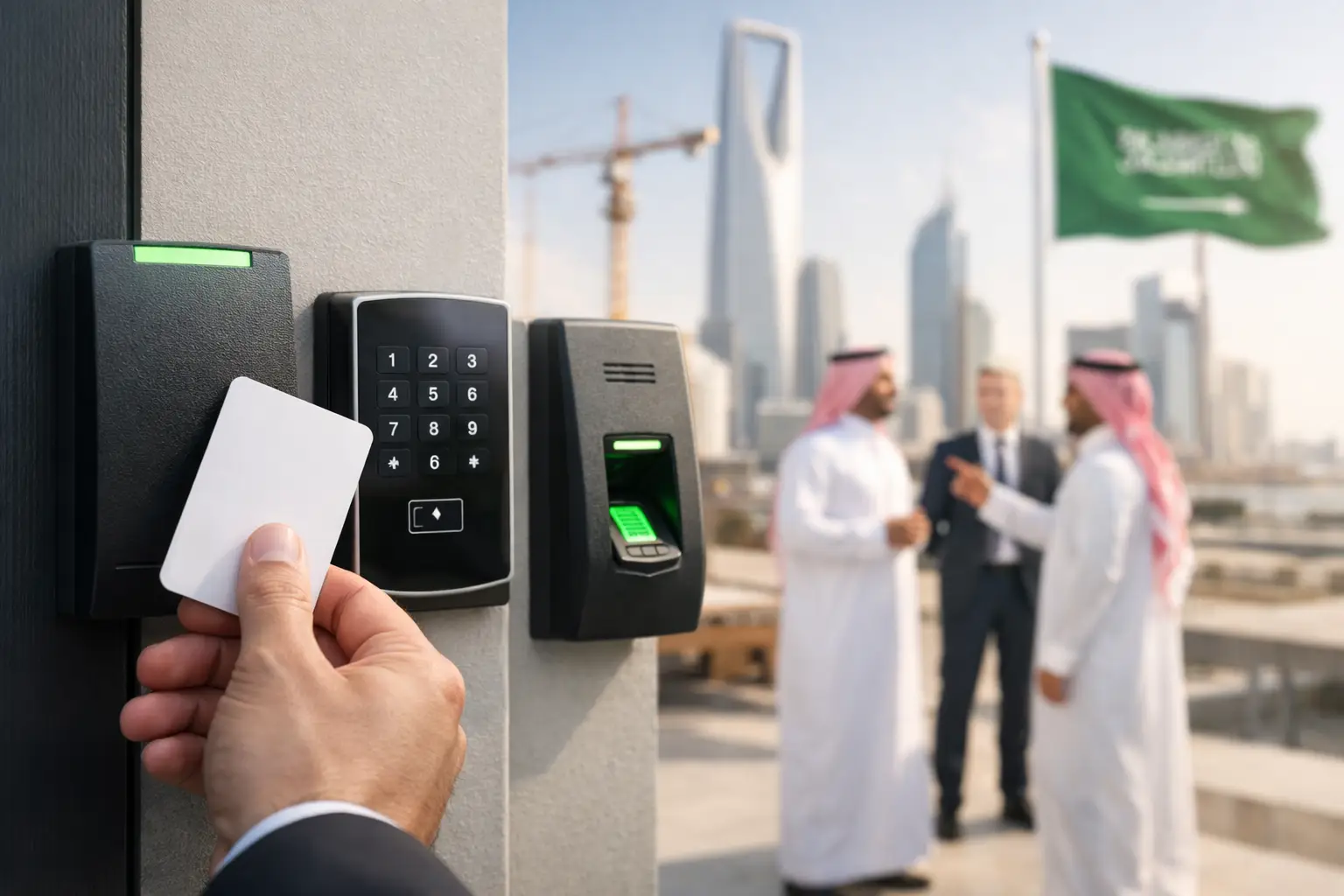
A search for an HID access control distributor Saudi usually begins when a specification has moved beyond basic door security. The project may require secure credentials for a government facility, mobile access for a corporate campus, or a reader platform that can remain relevant through expansion phases. In these cases, product authenticity, compatibility, local availability, and technical clarity matter as much as the reader mounted beside the door.
Seven Sectors supports Saudi system integrators, consultants, and procurement teams as an authorized local partner for HID access control solutions. From Jeddah, we supply HID solutions for projects across the Kingdom, including commercial developments, government sites, industrial facilities, and Vision 2030 infrastructure programs. Our role is to help project teams source the correct HID components with dependable channel support – not to replace the consultant, integrator, or commissioning team.
Why HID Access Control Fits Saudi Projects
HID, part of ASSA ABLOY, is specified globally where identity assurance and long-term credential strategy are central to physical security. A door reader is only one part of that strategy. The credential technology, controller architecture, enrollment process, access management software, and migration path all affect the final result.
For Saudi projects, this becomes especially relevant when a facility has multiple user groups and different risk profiles. A headquarters may need employee access, visitor access, contractor permissions, and privileged entry for critical rooms. A transport, utility, or government environment may require more stringent credential handling and clearly auditable access events. HID provides the reader and credential technologies that allow the broader access control platform to be selected around these operational requirements.
HID is also a practical choice for phased developments. A project does not always begin with every building, door, or user category defined. Specifying an adaptable reader platform helps consultants and integrators avoid unnecessarily early technology lock-in while maintaining a consistent access experience across later phases.
HID Signo Readers: A Practical Migration Platform
HID Signo readers are a core consideration for new projects and credential upgrade programs. The Signo range supports combinations of RFID credentials, NFC, and Bluetooth Low Energy communication for mobile credentials. This gives project teams options rather than forcing a single credential type across every door and user group.
Traditional physical cards remain appropriate in many environments. They are familiar, quick to issue, and can be managed effectively for large workforces. Mobile credentials can reduce the operational burden of card replacement and are particularly useful for staff populations that already rely on smartphones for daily workflow. The right decision depends on site policy, user behavior, cybersecurity requirements, and the access control software being used.
A mixed deployment is often the sensible route. An organization can retain cards for contractors, temporary labor, or users without managed mobile devices while issuing mobile credentials to employees and senior staff. HID Signo readers support this kind of transition, helping facilities modernize without requiring a disruptive all-at-once change.
Reader Selection Is More Than a Credential Decision
The reader must suit the door environment as well as the credential plan. Consultants should consider mounting location, indoor or exposed conditions, user throughput, door hardware, accessibility requirements, and the expected lifecycle of the facility. A reader at a high-volume employee entrance has different demands than one protecting a server room, electrical room, or controlled government archive.
For security-sensitive areas, the credential format should be assessed alongside the reader. Legacy proximity systems may be sufficient for some low-risk applications, but they are not automatically the best fit for every project. Smart cards and modern credential technologies can provide stronger options when the project requires higher assurance and a more controlled identity lifecycle.
The specification should also identify how readers connect to the selected panel and access control platform. Clear interface and compatibility requirements reduce procurement substitutions that can create avoidable integration work later. Seven Sectors can help procurement teams and integrators confirm the HID product references required before an order is released.
Smart Cards, Mobile Credentials, and Site Policy
Credential selection should begin with a site policy, not a preference for a particular form factor. The key question is what the facility needs to prove when a user requests entry. For some doors, the answer may simply be that an authorized employee is present. For more sensitive locations, the organization may need a credential that supports stronger protection, controlled issuance, or future expansion into multi-application use cases.
HID smart cards are relevant where organizations need a managed physical credential with defined security characteristics. They can be part of a structured card issuance approach for employees, contractors, and visitors. Mobile credentials are relevant where smartphone-based entry aligns with corporate policy and users can be enrolled and supported effectively.
There are trade-offs. Mobile access offers convenience, but it requires clear policies for device enrollment, replacement, and user support. Physical cards are operationally familiar, but they introduce printing, stock management, and replacement processes. The best Saudi access control projects make these decisions according to operational reality rather than treating either option as universally superior.
HID Access Control Partner Saudi Procurement Considerations
For tender and project procurement, specifying HID equipment by brand alone is not enough. The bill of quantities should distinguish readers, cards or mobile credential requirements, accessories, and any configuration or encoding requirements. This protects the project from receiving a technically incomplete package that looks correct on paper but cannot support the intended credential strategy.
Procurement teams should verify five points before approving supply:
- The exact HID reader model and supported credential technologies
- The card type, quantity, and any required card numbering or encoding details
- Compatibility with the selected access control controller and software platform
- Required accessories, mounting components, and door-specific interface requirements
- Lead time and phased-delivery needs for the construction schedule
For government and Vision 2030-related tenders, compliance documentation should be considered early rather than after the technical award. Requirements differ by client and project package. When NDAA or TAA compliance is part of the procurement condition, it must be checked against the specific equipment scope and tender requirement. A compliant security stack is a project-level outcome, not a label that should be assumed across unrelated products.
This is also where an authorized Saudi supply partner adds value. Direct product identification, clear commercial documentation, and realistic availability information help contractors maintain their schedule and protect consultants from late substitution requests. Seven Sectors works with project teams that need this discipline for single-site commercial orders as well as multi-phase Kingdom-wide programs.
Building the Physical Security Stack Around HID
HID access control does not operate in isolation. The door environment may also include video verification, intercom communication, network infrastructure, and centralized event management. The integration design remains the responsibility of the appointed system integrator and consultant, but the supply strategy should recognize the interfaces between these systems.
For example, Milesight AI cameras can provide visual coverage at entrances and perimeter approaches, while HID readers manage identity at controlled doors. AETEK PoE switches and extenders can support network connectivity for suitable PoE-powered devices across demanding cable runs, with AETEK H-series IP67 switches relevant for outdoor network infrastructure and D-series options suited to industrial conditions. These are separate product categories with different design rules, but sourcing them through a knowledgeable security partner can simplify coordination.
In larger command-center environments, ISS SecurOS can support video management and analytics workflows, while HID remains focused on the physical access layer. The value is not in forcing every system into one brand. It is in selecting compatible, properly specified technologies that let the integrator deliver the required operational workflow.
Source HID with Clear Project Support
A credible HID access control supply process starts with accurate project information: door count, reader locations, preferred credential method, controller and software environment, delivery schedule, and any tender compliance conditions. Sharing these details early allows the correct products to be identified before procurement pressure turns technical choices into last-minute substitutions.
For HID Signo readers, smart cards, and mobile credential requirements in Saudi Arabia, contact Seven Sectors at info@7sectors.com or submit your requirement through the website’s Get Quotation form for pricing and availability. Clear sourcing at the start gives the project team more control when the first door goes live.
Sourcing the right hardware is the next step — see our guide on how to source HID Signo readers for projects.
nnFrequently Asked Questions — HID Access Control for Saudi Projects
nnSeven Sectors supplies HID Signo readers — supporting NFC, Bluetooth, and RFID multi-technology credentials — along with HID Mobile Access credentials and HID smart cards. We serve system integrators, security consultants, and procurement teams on commercial, government, industrial, and Vision 2030 projects across the Kingdom from our Jeddah base.
Yes. HID Signo readers support simultaneous reading of legacy card formats (iCLASS, MIFARE, DESFire, and others) and HID Mobile Access via Bluetooth Low Energy and NFC. This allows a phased transition from physical cards to mobile credentials without replacing readers, which is cost-effective for large Saudi campuses and multi-phase Vision 2030 developments.
Government facilities, financial institutions, hospitals, corporate headquarters, transport hubs, and Vision 2030 giga-project facilities are the most common project types specifying HID. The combination of multi-technology credential support, audit trail capability, and ASSA ABLOY brand credibility makes HID a default specification on high-security and complex access environments.
HID, part of ASSA ABLOY, is not among the manufacturers restricted under NDAA Section 889. Seven Sectors can provide product documentation for inclusion in project compliance submissions. Confirm the specific NDAA or compliance requirement with your procurement or legal team, as project standards vary.
HID Signo reader and credential pricing depends on model, technology, and project volume. Seven Sectors does not publish list prices. Contact us with the number of openings, required reader models, credential types, and any compliance documentation needed — we will provide a project-specific quotation for your system integrator or procurement team.
Ready to discuss your project? Contact Seven Sectors or contact us directly on +966-012 229 3474.