
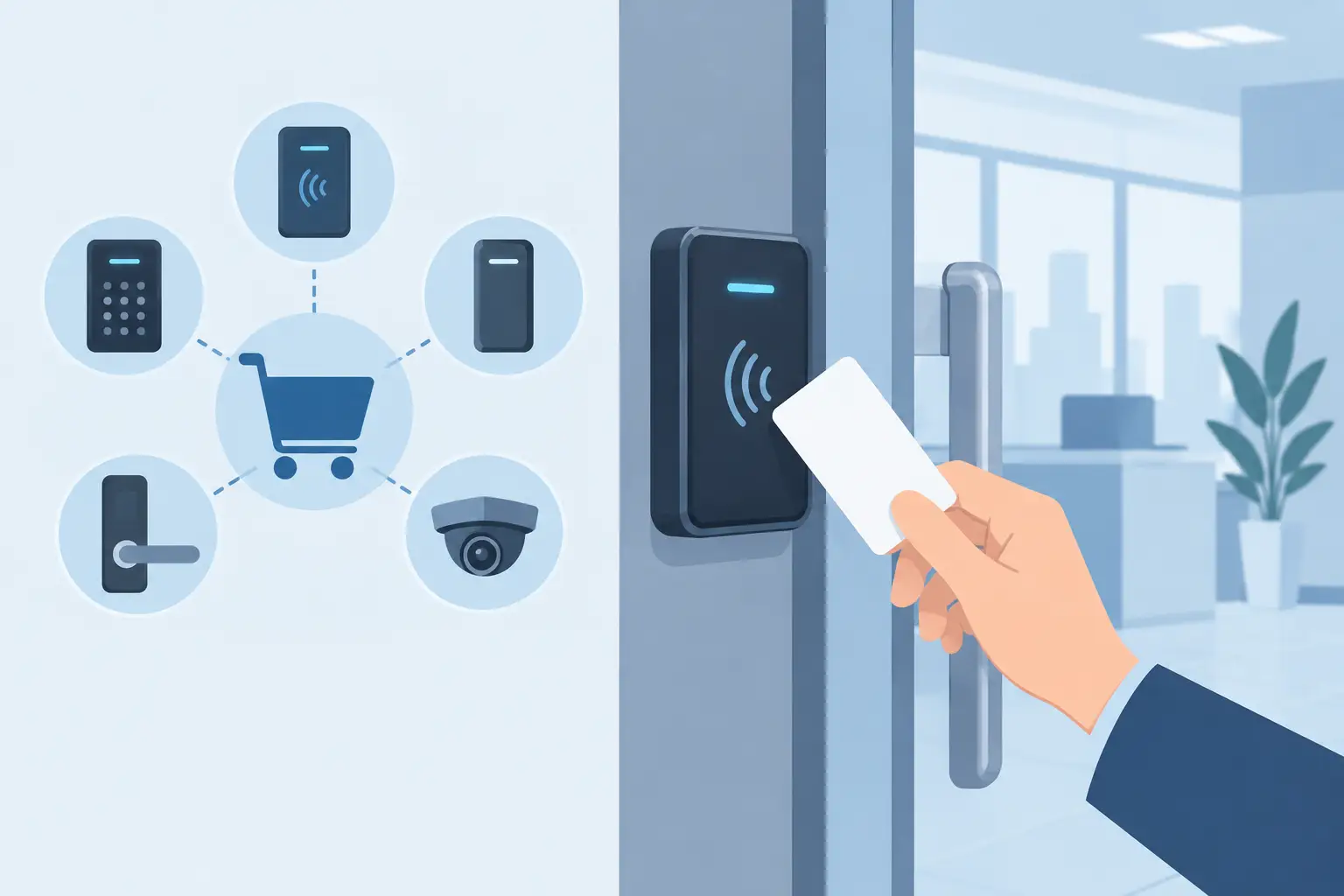
A reader may be a small line item in an access control BOQ, but the wrong selection can create a costly mismatch between credentials, controllers, door hardware, and site security policy. Knowing how to procure HID readers starts with confirming the access-control architecture already specified, then sourcing the correct reader and credential combination through an authorized HID partner.
For system integrators, consultants, MEP contractors, and government procurement teams, HID reader procurement is not simply a matter of matching a part number. HID access control products must support the project’s credential strategy, installation conditions, controller communications, and handover requirements. Seven Sectors Trading Co. supplies HID access-control hardware to support commercial, government, industrial, and major infrastructure projects across Saudi Arabia.
Start With the Credential Strategy
The first procurement question is not which reader looks suitable at the door. It is which credentials the end user will issue and manage throughout the life of the system.
A project may use physical cards, mobile credentials, key fobs, or a planned mix during a migration period. The reader must support the credential technology specified for the site. If the existing estate uses one credential format while a new phase is intended to use a more secure format, the procurement schedule may need readers that support both during transition.
This decision has long-term consequences. Replacing credentials across a large campus can involve enrollment effort, access-rights administration, and coordination with tenants, employees, contractors, or government personnel. A reader strategy that allows controlled migration can reduce disruption, but it must be confirmed against the controller and software environment rather than assumed.
Before requesting a quotation, establish whether the project is a new installation, an extension of an existing system, or a credential upgrade. Include the credential type, expected user population, number of controlled openings, and whether mobile access is part of the approved scope. These details allow the supply requirement to be reviewed accurately.
Confirm Reader-to-Controller Compatibility
A reader is one element of an access control chain. It must communicate correctly with the selected controller and align with the wiring approach, power arrangement, enclosure space, and project documentation.
Procurement teams should obtain the approved controller schedule before releasing HID reader quantities. Confirm the interface required between the reader and controller, along with any secure communications requirements defined by the consultant or authority. Do not substitute a reader based on appearance, mounting style, or a broadly similar description in a tender schedule.
Compatibility should also be checked at the system level. The credential, reader, controller, access control software, and enrollment process need to operate as one managed environment. If different phases are being supplied at different times, record the approved product references and credential approach so later orders do not introduce an unintended change.
For renovation projects, site verification is especially valuable. Existing cable routes, reader back boxes, mullion profiles, and door-frame conditions may affect what can be installed without rework. Seven Sectors supplies hardware only, but an integrator can use the approved product documentation to validate field conditions before placing the final order.
Match the Reader to the Opening Type
Not every controlled door needs the same reader form factor. Main entrances, turnstiles, parking barriers, internal office doors, server rooms, perimeter gates, and high-traffic staff entrances have different operational needs.
A narrow reader may suit a metal-framed door, while a wider unit may be appropriate where visibility, credential presentation, or mounting location requires it. Outdoor and perimeter applications need careful review of exposure, protective enclosures where specified, cable entry, and the physical environment. Doors in public-facing areas may also require a finish and mounting arrangement that fits the architectural package.
Reader selection should reflect how people actually move through the facility. A staff entrance with frequent peak-hour use may need a different approach from a restricted technical room where access is occasional but tightly controlled. The access-control design authority should determine the security policy. Procurement should then protect that policy by buying exactly to the approved schedule.
Define a Clear BOQ Before You Buy
A clean bill of quantities prevents ambiguity between the consultant, system integrator, procurement team, and supplier. A reader line should identify the approved manufacturer, exact model or series where available, credential compatibility, mounting type, finish if relevant, and required accessories.
It should also distinguish readers from related access-control items. Door projects frequently include controllers, power supplies, locking devices, request-to-exit devices, door contacts, break-glass units, enclosures, cards, fobs, and software licenses. Combining these into a vague “access control package” line makes it difficult to verify completeness and encourages avoidable substitutions.
For larger tenders, request a schedule that maps each reader quantity to a door group or building zone. This makes phased delivery easier to manage and helps the integrator identify missing items before installation begins. It is also useful when a project includes different security levels, such as public circulation areas, administration spaces, operations rooms, and restricted plant areas.
Buy Through an Authorized HID Partner
Authorized sourcing matters because access control is a managed security system, not a commodity purchase. Procurement teams need confidence that product identification is correct, documentation is traceable, and the hardware is supplied through a recognized channel.
An authorized HID partner can help review the requested references against the stated application and identify when a missing accessory, incompatible credential choice, or unclear model description needs clarification. This is particularly useful for government facilities and large contractor packages, where documentation discipline is as important as hardware availability.
When evaluating a supply partner, ask practical questions: Can they confirm the requested HID product reference? Can they distinguish reader hardware from credentials and accessories? Can they support phased project purchasing without changing the approved technical basis? Can they provide commercial documentation suitable for tender and procurement workflows?
The right answer is not always the lowest initial line-item cost. A reader that does not match the approved system can create commissioning delays, credential replacement costs, and disputes between packages. Correct sourcing protects the construction schedule and the end user’s operating model.
Plan Credentials and Readers as One Order
Reader procurement often fails when credentials are treated as a separate late-stage purchase. The project team may order reader hardware early, then discover later that the issued cards or mobile credential plan does not align with the selected technology.
Where physical credentials are in scope, define the card or fob requirements early. Consider who will hold credentials, whether visitor or contractor access is required, how lost credentials will be handled, and whether the site expects future expansion. For projects moving toward mobile access, confirm that mobile credential requirements are included in the access-control strategy, not left as an informal future option.
Security consultants should also define any credential separation needed across buildings or tenant areas. Integrators can then ensure the hardware schedule supports the approved access rules without creating unnecessary operational complexity.
Review Submittals Before Releasing the Purchase Order
The final technical review should compare the proposed HID readers against the approved specification, drawings, door schedule, and controller schedule. This is where small discrepancies are caught before they become site issues.
Check quantities by door, reader mounting location, credential compatibility, controller interface, and required ancillary items. Confirm whether each opening needs entry-only control or reader coverage on both sides. Review any phased construction plan so reader types and credential technologies remain consistent between early works and later packages.
Keep approved submittals, quotation references, and purchase-order descriptions aligned. If a revision is necessary, record why it was made and obtain approval through the project’s normal technical process. Access control is security infrastructure, so undocumented substitutions should never be treated as routine procurement changes.
FAQ: Procuring HID Readers
Can HID readers be added to an existing access control system?
They may be, but compatibility must be confirmed with the existing controller, credential technology, and software environment. An extension project should begin with a documented survey of the installed system and approved product references.
Should credentials be ordered with the readers?
Usually, yes. Ordering them as one coordinated package helps confirm that the credential technology matches the readers and supports the project’s enrollment and handover plan.
What should a quotation request include?
Provide the reader model or approved series, quantity, credential requirement, mounting application, project phase, and any related controller or credential requirements. Include the relevant BOQ and door schedule when available.
A well-procured HID reader package gives the installation team a clear, approved path from door schedule to credential issuance. For HID access-control hardware sourcing in Saudi Arabia, send your BOQ or approved specification to info@7sectors.com or submit a Get Quotation request for a focused supply review.
Ready to discuss your project? Contact Seven Sectors or contact us directly on +966-012 229 3474.