
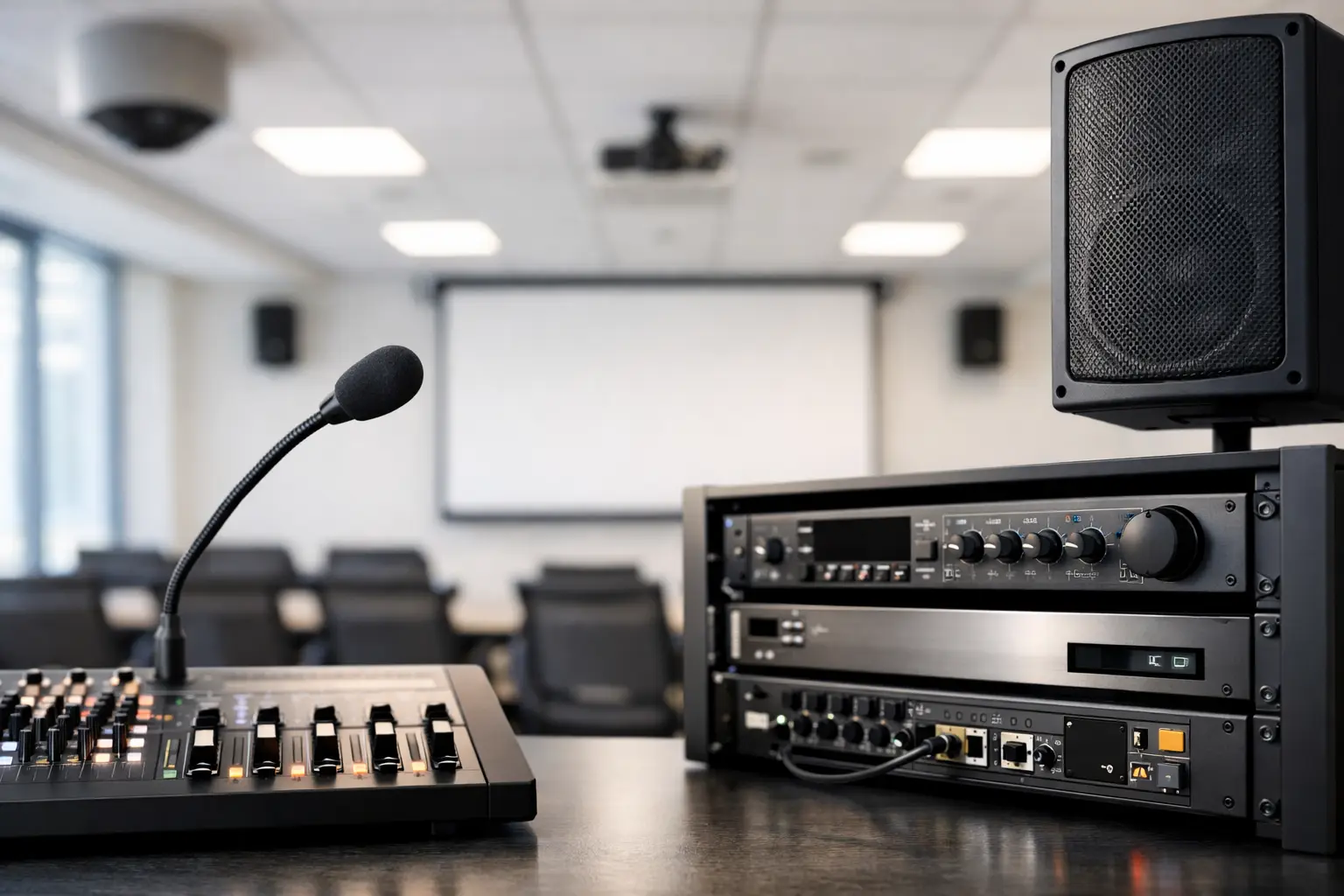
Start with the application, not the catalog
The first decision is simple: what is the PA system expected to do on this project? In practice, most tenders mix several objectives. One site may need routine announcements, background music in public zones, high-SPL paging in external areas, and emergency voice messaging integration. A theater or multipurpose hall may also need performance reinforcement, mixing flexibility, and acoustic tuning. A stadium adds another layer with long throw coverage, weather exposure, and delayed speaker zones.If the application is speech-first, intelligibility should lead the specification. For transport hubs, campuses, warehouses, government buildings, and industrial sites, the system must deliver clear voice reproduction under noisy conditions. That pushes selection toward the correct horn speakers, column speakers, ceiling speakers, or wall-mount units based on coverage pattern and ambient sound pressure.If the application is performance-first, the conversation changes. ITC KS and KF line arrays, digital mixers, DSP processing, and more capable amplifier platforms become more relevant. In those projects, even small mistakes in coverage modeling or amplifier headroom will be obvious once the room is occupied.How to select ITC PA systems by site type
A ceiling speaker layout that works in an office corridor will not work in a stadium concourse, and a stadium speaker package is the wrong answer for a mosque annex, school, or municipal building. The practical starting point is matching ITC equipment families to the physical environment.For offices, schools, clinics, retail interiors, and hospitality common areas, distributed 70V/100V speaker systems are often the most efficient option. They simplify long cable runs and zoning while keeping amplifier sizing manageable. ITC ceiling and wall-mount speakers fit this type of project well when the requirement is even voice coverage and moderate background audio.In factories, yards, logistics depots, and high-noise external zones, projector speakers and horn speakers are often a better fit. They provide stronger projection and improved intelligibility over distance, but the trade-off is tonal quality. If background music quality matters, horn-loaded designs may not satisfy the expectation on their own.When it comes to stadiums, arenas, and large event spaces, line array design matters far more than raw power figures on a datasheet. ITC KS and KF line arrays, supported by the right amplification and DSP, are better suited where the project demands controlled directivity and predictable coverage across large audience areas. In these cases, system prediction and delay strategy are not optional.Meanwhile, in boardrooms, council chambers, and conference venues, the PA layer may need to work with a broader AV signal chain. ITC conference systems, digital mixers, wireless microphones, and DSP platforms allow tighter control of feedback management, source routing, echo handling, and operator workflow.Amplifiers, DSP, and network audio are where many specs go wrong
When buyers focus only on speakers, the system usually ends up compromised. Amplifier selection affects stability, headroom, expansion, and fault tolerance. ITC offers several amplifier categories, including TC, DSP, Dante, and KT series options, and each has a different role depending on the project.A conventional amplifier approach may be enough for a smaller school, office building, or retail site with straightforward paging zones. But once the project includes many zones, centralized control, audio routing logic, or future expansion, DSP-based architecture becomes the safer choice. You get more precise signal management, better system tuning, and cleaner handling of multiple input priorities.Dante support matters when the site is large, distributed, or already designed around networked AV. In campuses, convention facilities, control rooms, and transport environments, Dante can reduce the limitations of long analog audio paths and give consultants more flexibility in routing. The trade-off is that the network design must be treated seriously. If the switching environment is poorly planned, audio performance suffers no matter how good the loudspeakers are.That network layer is where infrastructure decisions become relevant. AETEK, as a PoE switching and network infrastructure brand, is not part of the PA endpoint category, but on converged AV and security projects, the quality of the network backbone still affects system performance. For mixed environments carrying control, audio, surveillance, and access traffic, infrastructure planning should be aligned from the start.Coverage and intelligibility matter more than wattage
One common tender mistake is specifying speakers by power only. A 30W or 50W label tells you very little without knowing ceiling height, mounting position, dispersion, reverberation, and background noise. In practical terms, speech clarity depends more on placement, pattern control, and zoning than on inflated power margins.In reflective spaces such as terminals, atriums, and large lobbies, fewer loud speakers with poor placement can create worse intelligibility than a denser distributed design at lower output. Across outdoor sites, wind, distance, and environmental noise can force a different approach entirely. That is why ITC PA system selection should always consider acoustic behavior, not just equipment count.For consultant teams, this is where early coordination pays off. Ceiling type, cable routing, mounting height, and architectural finishes all affect the final result. If speaker selection happens after MEP coordination is locked, compromises usually follow.Select for control logic and emergency priorities
Many projects in Saudi Arabia require more than routine paging. Government, education, healthcare, transport, and major public venues often need priority-based messaging, zone selection, scheduled playback, and integration with fire alarm or emergency communication workflows. That changes the specification significantly.When evaluating how to select ITC PA systems, ask how many independent zones the site needs and who controls them. Then confirm what message priority applies and whether the system must support manual override or prerecorded trigger events. A simple amplifier and speaker package cannot solve those requirements cleanly without the right controller and DSP layer.It also helps to think about operations after handover. A technically capable system can still be a poor choice if daily users find the control interface confusing. Procurement teams should balance feature depth with practical operation, especially on municipal and institutional projects with rotating staff.Compliance, project standards, and source credibility
For public sector and Vision 2030-led procurement, source credibility matters almost as much as technical fit. Buyers increasingly need confidence that the brand is genuine, the supply channel is verified, and project support is available locally. That is especially important on phased developments where matching future supply with original specification is critical.Where compliance frameworks apply across the wider project stack, decision-makers also tend to prefer working with authorized partners. Those partners understand NDAA and TAA implications for adjacent systems such as surveillance, networking, storage, and access control. On mixed-scope developments, that coordination matters. A project may combine ITC PA, Milesight AI cameras, HID access control, and infrastructure or storage from AETEK, Rasilient, FIBRENETIX, or Dell. Even when PA is the primary package, buyers still benefit from a partner who understands the full technical environment.Don’t overspecify features you will never use
There is a commercial risk in buying too little, but there is also a project risk in buying too much. A Dante-ready, DSP-heavy, performance-capable architecture is not automatically the right answer for every school, mosque annex, warehouse, or office block. If the site only needs reliable zoned announcements and basic source playback, a simpler design may be the better procurement decision.The same applies to speaker grade. Premium array performance makes sense in stadiums, theaters, and large assembly spaces. It rarely makes sense for back-of-house paging or utility buildings. Good selection means paying for the functions the site will actually use.For Saudi project teams, the most reliable path is to define the environment, the use case, the zone strategy, and the control requirement before locking product families. ITC gives enough range to serve everything from distributed commercial paging to stadium-grade reinforcement, but the brand delivers its best results when the selection stays disciplined.Seven Sectors supports consultants, integrators, and procurement teams that need an authorized Saudi partner for ITC and adjacent project technologies. If your next tender includes campus audio, public paging, conference spaces, or large venue sound, the smartest first step is to treat PA selection as a system decision, not a speaker purchase.For a concrete example of zone amplification in practice, see how the ITC TI-5006S zone amplifier is deployed in Saudi mosque installations.
For a large venue — stadium, airport, mall, or conference centre — the key considerations are coverage uniformity, speech intelligibility (measured as STI/STIPA), system zoning for independent announcements, power redundancy, and integration with emergency broadcast (EVAC). ITC PA systems are engineered for these requirements, with Dante networking enabling flexible, fault-tolerant audio distribution.
ITC offers a professional audio portfolio covering DSP amplifiers, TC/KT series amplifiers, KS and KF line array speakers, ceiling and pendant speakers, conference systems, digital mixers, wireless microphones, and Ease Immersive spatial audio technology. This covers venues from small conference rooms through to 60,000-seat stadiums and large outdoor sites.
Yes. ITC KS and KF line arrays are engineered for high-SPL outdoor and stadium applications, with weather-resistant enclosures and wide horizontal dispersion suited to large crowds. ITC systems have been specified on stadium and large venue projects. Seven Sectors supplies ITC to Saudi system integrators serving sports, entertainment, and infrastructure clients.
Dante is an IP-based audio networking standard that carries high-quality, low-latency audio over standard Ethernet infrastructure. ITC DSP amplifiers and Dante-enabled devices connect to the same network as IT equipment, eliminating analogue cabling runs. This simplifies large-venue installs, reduces cost, and allows remote management of audio routing from a single software interface.
Seven Sectors is the authorized ITC partner in Saudi Arabia, supplying PA systems to system integrators, MEP contractors, and project consultants. Contact us with your venue type, capacity, and coverage requirements to receive a technical recommendation and project quote.
Ready to discuss your project? Contact Seven Sectors or contact us directly on +966-012 229 3474.