A surveillance project usually fails long before the first camera goes live. The weak point is often the video management system vms software – the layer that decides how video is recorded, searched, displayed, secured, and scaled. For system integrators, consultants, and procurement teams, that choice affects everything from camera compatibility to storage sizing, operator workflow, and long-term expansion.
In Saudi projects, this decision has become more demanding. Government facilities, transport sites, border infrastructure, industrial zones, and Vision 2030 developments are not buying a basic recorder with a few camera licenses. They are specifying enterprise surveillance platforms that can support AI analytics, cyber policy requirements, evidence retention rules, and multi-site operations. That is why teams should treat the VMS as core infrastructure, not a software line item.
What video management system VMS software actually does
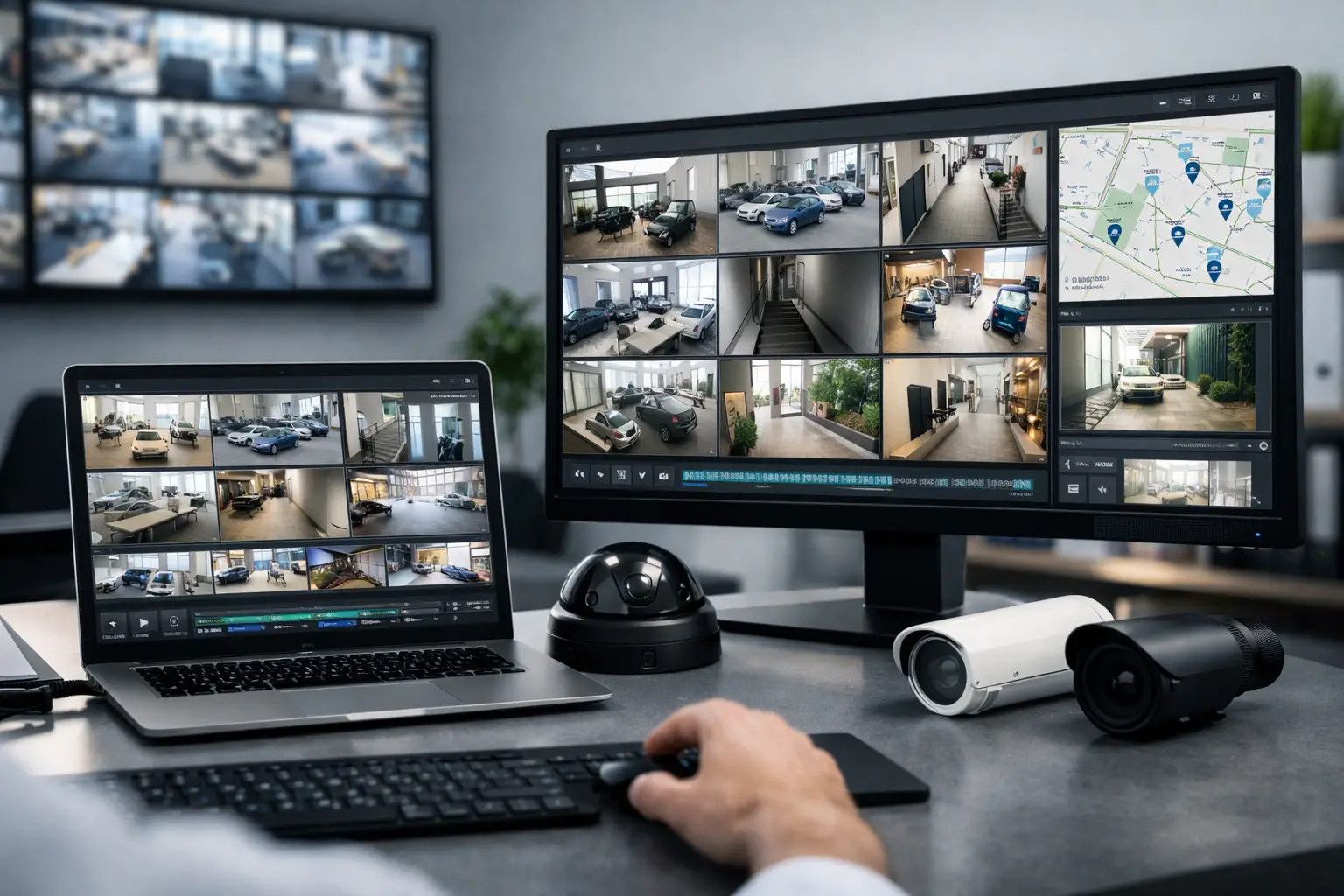
At a practical level, a VMS connects field devices, recording servers, operators, and archived evidence into one operating environment. It receives video streams from cameras, manages recording rules, controls user permissions. It also handles alarms and provides the client interface for live view, playback, export, and investigation.
The difference between entry-level and enterprise-grade platforms becomes clear when the camera count rises, the sites multiply, or the security policy gets stricter. In a warehouse, a simple setup may be enough.
In a city surveillance project, an airport perimeter, or a government command center, the stakes rise. The VMS must coordinate thousands of streams, different user roles, failover logic, and analytics events without creating delays for operators.
This is where ISS SecurOS stands out. ISS has deployments across more than 50 countries and supports very large environments, with the platform used in systems exceeding 7 million cameras globally. For Middle East customers, that matters because scale is not theoretical. Saudi projects often start with one package and then expand in phases, sometimes across regions and multiple command centers.
Why the VMS choice affects the full surveillance stack
A VMS is never selected in isolation. It shapes how well the rest of the system performs.
Take cameras first. If the project uses Milesight AI cameras, the VMS should not reduce them to simple video sources. Milesight models bring value through functions such as intelligent event detection, TrueColor AI imaging, strong low-light performance down to 0.002 Lux on certain models, and wide dynamic range up to 140 dB WDR in relevant series. If the VMS cannot ingest events properly, classify them well, or present them in a useful operator workflow, part of that investment is wasted.
The same applies to networking. AETEK is not a camera brand – it is PoE infrastructure built for surveillance transport. In real projects, switch selection affects camera uptime, distance, enclosure design, and outdoor survivability. AETEK H-series outdoor switches with IP67 protection, C-series indoor models, D-series industrial models, Ceiling PoE Switches, and PoE Extenders supporting up to 250 meters all influence how video reaches the VMS reliably.
If the network edge is unstable, the software cannot compensate for dropped connectivity.
Storage and compute also sit directly under the VMS decision. Enterprise platforms need properly matched recording servers, archive storage, and retention planning. Rasilient provides surveillance servers and forensic storage with NFD – No Frames Dropped – architecture. That is especially relevant in government, oil and gas, and smart city environments where missing footage creates operational and legal exposure. FIBRENETIX and Dell infrastructure can also support VMS environments. However, the sizing logic should always reflect real stream parameters, retention days, redundancy requirements, and analytics load, not rough camera-count assumptions.
What to evaluate before you specify a VMS
The first question is not feature count. It is operational fit. A VMS for a campus, a logistics facility, and a national infrastructure site may all record video, but they do not share the same demands.
Scalability and architecture
Ask whether the software can grow from the initial phase to the full project scope without major redesign. Some platforms are acceptable at 64 cameras and painful at 600. Others target distributed architecture from the start. ISS SecurOS Professional, Premium, Enterprise, and MCC give a path from smaller systems to multi-site command-and-control environments, which is useful when projects are tendered in stages.
Analytics integration
Analytics should be part of the operating logic, not a disconnected add-on. If the project requires license plate recognition, facial recognition, or behavior analysis, the VMS needs to manage those events in a way that supports response, search, and audit trails.
ISS is strong here, especially where advanced analytics are central to the project rather than optional extras.
Compliance requirements
For many Saudi public-sector and strategic projects, NDAA and sometimes TAA considerations are no longer secondary. Compliance affects brand selection, tender approval, and long-term risk. That is one reason ISS, Milesight, and AETEK are relevant in serious project discussions. NDAA-compliant components give consultants and procurement teams a clearer path when end users require trusted supply chains.
Operator workflow
A crowded user interface slows response. Good VMS software helps operators prioritize alarms, move quickly through playback, control PTZ cameras efficiently, and export evidence without confusion. This becomes even more important in central monitoring environments where one team may be managing perimeter alarms, traffic events, access incidents, and forensic review at the same time.
Cybersecurity and permissions
User roles, audit records, encryption support, and segmented architecture matter. In government and enterprise environments, the VMS is part of the security posture, not just an operations tool. Procurement teams should ask how the platform authenticates users, how it logs events, and how it handles distributed administration across multiple sites.
Where ISS SecurOS fits best
ISS SecurOS is not the right answer for every project simply because it has advanced capabilities. In smaller commercial systems with limited analytic needs, a lighter platform may be enough. But when the brief includes command center visibility, automated incident detection, LPR, facial recognition, or large-scale multi-site management, ISS belongs on the shortlist immediately.
That is especially true in Saudi deployments tied to border security, transport, municipal surveillance, industrial operations, and high-security government sites.
ISS has a strong regional track record, including Saudi border deployments, which gives consultants and integrators more confidence than a platform that looks good on paper but lacks proven performance in similar environments.
Another advantage is the ability to build around the VMS with the right surrounding brands. A practical example would be Milesight AI cameras at the edge, AETEK PoE switching for stable field connectivity, ISS SecurOS for management and analytics, and Rasilient or Dell-backed server infrastructure for recording and archive performance. That kind of stack makes sense because each layer has a defined role.
The trade-offs procurement teams should watch
More capability usually means more planning. An enterprise VMS can support advanced features, but it also requires disciplined design from the integrator and realistic expectations from the client. Server resources, storage throughput, failover design, and licensing structure all need to be understood early.
There is also the question of who will actually use the advanced functions. If facial recognition or behavior analytics appear in the spec but the end user has no policy, staffing, or legal framework around them, the project may end up carrying expensive features with limited operational value.
The better approach is to match the platform to the use case and planned workflows.
Multi-brand compatibility is another area where assumptions can cause problems. A VMS may technically support a wide range of cameras, but support depth varies. Basic streaming is not the same as full event integration, metadata handling, PTZ control depth, or health monitoring. That is why pre-sales validation matters.
Why authorized local distribution matters
In this category, product access is only one part of the job. Integrators and consultants also need specification support, compliance clarity, and confidence that the supply chain is legitimate. For NDAA-sensitive projects and Vision 2030 procurement environments, that matters as much as the software feature set.
Seven Sectors operates as the authorized Saudi distributor for brands including ISS, Milesight, and AETEK, serving integrators and procurement teams that need dependable product sourcing for serious projects. That distributor role is important because surveillance platforms are rarely procured alone. They are part of a wider package involving cameras, PoE switching, storage, servers, access control, body-worn systems, and often PA or command-center infrastructure.
A trusted channel partner helps align those pieces before the project reaches a costly mismatch. That may involve clarifying whether Milesight LPR Pro Bullet Plus Camera models suit the road layout, whether AETEK PoE Extenders are required for 250-meter runs, or whether Rasilient NFD architecture is more suitable than general-purpose storage for evidence-critical environments.
The best video systems are not the ones with the longest datasheet. They are the ones that keep working under pressure, support the operator instead of slowing them down, and still make sense when the project grows from one site to ten. That is the standard video management system VMS software should meet before it is written into any serious specification.
VMS software is the platform that collects, manages, and presents video streams from IP cameras across a site or network of sites. It handles live viewing, recording, search, and playback, and acts as the integration layer for analytics, access control, and alarm management. Modern enterprise VMS platforms like ISS SecurOS scale from dozens to tens of thousands of cameras.
Free or entry-level VMS platforms cap camera counts, lack enterprise integrations, and offer no technical support or SLA. Enterprise VMS like ISS SecurOS provides unlimited scalability, redundant server architecture, AI analytics modules, and formal support agreements — critical for Saudi projects where downtime has operational or contractual consequences.
Entry-level VMS platforms typically support up to 64 cameras. Enterprise VMS platforms like ISS SecurOS handle thousands of cameras across distributed server clusters, making them suitable for giga-project scale deployments like NEOM, Red Sea, or Saudi Aramco facilities. Camera count scales with server hardware and licensing.
Yes. Enterprise VMS platforms integrate with HID access control, intrusion detection, and building management systems to correlate video with access events. For example, an access denial at an HID Signo reader can trigger automatic camera review in ISS SecurOS — giving security teams full context without manual searches.
ISS SecurOS is a proven enterprise VMS with deployments on Saudi border infrastructure and across the Middle East. It offers SecurOS Professional, Premium, Enterprise, and MCC editions to match project scale. Seven Sectors is the authorized ISS partner in Saudi Arabia — contact us to discuss which edition fits your project.
Ready to discuss your project? Contact Seven Sectors or contact us directly on +966-012 229 3474.