
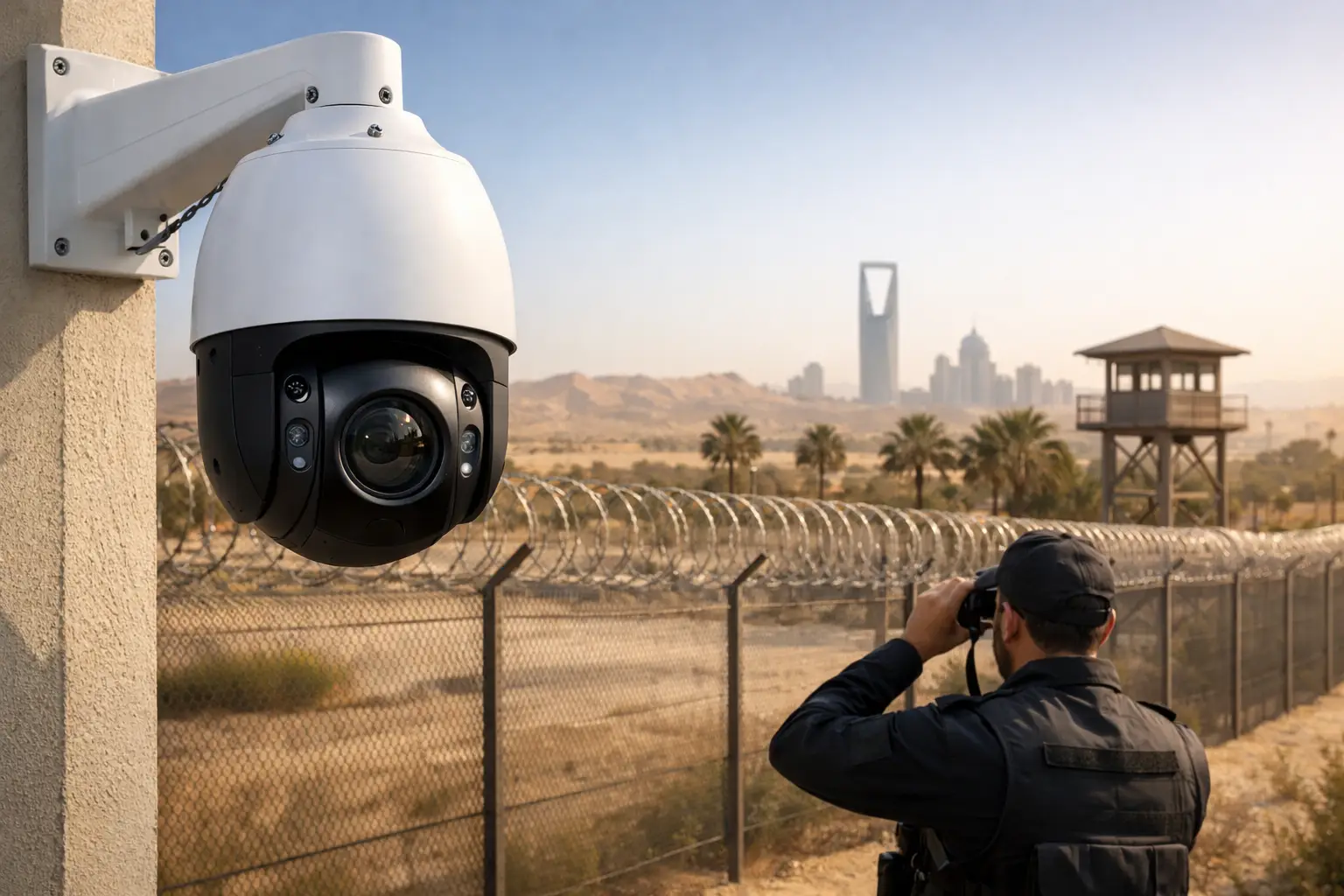
A Milesight PTZ camera with 23x zoom, auto tracking, and perimeter coverage in Saudi Arabia is specified for one reason: a fixed camera can detect an event, but it cannot follow it across a long boundary, access road, yard, or restricted zone. For industrial facilities, government sites, logistics compounds, and Vision 2030 project packages, the PTZ must provide usable identification detail while maintaining reliable, alarm-driven operation.
Milesight PTZ cameras are a strong fit where a security design requires long-range optical coverage, AI-assisted tracking, and a compliance-conscious product selection. The correct result, however, depends on camera placement, scene design, network capacity, and the relationship between the PTZ and the fixed cameras that trigger or verify alarms.
Why 23X Optical Zoom Matters on a Perimeter
A 23X optical zoom PTZ is not simply a camera that sees farther. It gives the operator a way to move from broad situational awareness to a closer view of a person, vehicle, gate, or incident location without relying on digital enlargement. Optical zoom preserves useful image detail as the lens narrows its field of view, which is essential when the control room needs to verify an alarm rather than merely observe movement.
This is particularly relevant on Saudi sites with long fence lines, wide vehicle approaches, laydown yards, utility corridors, and large external parking areas. A PTZ installed at a strategic elevation can cover multiple zones through presets and patrol routes. When an alarm occurs, the camera can move to the relevant preset or track the target, giving operators a closer view before dispatching security personnel.
The trade-off is straightforward. High zoom narrows the scene. A 23X PTZ cannot replace fixed overview cameras because it can only look in one direction at a time. A well-considered perimeter design therefore uses Milesight fixed AI cameras for continuous scene coverage and positions the Milesight PTZ as the active verification and follow-up camera.
Optical zoom is only one part of identification
Lens performance must be considered alongside mounting height, target distance, illumination, weather conditions, and the required recognition objective. A camera may technically see a target at a distance while still not delivering enough facial, vehicle, or operational detail for the project requirement. Consultants should define the desired outcome at the design stage: detection, observation, recognition, or identification.
Milesight AI camera technologies, including low-light capabilities such as TrueColor AI on applicable models, can support difficult outdoor scenes. Yet no camera specification removes the need to evaluate glare from vehicle headlights, directional sunlight, dust, reflective surfaces, and lighting transitions at gates and perimeter roads.
Auto Tracking Should Follow a Verified Event
Auto tracking is most valuable when it is driven by a meaningful event. For perimeter applications, the goal is not to make the PTZ chase every moving object. The goal is to direct attention to a person or vehicle entering a defined area, crossing a line, approaching a gate outside approved procedures, or remaining in a restricted zone.
Milesight AI analytics can help distinguish people and vehicles from less relevant motion. This matters in open environments where wind-blown vegetation, shadows, animals, rain, or lighting changes can create unnecessary alerts. Milesight states that its AI false-alarm filtering can reduce false alarms by up to 95 percent in applicable analytics scenarios, but the actual result depends on calibration, camera angle, and the site environment.
For a 23X PTZ, auto tracking should be configured with practical limits. The camera needs exclusion zones so it does not follow traffic outside the protected boundary. It also needs a return-to-home position or preset behavior so that it resumes its intended coverage after the tracked event ends. Without these controls, a PTZ can remain focused on a low-priority target while another area is left unobserved.
Use fixed cameras to protect the PTZ’s blind time
The strongest layout pairs the PTZ with fixed Milesight cameras covering critical sectors continuously. Fixed cameras detect and record activity even when the PTZ is following another target or moving between presets. They also provide the contextual view needed to understand how an event started and whether additional persons or vehicles are involved.
This approach is especially useful at vehicle entrances, warehouse compounds, substations, ports, construction logistics areas, and government campuses. The fixed camera establishes the event. The PTZ gives the operator a closer, active view. The VMS records both perspectives as part of the same incident workflow.
Designing Milesight PTZ Coverage for Saudi Conditions
Saudi Arabia presents conditions that should be addressed in the bill of materials and technical submittal, not after installation. Outdoor cameras may face high ambient temperatures, direct sun exposure, airborne dust, humidity in coastal cities, and large differences between daytime and nighttime lighting. The selected Milesight PTZ model and enclosure rating should be checked against the project’s environmental requirements and approved installation location.
Mounting position is equally important. A PTZ mounted too low may lose targets behind parked vehicles, walls, or landscaping. One mounted too high may have a poor angle for identification at the intended distance. Pole vibration, structural movement, and unsuitable brackets can also reduce the value of high optical zoom because minor movement becomes more visible at long focal lengths.
For sites near Jeddah, Yanbu, Dammam, Al Khobar, or other coastal areas, corrosion exposure deserves attention. For inland and desert locations, dust management and routine cleaning access should be considered. The procurement team should ask the integrator to document the proposed camera locations, target distances, preset scenes, and the operational purpose of each PTZ rather than approving a generic coverage statement.
Network and Storage Are Part of PTZ Performance
A 23X PTZ is an active IP endpoint. It requires dependable PoE network infrastructure, appropriate uplink capacity, and storage sized for the intended resolution, frame rate, retention period, and recording policy. Power sizing must account for PTZ movement and any applicable heater, fan, or IR functions listed for the selected camera model.
AETEK supplies PoE infrastructure, not cameras, and is relevant here because perimeter camera networks often require outdoor-rated switching and long cable paths. AETEK H-series outdoor PoE switches provide IP67 protection for suitable field deployments, while PoE extenders can support distances up to 250 meters where the network design permits. Final power budget, cable route, surge protection, and fiber uplink requirements should be calculated by the system integrator.
For larger deployments, the Milesight PTZ should be connected to a VMS that can manage alarms, presets, operators, recorded video, and evidence retrieval. ISS SecurOS can be considered where an enterprise VMS environment requires centralized monitoring and analytics integration. Storage should be selected for the recording workload, with options such as Rasilient forensic storage, FIBRENETIX surveillance servers, or Dell PowerEdge and PowerVault infrastructure depending on the approved architecture.
Compliance and Tender Documentation
Government, critical infrastructure, and giga-project tenders increasingly demand traceable product selection. Milesight cameras are NDAA-compliant, making them relevant to projects where supply-chain and compliance requirements are part of the technical evaluation. Where TAA compliance is mandatory, procurement teams should confirm the exact model, country-of-origin documentation, and tender requirement before finalizing the submittal.
A credible PTZ submittal should identify the precise Milesight model, optical zoom range, resolution, environmental rating, analytics capabilities, power method, mounting accessories, warranty terms, and VMS compatibility. It should also explain how auto tracking will operate in the specified scene. Claims such as “full perimeter coverage” are not enough without a coverage drawing, target-distance assessment, and defined alarm logic.
For contractors working on NEOM, the Red Sea Project, Qiddiya, Diriyah, KAEC, or major public-sector facilities, this documentation reduces avoidable review cycles. It also helps protect the project from last-minute substitutions that affect compliance, supportability, or system performance.
Where a 23X PTZ Is the Right Choice
Milesight 23X PTZ cameras are best suited to locations where targets move across a broad area and operators need a closer view after an alarm. They are less appropriate as the only cameras in a dense, multi-directional scene, or where an unbroken evidential view of every location is mandatory. In those cases, multiple fixed cameras, panoramic coverage, or additional PTZ positions may be the better answer.
The practical question is not whether a PTZ has auto tracking. It is whether the camera, analytics, network, VMS, and operator workflow work together to turn a perimeter alert into a verified response. Seven Sectors supports Saudi system integrators and procurement teams as an authorized partner for Milesight, helping ensure the selected PTZ solution is aligned with the project’s technical and compliance requirements.
For zone-level occupancy alongside PTZ tracking, see the VS126 ultra high-mount people counter and the VS361 storefront footfall sensor.
See also the VS340/VS341 desk and seat occupancy sensor and VS330 bathroom occupancy sensor for indoor space analytics.
Ready to discuss your project? Contact Seven Sectors or contact us directly on +966-012 229 3474.