
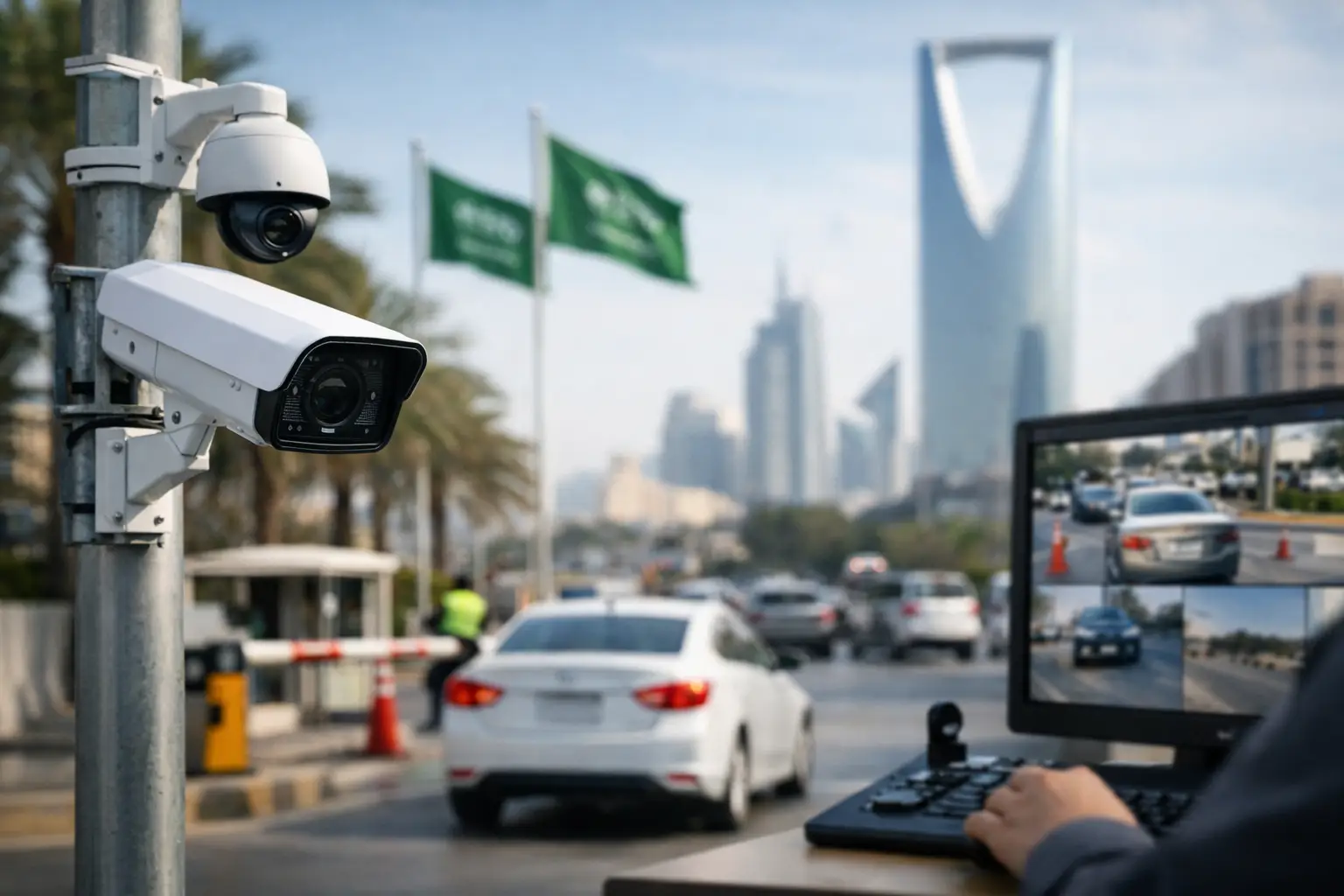
A vehicle can pass a gate in less than two seconds. If the plate is blurred by headlight glare, mounted at the wrong angle, or captured outside the camera’s designed recognition range, the project has video but no usable vehicle identity. This Milesight LPR guide focuses on the decisions that determine whether license plate recognition becomes dependable operational evidence for Saudi commercial, government, industrial, and infrastructure sites.
Milesight LPR Pro Bullet Plus Camera is purpose-built for vehicle identification applications rather than general scene monitoring. For system integrators and consultants, that distinction matters. A wide overview camera may show a vehicle entering a facility, but LPR performance depends on controlled capture conditions, readable plate pixels, shutter behavior, illumination, and a clearly defined lane.
Start With the LPR Objective, Not the Camera
The first specification question is not megapixels. It is what the site needs the system to do after a plate is captured. A logistics yard may need a searchable record of every truck entering and leaving. A government facility may require allowlist and blocklist alerts at controlled gates. A large campus may need plate events correlated with access control, guard activity, and video evidence in a VMS.
These uses demand different rules, retention periods, and integrations, but they share one requirement: the camera must be installed for identification at the capture point. LPR should therefore be treated as a dedicated lane-based function. It can complement overview cameras, PTZ coverage, and perimeter analytics, but it should not be expected to replace them.
For Saudi projects, consultants should also confirm the plate formats, vehicle types, and traffic patterns expected at each entrance. A staff-car lane, a visitor lane, and a truck gate can have very different vehicle speeds, approach angles, mounting constraints, and nighttime lighting conditions. One camera position rarely delivers the same result across all three.
Milesight LPR Guide: Build the Capture Zone First
Recognition accuracy begins with image quality at the plate, not with software settings. Before selecting the final mounting point, define a capture zone where the vehicle is expected to slow, align, and pass consistently. Barriers, road markings, islands, speed humps, and gate geometry often influence LPR performance as much as the camera specification.
Control distance, angle, and lane width
The Milesight LPR Pro Bullet Plus Camera should be matched to the required capture distance and field of view. A camera that is too wide may include the entire roadway but leave the plate too small in the image. A camera framed too tightly may miss vehicles that drift within a broad lane or approach off-center.
Horizontal and vertical viewing angles need equal attention. Excessive side angle distorts plate characters, while a steep downward angle can make reflective plates difficult to read. The practical target is a controlled, single-lane view that keeps the rear or front plate within the camera’s recognition area throughout the expected point of capture.
Vehicle speed is another design constraint. At low-speed barriers and guard gates, the available capture window is generous. At free-flow entrances, internal roads, or industrial yards, motion becomes more demanding. The shutter must stop vehicle and plate motion without producing an image that is too dark for recognition. This is why an LPR camera should not simply inherit the exposure settings of a general surveillance camera.
Plan for the night scene, not only the daytime test
Saudi daylight can create deep shadows, reflective vehicle surfaces, and strong contrast at entry roads. Night operation introduces headlights, plate reflections, and uneven illumination from gate canopies. Milesight LPR Pro Bullet Plus Camera specifications such as 0.002 Lux sensitivity and 140 dB WDR are relevant because difficult contrast is normal at vehicle entrances, not an exception.
However, wide dynamic range is not a substitute for disciplined scene control. Headlights aimed directly at the lens, external floodlights positioned behind the vehicle, and glossy signs close to the lane can still compromise a capture. Test the scene at day, dusk, and night with the actual traffic direction. If the project has 24-hour operations, nighttime acceptance testing should be a contractual requirement, not a final check performed after handover.
Configure Recognition Around Real Site Rules
Once the image is readable, the recognition workflow needs to reflect how the facility operates. Plate recognition can produce an event, attach a plate number to recorded video, search historical traffic, or trigger actions based on defined rules. The right approach depends on the security policy and the level of operator oversight.
For a visitor gate, an allowlist can support faster entry while keeping an audit trail. For restricted facilities, a blocklist alert may prompt guards to verify a vehicle before access is granted. In higher-risk environments, the plate result should be treated as a decision-support input rather than the sole authority to open a barrier. Dirty plates, temporary plates, trailers, glare, and intentional obstruction remain real operational exceptions.
This is where false positives and false negatives must be discussed clearly. Tightening recognition confidence can reduce questionable matches but may also create more events for manual review. Loosening it can improve convenience while increasing the possibility of incorrect matches. There is no universal setting. The best configuration follows the site’s risk tolerance, traffic volume, and guard response process.
A useful rule is to preserve the associated image and video clip for every material LPR event. The recognized text alone is not enough for investigation, incident reporting, or dispute resolution. Operators need the vehicle context, time stamp, lane, direction of travel, and a clear image of the plate.
Connect Milesight LPR to the Wider Security Stack
LPR is strongest when it works as part of a defined evidence workflow. Milesight AI cameras can provide vehicle events at the edge, while an ISS SecurOS deployment can centralize video, searches, alarms, and operator response across a larger estate. For projects with multiple gates or sites, this helps security teams move from isolated camera views to searchable vehicle intelligence.
Integration should be specified carefully. Confirm which plate data, event fields, images, and alarm actions must be passed to the VMS or access-control workflow. If LPR is intended to support HID access control at a gate, the project team should document what happens when a plate is recognized, unknown, expired, or associated with an exception. The system logic must account for tailgating, pedestrian access, intercom calls, and manual guard overrides.
Storage is also part of the LPR design. Vehicle incidents often require review weeks or months after the event, especially in logistics, public-sector, and critical-infrastructure environments. Retention requirements should cover continuous video, event clips, snapshots, and the metadata needed to find an event quickly. For larger deployments, Rasilient surveillance storage or Dell PowerEdge and PowerVault infrastructure can be evaluated according to the selected VMS, camera count, recording profile, and retention policy.
Size the Network for Video Evidence
LPR cameras are network endpoints first and analytics devices second. A stable PoE connection is necessary for camera power, video transmission, and reliable operation at gates that may be exposed to heat, dust, vibration, or outdoor conditions.
AETEK PoE infrastructure is relevant where projects require purpose-built switching for the environment. The AETEK H-series provides IP67 outdoor PoE switching for exposed locations, while D-series industrial models suit harsher cabinets and industrial applications. Where the gate topology calls for longer cable reaches, AETEK PoE Extenders can support distances up to 250 meters, subject to the project’s power and network design.
The design team should calculate camera power draw, switch budget, uplink capacity, VLAN policy, surge protection, cabinet thermal conditions, and fiber backhaul requirements. Do not base a high-value gate deployment on a marginal PoE budget or an unmanaged network path. Video loss during a barrier event defeats the purpose of LPR, even if the recognition engine is correctly configured.
Procurement Checks for Saudi Tenders
For government, critical infrastructure, and Vision 2030 procurement, compliance and supply-channel assurance need to be reviewed early. Milesight cameras are NDAA-compliant, and AETEK offers Taiwan-made NDAA/TAA-compliant PoE infrastructure. These details can be material when tender documents, consultant specifications, or end-user policies require verified compliant products.
Procurement teams should request clear model references, data sheets, warranty terms, lead-time confirmation, and compatibility details before approving substitutions. A generic statement that a camera supports LPR is not enough. The submittal should identify the Milesight model, lens and mounting approach, intended capture distance, lane conditions, VMS requirements, network equipment, and evidence-retention assumptions.
Seven Sectors is an authorized Saudi partner for Milesight and a local source for project supply across the Kingdom. For integrators working in Jeddah, Riyadh, the Eastern Province, or giga-project zones, early product availability checks can prevent late design changes that affect gate civil works, cabinets, network paths, and acceptance criteria.
A well-specified LPR deployment gives security teams more than a plate number. It gives them a defensible vehicle record that can be found quickly when an incident, access dispute, or operational investigation demands it. Contact Seven Sectors at info@7sectors.com or use the website’s Get Quotation form for Milesight LPR camera pricing and availability for your project.
Ready to discuss your project? Contact Seven Sectors or contact us directly on +966-012 229 3474.