
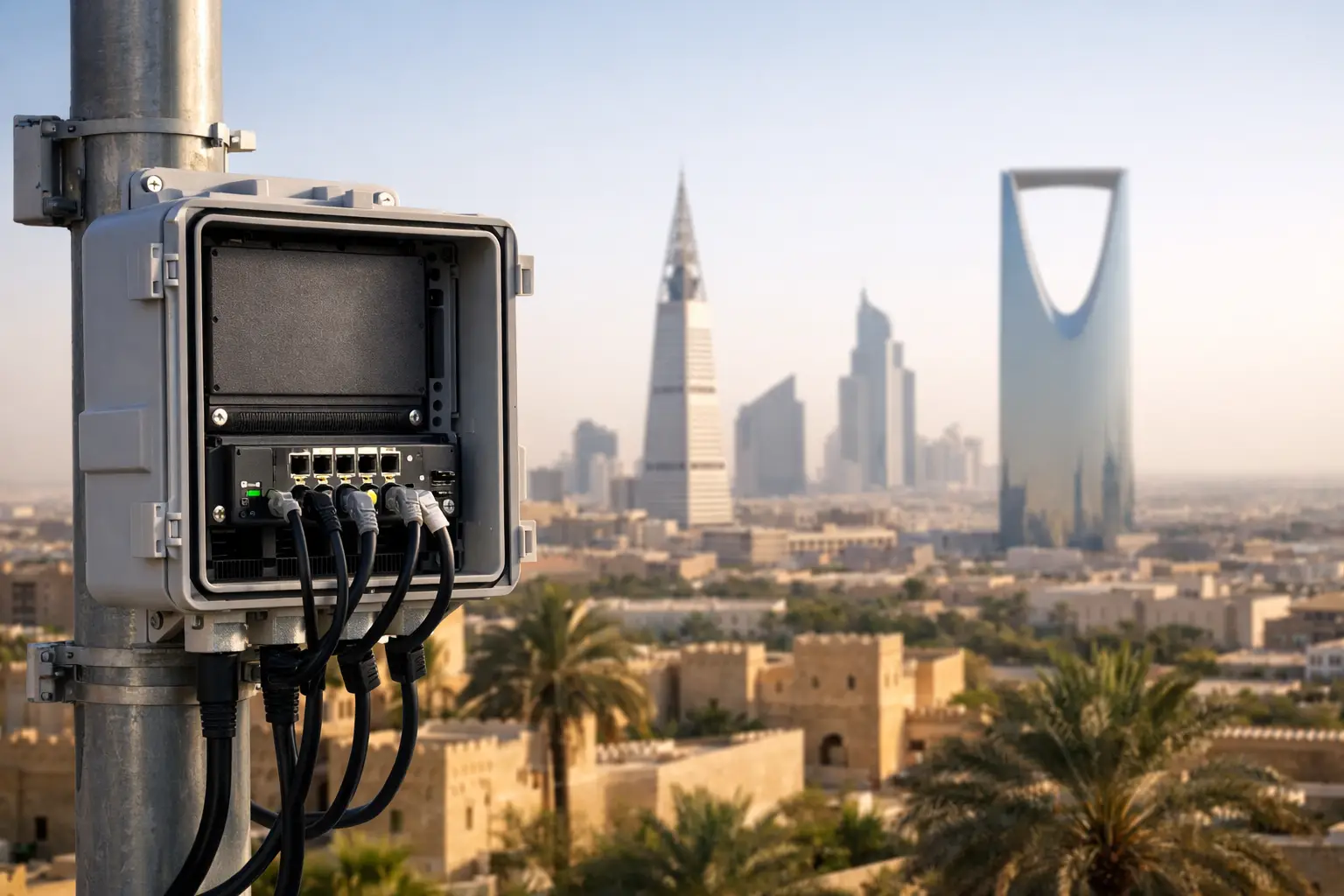
An outdoor surveillance network rarely fails because someone overlooked a camera specification. Instead, it fails at the edge: inside a roadside cabinet, on a perimeter pole, or at a gate. These are the points where heat, moisture, dust, voltage exposure, and cable distance meet. This AETEK outdoor PoE switch guide addresses the infrastructure decisions that system integrators, consultants, and procurement teams must make. These decisions come before teams deploy cameras, access devices, and network links across Saudi project sites.
AETEK is a PoE infrastructure manufacturer, not a camera manufacturer. AETEK designs its outdoor H-series switches for field deployment. In these locations, a standard indoor network switch and separate enclosure can add unnecessary points of failure. For projects requiring traceable supply, Taiwan-made AETEK products and applicable NDAA/TAA-compliant options deserve early consideration. This is particularly true for government facilities and Vision 2030 procurement environments.
Why outdoor PoE switching requires a different specification
A switch installed in a conditioned telecom room has a controlled operating environment, predictable cable routing, and routine maintenance access. A switch serving a perimeter line, vehicle entrance, temporary logistics area, solar field, or remote utility structure does not. Here, the equipment may face direct sun, airborne dust, and humidity near coastal locations. It may also face condensation, vibration, and electrical disturbance from long copper runs.
The core benefit of an AETEK H-series outdoor PoE switch is its IP67-rated enclosure. IP67 addresses ingress protection at the switch itself, helping reduce dependence on an additional field cabinet for suitable applications. As a result, it can simplify pole and wall deployments and reduce enclosure space requirements. It can also shorten the path between the uplink and powered endpoints.
However, IP67 is not a substitute for sound field engineering. Tighten cable glands correctly and select outdoor-rated cabling for the route. Consider drip loops where appropriate. Grounding and surge-protection practices must follow the project electrical design and local requirements. A sealed switch cannot compensate for poor termination, unsuitable connectors, or an unprotected upstream power source.
For Saudi Arabia, environmental conditions make this distinction practical rather than theoretical. A coastal deployment in Jeddah, Umluj, or the Red Sea Project may prioritize corrosion exposure and humidity management. In contrast, an inland project in Riyadh, Qiddiya, or a remote industrial site may place greater emphasis on heat and dust. It may also prioritize the serviceability of distributed field nodes. The switch specification should reflect the installation condition, not merely the number of cameras on a drawing.
AETEK outdoor PoE switch guide: start with the powered load
The first sizing question is not port count. It is power demand at each endpoint and the total PoE budget available from the switch. Consider a fixed AI camera, an IR illuminator-equipped camera, a PTZ camera, an intercom, and an access-control device. These do not consume power in the same way. Load can also change by operating mode. For example, it can change when infrared illumination activates, a heater engages, a PTZ moves, or someone uses an intercom.
Review the device datasheet for its PoE class and maximum consumption. Then calculate the expected simultaneous load rather than adding only nominal values. A design that works when cameras are idle may become unstable when several endpoints enter peak power states at once. Allow practical headroom. This matters most when one field switch supports Milesight AI cameras, intercoms, and other edge devices together.
PoE standards also matter. IEEE 802.3af, 802.3at, and 802.3bt define different power capabilities. However, cable length and resistance affect the usable power at the endpoint. Do not assume the switch can power a device simply because both use an RJ45 connection. Confirm the PoE standard, switch port capability, total budget, and cable route before procurement.
AETEK outdoor switch selection should also consider whether all ports require PoE. Alternatively, the design may reserve some ports for uplink or non-powered network equipment. This affects both the physical port layout and the available power budget. A small camera cluster may suit a compact field switch. In contrast, a larger perimeter segment may require multiple distributed nodes. This avoids excessive copper distances and difficult fault isolation.
Plan the uplink before choosing copper ports
A field switch is only as useful as its path back to the core network. Standard Ethernet rules typically limit copper Ethernet to 100 meters per channel. Consider long perimeter deployments, parking facilities, port environments, campuses, and industrial compounds. In these, fiber uplinks are often the more appropriate architecture between field nodes and the control room network.
The selection process should identify the uplink medium, connector requirements, fiber type, available cores, and redundancy expectations early. A switch with the right number of PoE ports but an unsuitable uplink arrangement creates a late-stage redesign problem. Consultants should also define whether the field node needs a single uplink, a ring topology, or a separate secondary route. Base this on the project’s availability requirement.
AETEK PoE extenders can support specific long-distance endpoint scenarios. Under appropriate conditions, they extend PoE and Ethernet transmission up to 250 meters. They are useful where adding a local power source is difficult and the endpoint load is compatible with the extender design. However, an extender is not automatically the best answer for every long run. It introduces another active device in the path. You must also calculate its power delivery from the source switch through the full cable length.
Some cases call for a different approach: high-value camera positions, high-power PTZ devices, or routes crossing exposed outdoor areas. Here, fiber to a local AETEK outdoor switch may provide better separation and maintenance control than repeatedly extending copper. The correct choice depends on the endpoint power draw, route length, civil constraints, resilience target, and future expansion plan.
Treat surge protection and grounding as part of the network
Outdoor Ethernet routes can carry electrical risk as well as data. A camera mounted on a fence line or pole may connect through a long cable run. That run can face induced surges, nearby electrical events, and ground-potential differences. If the switch specification ignores protection at the network boundary, the project can face recurring equipment failures. These failures can appear to be camera or switch faults.
Evaluate AETEK outdoor infrastructure alongside the site’s lightning-protection, earthing, and electrical segregation strategy. The project’s qualified electrical and network design teams must set the exact arrangement. However, procurement teams should ensure these requirements are visible in the bill of materials. Do not leave field equipment, cable shielding strategy, power input protection, surge devices, or grounding points as installer assumptions.
This is particularly relevant for government perimeters, transport facilities, industrial plants, and large construction zones. On these sites, cameras spread across broad outdoor areas. The lowest initial switch cost can become expensive once you include replacement access, site permits, downtime, and troubleshooting.
Specify compliance and lifecycle requirements early
For government and critical-infrastructure projects, product compliance is often a commercial gate as much as a technical one. Where tender requirements call for NDAA/TAA-compliant infrastructure, request the relevant compliance documentation at the quotation and submittal stage. Do not wait until final approval, when a network infrastructure substitution may affect adjacent equipment schedules and integration plans.
AETEK’s Taiwan-made PoE infrastructure is a practical fit for projects seeking a defined, compliant supply path. Still, verify compliance against the exact model and tender requirement. “NDAA compliant” and “TAA compliant” are not interchangeable claims. The procurement file should reflect the end user’s stated requirement.
Lifecycle planning deserves the same discipline. Confirm model availability, lead time, approved alternatives, accessories, and the expected service strategy for remote locations. For a large rollout, standardizing on a manageable set of switch configurations can reduce spares complexity and make fault replacement faster. It can also help integrators maintain consistent documentation across camera, access-control, and network packages.
Match the switch to the deployment, not the catalog
An AETEK H-series outdoor switch is most effective when it solves a clearly defined field problem. Examples include a camera cluster on a pole, a remote gate, or a perimeter segment. Another is an outdoor facility that requires protected PoE distribution. It is not automatically the right choice for every endpoint. For example, an AETEK C-series indoor switch may better serve a conditioned security room. Similarly, harsh industrial environments may require assessment of the AETEK D-series industrial range.
For the procurement team, the practical deliverable is a switch schedule. It records endpoint count, peak power demand, uplink type, cable distances, and enclosure requirement. It also records environmental exposure, compliance status, and spare strategy. That schedule gives the integrator a defensible basis for sourcing and gives the consultant a clearer way to review substitutions.
Seven Sectors is an authorized Saudi partner for AETEK PoE infrastructure. We support system integrators, consultants, and procurement teams with project-focused supply for outdoor network deployments. Do you need AETEK H-series availability, compliance documentation, or pricing aligned to your bill of materials? Contact Seven Sectors at info@7sectors.com or submit the website Get Quotation form. The best time to resolve field-switch constraints is before anyone pulls the first perimeter cable.
Frequently Asked Questions
What is the AETEK H-series outdoor PoE switch and where is it used?
The AETEK H-series is an IP67-rated outdoor PoE switch designed for field deployment in environments where a standard indoor switch and separate weatherproof enclosure would add cost and failure points. It is used on perimeter poles, gate columns, roadside cabinets, rooftop installations, and any surveillance node that must survive heat, humidity, dust, and direct exposure — conditions common across Saudi Arabia’s coastal, desert, and industrial project sites.
How far can AETEK PoE switches extend camera power and data without fibre?
AETEK PoE extenders can push PoE power and data up to 250 metres per segment beyond the standard 100-metre Ethernet limit, using standard UTP cable. This is particularly relevant for Saudi perimeter, road, and large-site deployments where trenching fibre to every camera pole is cost-prohibitive. Extenders can be chained for longer runs where site layout allows.
Are AETEK outdoor PoE switches NDAA and TAA compliant?
Yes. AETEK switches are manufactured in Taiwan and are NDAA Section 889 and TAA compliant, making them suitable for government facilities, military-adjacent developments, and Vision 2030 infrastructure projects with compliant-supply-chain requirements. Seven Sectors can provide compliance documentation on request.
What PoE budget do AETEK outdoor switches provide for surveillance cameras?
AETEK H-series switches support PoE+ (IEEE 802.3at) and PoE++ (IEEE 802.3bt) standards with per-port and total budgets sized for multi-camera deployments. Specific wattage depends on the model; Seven Sectors can recommend the correct switch model based on your camera power draw per port and total site node count.
How does AETEK outdoor PoE switch specification differ from indoor AETEK C-series?
The H-series is IP67-rated for direct outdoor exposure; the C-series is designed for indoor data-room, riser-closet, and conditioned-space installation. Both carry NDAA/TAA compliance and PoE infrastructure capability, but H-series models include extended operating temperature ranges and ruggedised housings for KSA field conditions.
Ready to discuss your project? Contact Seven Sectors or contact us directly on +966-012 229 3474.