
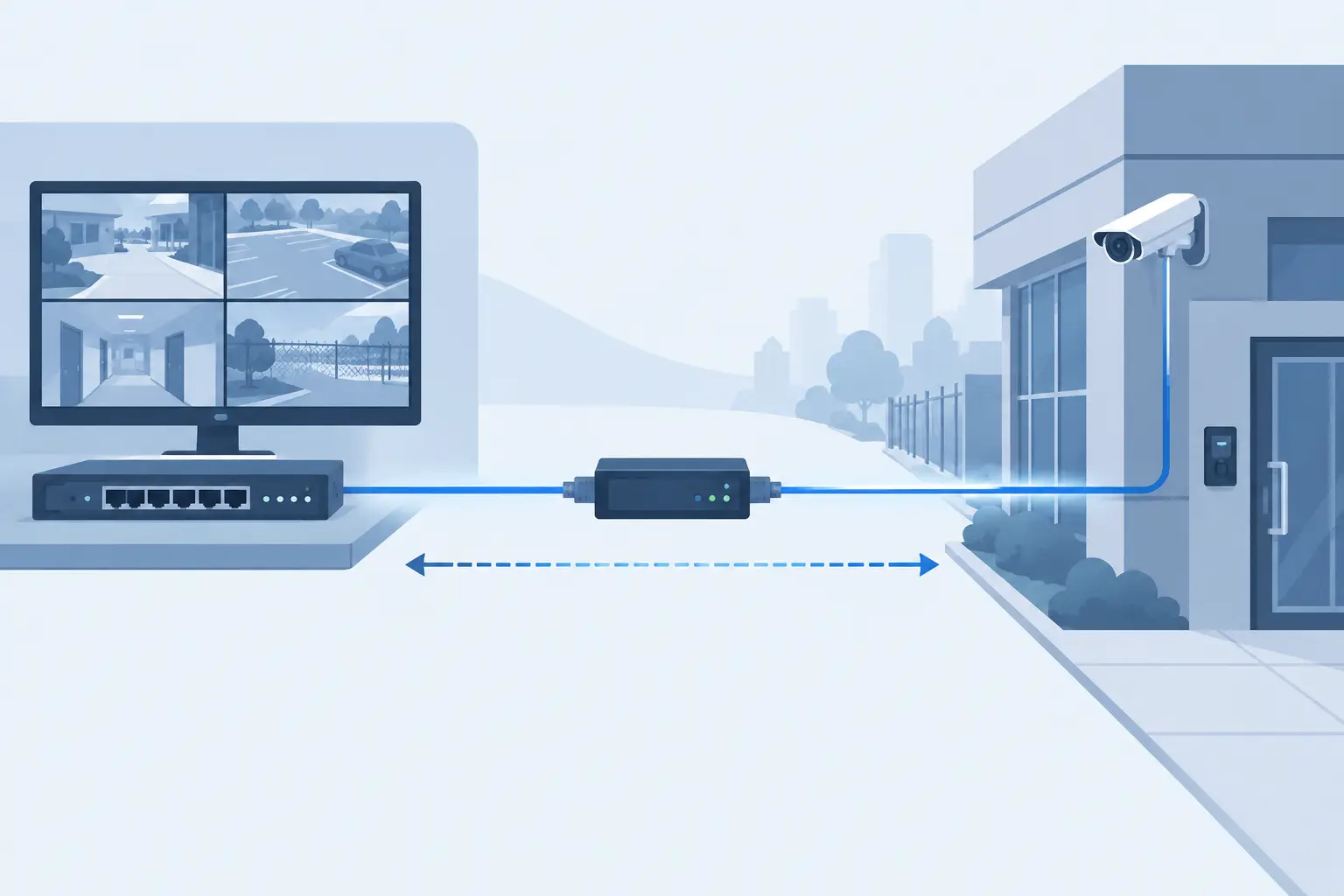
A remote camera point, gate controller, or intercom station can look simple on a drawing until the nearest network cabinet is well beyond a conventional copper run. A PoE extender 250m can be a practical answer when the project needs to carry both data and power farther without adding an active field cabinet. For integrators sourcing AETEK network infrastructure through Seven Sectors Trading Co., the key decision is not just whether a 250m claim appears on a datasheet. It is whether the complete path can deliver the required power and network performance at the far end.
The extender is one part of the link. Cable construction, powered-device demand, switch capability, route conditions, and required bandwidth all determine whether an extended run is suitable for a commercial security deployment.
When a PoE extender 250m is the right approach
A 250m PoE extension approach is most useful where a single remote endpoint sits beyond a standard Ethernet segment and building a new telecom room would add unnecessary civil, electrical, and maintenance scope. Typical applications include perimeter surveillance points, vehicle entrances, parking areas, utility compounds, warehouses, and long building corridors.
For these applications, the appeal is clear: one structured cabling route can support a field device while avoiding a separate local power outlet. That can reduce coordination between security, electrical, and civil packages. It can also simplify fault isolation when the network team can trace the path back to a known switch port.
That said, long reach is not automatically the best architecture. If several devices are clustered in one remote location, a properly planned field network cabinet or fiber uplink may be more appropriate than extending separate copper links. A single long-run solution works best for a limited number of endpoints with predictable power demand.
Start with the complete power path
An extender does not create power. It passes available power along the route, with losses that increase as cable length and resistance increase. This is the first issue to verify before selecting any extended-distance PoE solution.
The project team should identify the power sourcing equipment at the cabinet, the powered device at the far end, and every component between them. The selected switch port and extender must support the required PoE method, while the remote device must still receive sufficient power under normal operating conditions. A device that powers up successfully during a bench test may still become unreliable after cable losses, heat, or higher operating demand are introduced.
This matters particularly for security endpoints whose consumption changes during operation. Features such as heaters, illuminators, motorized functions, or connected accessories can raise demand beyond an idle-state reading. The system should be assessed against the device manufacturer’s documented power requirement, not an assumed average load.
A practical procurement request should therefore include the switch model or intended PoE output class, the remote device type, expected cable route length, and whether any intermediate protection or junction hardware is planned. These details allow the supply package to be checked as a system rather than as a collection of individual part numbers.
Do not treat 250m as a universal network speed promise
The phrase “250m” describes an extended-reach application, not a guarantee that every device will operate with the same data behavior at every cable length. Some extended PoE architectures use a reduced link speed to reach farther than conventional Ethernet limits. That may be acceptable for a single security endpoint, but it must be evaluated against the actual traffic requirement.
For a typical remote surveillance point, consider the expected video stream, recording profile, analytics load, and any management traffic. For an access or intercom endpoint, consider communications traffic, controller behavior, and the operational impact of an intermittent connection. The correct question is not simply, “Can the link come up?” It is, “Can the link support the application consistently during peak use?”
This distinction is especially relevant where many long-run endpoints return to the same network switch. Each endpoint may work independently, yet the aggregate uplink and switching capacity still need to support the total traffic. A long-reach edge connection does not remove the need for proper network capacity planning upstream.
Cable quality decides whether the design has margin
The distance shown in an extended PoE topology assumes suitable copper cabling and sound installation practice. Poor-quality conductors, unknown cable composition, degraded joints, water ingress, or excessive intermediate connections can erode the margin available for both power and data.
For commercial projects, use documented structured cabling appropriate to the route and environment. Confirm the actual route length rather than relying on a straight-line distance from cabinet to device. Vertical risers, containment changes, service loops, and route diversions can add substantial length.
The cable path also deserves attention where it leaves a protected building environment. Outdoor routes, perimeter equipment, and exposed areas may require an appropriate enclosure, protection strategy, and grounding approach determined by the project design team. An extender may solve the distance issue, but it should not be expected to resolve environmental or electrical risks elsewhere in the installation.
Choose the topology before selecting the hardware
A clear topology prevents costly changes after devices are already installed. For one remote endpoint, the architecture may be straightforward: a PoE-capable network switch, a long copper run, an extension device where required, and the powered field device. However, the placement of each component still matters.
An intermediate extender should remain accessible for testing and replacement. It should not be concealed in a location that cannot be safely reached after handover. The enclosure must suit the installation environment, and the cable entry method should preserve the intended protection level of the overall assembly.
Where the route serves a remote cluster rather than a single endpoint, compare the copper-extension approach with a fiber backbone and a remote network node. Fiber can be the stronger option where distance, electrical separation, expansion capacity, or multiple endpoints are the governing factors. The right choice depends on the site constraints and the lifecycle needs of the facility.
What to include in an RFQ for extended PoE links
Long-reach requirements become easier to source accurately when the request is specific. Rather than asking only for a “250m extender,” provide the cable route length, number of remote endpoints, device type, source switch details, indoor or outdoor placement, and any required mounting or enclosure conditions.
Also clarify whether the project needs a standalone extension component, an extended-reach switch architecture, surge protection accessories, or replacement units compatible with an existing network design. This avoids selecting a product that fits the distance requirement but does not match the installed system’s power or management approach.
For tenders and government procurement packages, keep product documentation, approved makes, and technical submittal requirements aligned from the start. A verified supply source is valuable when the consultant requires clear manufacturer information and consistent model references across the network package.
Frequently asked questions
Can a 250m PoE extender power any remote device?
No. Suitability depends on the available power from the source, cable resistance, the extender architecture, and the remote device’s documented demand. Verify the entire power path before final selection.
Is an extender better than installing a local power supply?
It depends on the route and site conditions. Extending PoE can reduce the need for local electrical works, but a local power source or remote network cabinet may be more suitable for high-demand devices, multiple endpoints, or difficult cable routes.
Can one long cable run support several devices?
Not without a topology designed for that purpose. A single extension link is generally evaluated for its intended endpoint. A remote cluster may require a dedicated network node and a different backbone strategy.
When a remote endpoint is forcing changes to the network layout, treat the distance as an engineering decision rather than a catalog filter. Send the route details and intended device information to Seven Sectors Trading Co. at info@7sectors.com or use the Get Quotation form to source the appropriate AETEK network infrastructure for the project.
Ready to discuss your project? Contact Seven Sectors or contact us directly on +966-012 229 3474.