
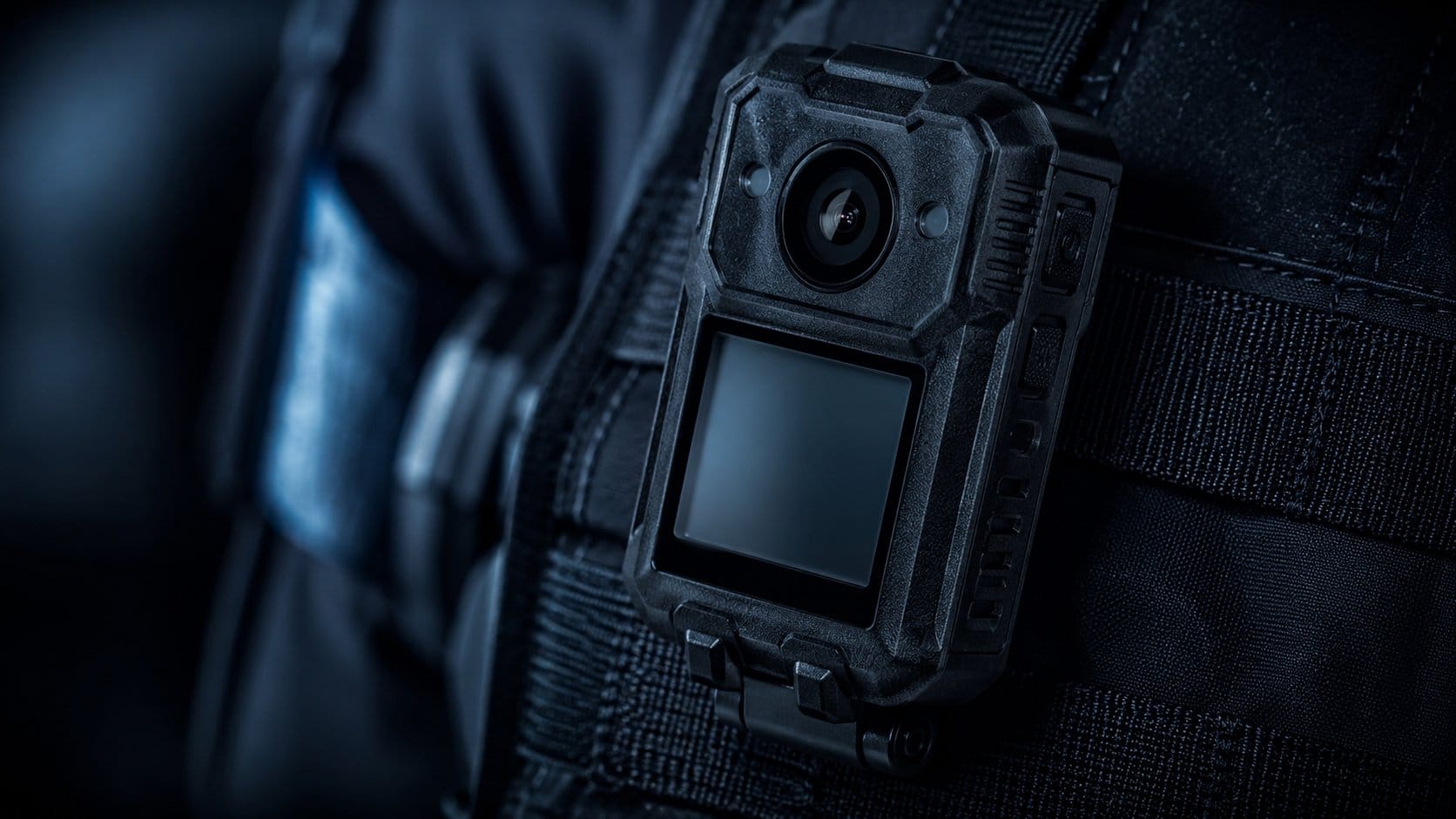
Government buildings across Saudi Arabia face growing pressure to prove exactly what happened during every security incident, public interaction, and access dispute. Fixed CCTV records the scene, but it rarely captures the exchange itself — what was said, what was shown, why entry was denied. Body worn cameras close that gap. For procurement teams evaluating a body-worn camera solution for government facilities in Saudi Arabia, the real decision isn’t the camera hardware. It’s the evidence chain behind the footage, and whether it can survive an audit or a legal challenge months later.
Why government facilities in Saudi Arabia demand body-worn evidence
Public sector sites face high public footfall, VIP movement, and strict compliance reporting. These include ministries, municipal offices, courts, licensing centers, and the administration buildings springing up around Vision 2030 giga-projects. Fixed cameras alone cannot fully document this. A guard’s body camera captures the interaction itself: the verbal exchange at a checkpoint, the reason for an access denial, the moment a dispute escalates. Internal audit teams, legal counsel, and inspection bodies increasingly request this first-person record when handling misconduct claims or disputed incidents.
Saudi public-sector procurement is also shifting toward documented personnel accountability in sensitive zones, not just perimeter monitoring. A body-worn camera program gives a government facility manager a defensible, timestamped answer when reviewers question an incident. This avoids stitching together footage from multiple fixed cameras and inferring context that no camera ever captured. For sites handling public complaints, security escorts, or restricted-area enforcement, body-worn cameras shift the burden of proof. Evidence replaces memory and assumption.
There is also a workforce management angle procurement teams often underweight. Body-worn footage protects guards as much as it protects the institution. It gives frontline staff a record that supports their own account. They are far less exposed to one-sided complaints. Facilities that have run pilot programs elsewhere in the region typically report fewer disputed complaints. Once staff know an interaction is captured on camera, both sides behave differently.
VANGUARD body-worn cameras: what they actually do
VANGUARD is a body-worn camera platform built for frontline personnel — not a fixed CCTV brand, not a repackaged consumer action camera. Instead, it pairs a ruggedized, officer-worn camera with a dedicated evidence management platform. Footage moves from the field into a controlled chain of custody. There is no manual file handling, USB transfers, or ad-hoc storage on personal devices.
That distinction matters for procurement teams: a body-worn camera without a structured evidence platform is just a recording device. Recordings without custody controls are weak evidence. VANGUARD covers the full lifecycle — capture, upload, tag, retain, retrieve. That is what government legal and compliance teams care about when they reopen a case months after the incident.
Key capabilities
- Officer-worn recording built for extended shifts across outdoor and indoor government environments
- A structured evidence management platform for upload, tagging, and retrieval — not just local card storage
- Access-controlled footage handling designed to support chain-of-custody requirements during disputes or audits
- A deployment model suited to guard forces, facility security teams, and municipal enforcement units
- Designed to complement, not replace, a site’s existing fixed camera and access control layers
Deployment considerations for government-facility sites
Rolling out body-worn cameras at a government site is a personnel program as much as a technology purchase. Facility managers need a written policy on recording. It should cover when to start and stop, who can review footage, and how long evidence is held. These decisions need to be in place before hardware ships, not improvised after the first incident review. Charging and docking infrastructure needs a physical home. A guard room or control room with secure, access-controlled storage works well for housing units between shifts.
Most of these sites already run fixed CCTV and access control. The body-worn layer should add to that existing architecture. Teams should establish clear rules on how footage from all three sources is reviewed during an investigation. Sites with multiple entry points or rotating shifts need enough units for full shift coverage plus spares. Seasonal footfall spikes — public holidays, pilgrimage routes, high-profile visits — add to this requirement.
Training is the piece most often skipped in a rushed rollout. Guards need clear guidance on when activation is mandatory versus discretionary. Supervisors need a simple review workflow so footage doesn’t sit unreviewed. If footage only gets reviewed when a dispute arises, it’s already too late to catch coverage gaps. Budget planning should also account for the evidence platform’s ongoing storage and licensing needs, not just the one-time hardware cost. Footage retention windows for government use tend to run longer than typical commercial policy.
How this fits alongside access control and surveillance
Body-worn evidence works best as one layer in a broader security stack, not a standalone purchase. HID access control governs who enters a government facility and when, while body-worn cameras document how guards actually handle the interactions that access control alone can’t explain — a denied entry, a visitor dispute, a search request. Sites already running AI-analytics CCTV benefit from body-worn footage as corroborating evidence that adds context to what a fixed camera captured from a distance.
Teams standardizing security across multiple government sites should plan body-worn and access control procurement together. Separate budget lines often create gaps: one layer ends up covering scenarios the other was never assigned to address.
Compliance, support and sourcing in the Kingdom
Seven Sectors Trading Co. is an authorized partner for VANGUARD body-worn systems in Saudi Arabia. We supply system integrators, security consultants, and government procurement teams. Our approach is to work alongside the consultants and integrators who scope and install these programs, providing product access, technical guidance, and support sized to real project timelines — not a one-size-fits-all quote pushed through a call center.
In practice, government procurement often carries its own documentation and compliance requirements — vendor registration, technical compliance sheets, local support commitments. We help integrators assemble the technical information needed for tender submissions and internal approval processes. That work stays with us, not the end client. For more on how we support security procurement across categories, see our Seven Sectors blog.
VANGUARD BWC-103W Program — Component Overview
| Component | What It Does | Why It Matters for Procurement |
|---|---|---|
| BWC-103W Camera Unit | Ruggedized, officer-worn recording built for extended shifts, indoor and outdoor | Durability and shift-length coverage for guard forces and municipal enforcement |
| Evidence Management Platform | Structured upload, tagging, and retrieval — not local card storage | Turns raw footage into evidence that stands up to legal/audit review |
| Chain of Custody | Access-controlled footage handling, no manual file handling or USB transfers | Required for disputes, misconduct claims, and legal challenges |
| Docking & Charging | Secure, access-controlled unit storage between shifts | Needs a physical home in a guard/control room — plan before rollout |
| Deployment Model | Complements existing fixed CCTV and access control | Adds personnel-level context fixed cameras cannot capture |
* Detailed BWC-103W hardware specifications (resolution, battery life, onboard storage) and evidence-platform licensing depend on configuration. Contact Seven Sectors for the full datasheet.
Need the full datasheet or project spec?
We’ll send you official documentation + B2B pricing within 2 hours.
FAQ
Is VANGUARD a CCTV brand?
No. VANGUARD is a body-worn camera and evidence management platform for personnel, distinct from fixed CCTV. It complements a site’s existing camera and access control systems, giving personnel-level context that fixed cameras can’t capture.
Who typically deploys body-worn cameras at government sites?
Facility security guard forces, municipal enforcement units, and site security teams at ministries, courts, licensing centers, and public administration buildings — particularly where interactions with the public need a documented, defensible record.
Does a body-worn camera program require new infrastructure?
Mainly a secure docking and charging point in a guard or control room, plus an internal policy for review and retention. It does not require the rewiring or new cabling runs of fixed CCTV expansion. This keeps rollout timelines shorter.
If you’re scoping a body-worn camera program for a government facility, request a technical recommendation and we’ll help you size the deployment to your site, shift structure, and compliance requirements.
Ready to discuss your project? Contact Seven Sectors or contact us directly on +966-012 229 3474.