
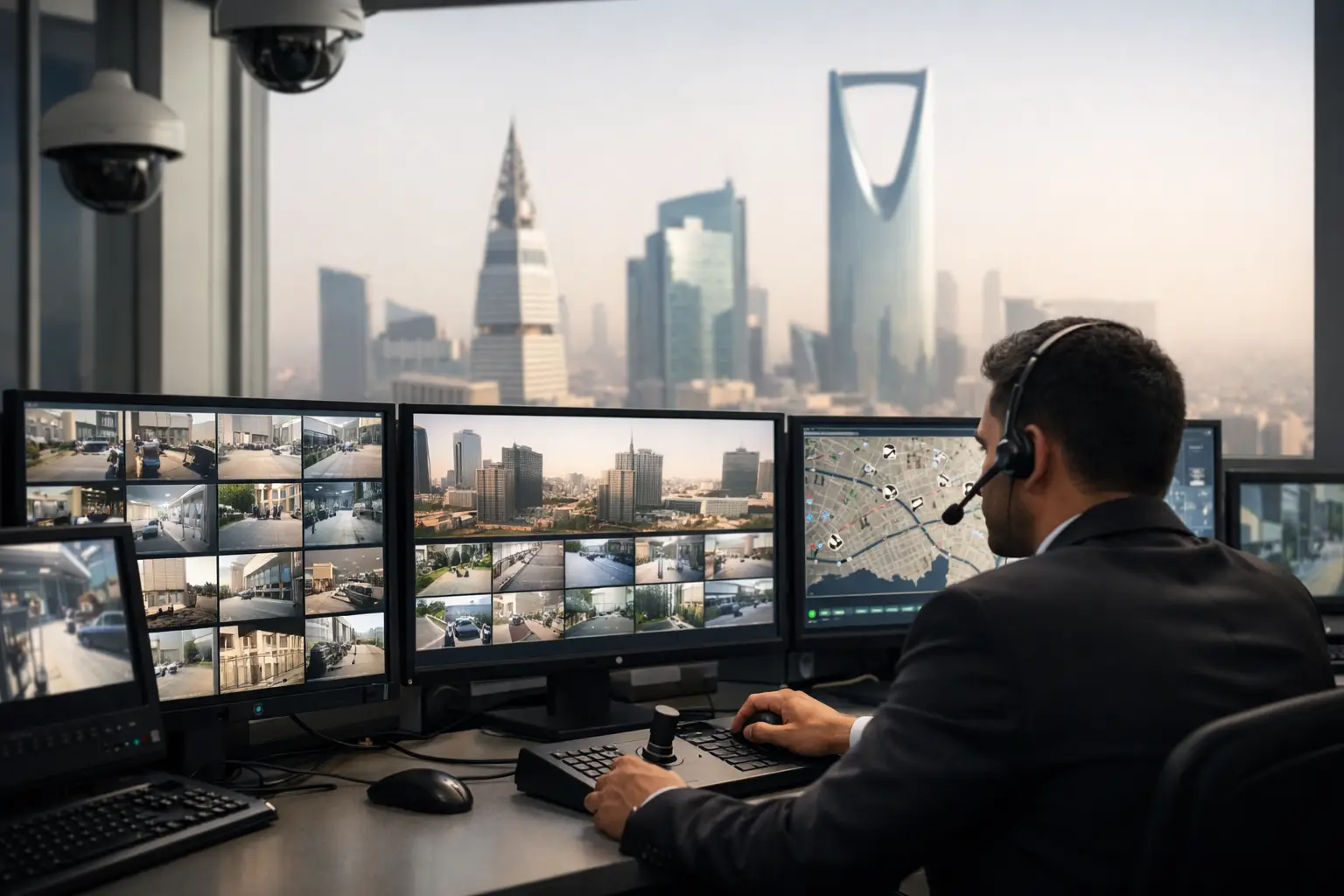
A large surveillance project in Saudi Arabia usually fails for one reason long before anyone mounts a camera. Too often, the project treats the VMS like software instead of operational infrastructure. For any video management system enterprise surveillance Saudi Arabia project, that mistake shows up later as dropped streams, fragmented analytics, hard-to-manage user rights. It also causes poor evidence handling across sites. In practice, the VMS decides whether an enterprise platform scales cleanly or becomes a maintenance burden.
For system integrators, consultants, and procurement teams working on government, transportation, industrial, and smart city scopes, this matters most. ISS SecurOS is the part of the stack that deserves early attention. Cameras, storage, servers, and network switching all matter, but the VMS defines how those elements behave together. That is especially relevant in Saudi projects where multi-site control, compliance requirements, and long retention periods are common from the start.
Why ISS fits enterprise surveillance in Saudi Arabia
ISS is not positioned as a lightweight recorder with a polished interface. SecurOS targets enterprise and government environments where the requirement is centralized management, advanced analytics, and consistent control across large estates. With deployments in more than 50 countries and architecture supporting over 7 million cameras globally. As a result, ISS operates in the part of the market where scale is not theoretical.
That matters in Saudi Arabia because enterprise surveillance is rarely limited to one building. A ministry campus, logistics network, industrial perimeter, border-related deployment, or giga-project zone may need staged expansion over several phases. The VMS has to support that growth without forcing a platform change every time the camera count increases or analytics requirements become more demanding.
ISS SecurOS also has regional relevance. The platform is already associated with Middle East deployments, including Saudi border use cases. For procurement teams, that local relevance matters more than broad software marketing claims. It suggests the platform has already proven itself in environments where uptime, security, and event response are not negotiable.
What a video management system enterprise surveillance Saudi Arabia project actually needs
In enterprise tenders, tender writers usually express the requirement as camera quantity, storage duration, and operator positions. Those are necessary, but they are not enough. A serious VMS selection should also account for how the end user will operate the site after handover to the end user.
The first issue is architecture. A single-site commercial building may run comfortably on a smaller VMS tier. By contrast, a large public-sector or infrastructure project often needs distributed recording, central monitoring, failover planning, and role-based access across departments. This is where SecurOS Enterprise and SecurOS MCC become relevant. They target environments where operators need to manage multiple subsystems and remote locations from a unified operational layer.
The second issue is analytics integration. Many projects now specify AI cameras, but camera-side analytics alone are not enough if the VMS cannot organize alarms, correlate events, and present usable evidence. ISS supports advanced functions including LPR, facial recognition, and behavior analytics. Whether to activate those depends on the site, legal framework, and end-user policy, but the platform supports that higher-level use case when the application justifies it.
The third issue is evidence workflow. Security operations teams do not just watch live video. They search, review, export, annotate, and hand off evidence. In enterprise environments, those workflows need consistency. A VMS with weak forensic handling creates operational delays even when live monitoring appears acceptable.
The surrounding stack matters as much as the VMS
A VMS cannot fix weak infrastructure. In Saudi enterprise deployments, platform performance depends heavily on the supporting hardware and network design specified around it.
On the camera side, Milesight AI cameras are a practical fit where analytics quality matters. Models with TrueColor AI, up to 95% false alarm reduction, 0.002 Lux low-light performance, and 140 dB WDR can improve event quality before the stream reaches the VMS. That does not replace VMS logic, but it improves what operators and analytics engines receive. In difficult lighting, perimeter zones, parking access lanes, and mixed indoor-outdoor facilities, that upstream quality can materially affect search and incident review.
On the network side, AETEK deserves consideration where PoE delivery and switching reliability are part of the surveillance design. This is especially true in outdoor or industrial conditions. AETEK H-series outdoor switches with IP67 protection, D-series industrial models, C-series indoor switches, ceiling PoE switches, and PoE extenders supporting up to 250 meters are relevant where camera density, cabinet constraints, or long-run connectivity affect deployment planning. For consultants, this is not just a bill-of-materials detail. Poor PoE infrastructure is still one of the most common reasons surveillance projects underperform in the field.
For compute and storage, enterprise VMS design should avoid generic IT assumptions. Surveillance workloads are sustained, write-heavy, and retention-driven. Depending on project size and forensic requirements, Rasilient, FIBRENETIX, and Dell infrastructure may each make sense. Rasilient surveillance servers are especially relevant where forensic storage performance and NFD – No Frames Dropped – are critical. FIBRENETIX addresses enterprise CCTV server and storage requirements, while Dell PowerEdge servers, Precision workstations, and PowerVault storage are widely specified in VMS infrastructure stacks. The right choice depends on camera count, retention policy, failover expectations, analytics load, and whether the end user wants appliance simplicity or more open infrastructure control.
Compliance is not a side note
In Saudi government and Vision 2030-related procurement, compliance is increasingly part of technical selection, not an afterthought. NDAA and TAA requirements can affect brand eligibility well before final award. That means the surveillance stack deserves review as a whole, not product by product in isolation.
ISS, Milesight, and AETEK all have clear relevance here because compliance conversations are now tied directly to project approvals, consultant specifications, and end-user risk reviews. In practice, this also changes sourcing behavior. Procurement teams want an authorized local partner that can confirm product positioning, support submittal accuracy, and help avoid compliance issues late in the tender cycle.
Where SecurOS makes the most sense
Not every project needs the full weight of an enterprise VMS. A mid-size commercial facility with limited analytics and a straightforward topology may be better served by a simpler platform tier. But once the project includes multiple sites, centralized control, analytics-driven operations, or future command-center integration, the case for ISS becomes stronger.
This is particularly true in border-related applications, transportation, ports, logistics corridors, municipalities, industrial zones, and major public infrastructure. These environments generate large video volumes, require fast event review, and often involve layered user permissions. They also tend to expand over time. Choosing a VMS that can handle growth from the beginning is usually less costly than replacing one after the estate becomes too large to manage comfortably.
Procurement questions worth asking early
Before freezing a VMS specification, procurement and consultant teams should ask a few direct questions. Is the platform sized for the five-year camera count, or only phase one? Do analytics appear in the spec because the site will use them operationally, or simply because they look good on a tender sheet? Does storage sizing reflect real retention and export workflows, or only nominal recording assumptions? And can the local partner support product alignment across cameras, PoE, servers, and VMS without introducing compatibility risk?
Those questions usually expose the difference between a workable enterprise design and a document that looks complete but creates operational problems later.
The value of a local authorized partner
For Saudi projects, brand access alone is not enough. What matters is whether the partner understands how ISS SecurOS fits with the rest of the surveillance stack in real project conditions. Seven Sectors supports that requirement as the authorized Saudi partner for relevant international brands across VMS, AI cameras, PoE infrastructure, access control, audio, body-worn video, and surveillance storage. For integrators and procurement teams, that means one technical channel that can align ISS with Milesight, AETEK, Rasilient, FIBRENETIX, and Dell based on project scope rather than generic product pushing.
That is usually where enterprise surveillance projects become easier to execute. Not because the technology becomes simpler, but because the team makes product decisions with the final operating environment in mind. That is the standard a video management system enterprise surveillance Saudi Arabia package should meet.
If your next enterprise surveillance package in Saudi Arabia includes scale, analytics, compliance, or multi-site control, start with the VMS architecture first. Everything else is easier to specify once that foundation is right.
Frequently Asked Questions
What is the difference between an NVR and an enterprise VMS?
An NVR (Network Video Recorder) records camera streams to local storage with basic playback. An enterprise VMS (Video Management System) manages recording, live viewing, operator permissions, AI analytics, event workflows, multi-site federation, and evidence export across a potentially unlimited camera estate. For Saudi projects with more than one site, compliance requirements, or analytics-driven operations, a VMS is the correct platform rather than standalone NVRs.
Which VMS is best for large multi-site government surveillance in Saudi Arabia?
ISS SecurOS Enterprise is the recommended VMS for large Saudi government and multi-site deployments. It supports distributed recording architecture, granular operator permissions, centralized command oversight, and built-in AI analytics including LPR and facial recognition. ISS has existing deployments in Saudi border security infrastructure and over 50 countries globally.
How many cameras can an enterprise VMS handle in a Saudi project?
An enterprise VMS such as ISS SecurOS scales across multiple servers and sites without a fixed camera ceiling. The practical limit is determined by server compute capacity, network bandwidth, storage throughput, and analytics workload. Seven Sectors designs the server and storage architecture to match the camera estate and retention requirement for each project.
Does VMS software work with cameras from multiple brands on the same project?
Yes. Enterprise VMS platforms support ONVIF, allowing cameras from different manufacturers to be managed under a single interface. Seven Sectors typically specifies Milesight AI cameras as the primary camera brand alongside ISS SecurOS VMS, with the full integration profile tested and validated before deployment.
Can Seven Sectors provide VMS design and support for enterprise projects in Saudi Arabia?
Yes. Seven Sectors provides VMS architecture design, product supply, integration guidance, and after-sales support for enterprise surveillance projects across Saudi Arabia. We work with system integrators and consultants at the specification stage to ensure the camera, VMS, server, and storage layers are correctly sized and integrated from the outset.
Ready to discuss your project? Contact Seven Sectors or contact us directly on +966-012 229 3474.