
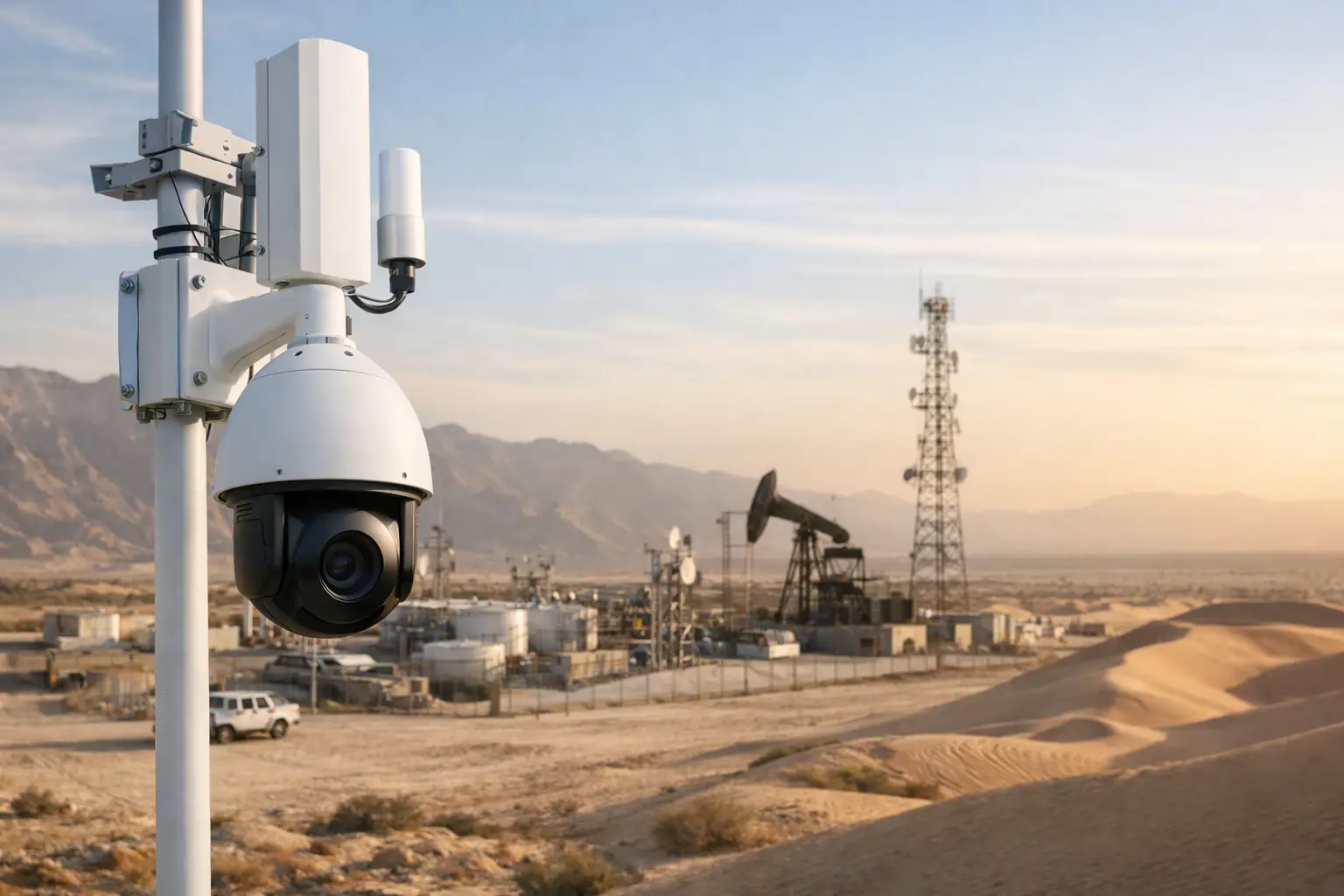
A remote worksite can be operationally active long before fiber, fixed internet, or a permanent security control room is available. This is where Milesight 5G camera remote site surveillance Saudi Arabia projects come in. A professional AI surveillance point can be deployed where conventional network infrastructure is delayed, impractical, or too costly to extend.
For system integrators, consultants, and procurement teams, the camera is only one part of the decision. A successful remote deployment depends on several factors. These include mobile coverage, power availability, recording policy, and cybersecurity. Analytics configuration also matters, along with a realistic plan for how video will be monitored. Milesight 5G Series cameras address the connectivity gap. But they should be specified as part of a defined site-security architecture. They are not a standalone replacement for a wired CCTV system.
Why 5G Surveillance Fits Saudi Remote Sites
Saudi projects regularly begin in locations where permanent infrastructure follows construction activity rather than leading it. This applies to perimeter packages at NEOM and Red Sea Project zones. It also applies to temporary compounds, logistics yards, utility works, road projects, and quarries. Remote industrial facilities in the Western Region and Eastern Province face the same challenge.
Running a new fiber route to one camera position can be difficult. It may require civil works, permissions, long lead times, and additional protection for cable routes. A Milesight 5G camera can use a compatible cellular connection for video transmission instead. This lets the integrator establish visibility without waiting for fixed broadband. The practical benefit is not simply faster deployment. It is the ability to place surveillance at the point of risk: a remote gate, material laydown area, equipment yard, access road, or boundary line.
That said, 5G should not be assumed to be available everywhere. Performance can vary substantially across a single project area. Coverage differs between open terrain, steel structures, valleys, containerized offices, and developing sites. So before equipment is selected, confirm the mobile operator, SIM arrangement, APN requirements, signal level, and expected upload capacity.
Milesight 5G Cameras for Remote Site Surveillance
Milesight 5G Series cameras bring cellular connectivity into an AI CCTV platform built for professional security applications. This is particularly useful when an IP camera needs a direct communications path to a VMS or remote monitoring center. It also helps when a camera must reach an approved cloud service without depending on a local fixed network.
The right camera form factor still depends on the surveillance objective. A fixed camera may suit a narrow entrance, vehicle lane, generator enclosure, or materials gate. A Milesight PTZ camera is more suitable where an operator needs to investigate activity across a broad yard or follow a moving vehicle. On large, open sites, a panoramic camera can provide wide-area context. PTZ coverage then supports closer examination of an event.
Camera image performance matters most after sunset, when remote sites are often most exposed. Applicable models offer 0.002 Lux sensitivity and 140 dB WDR on applicable product lines. These specifications can be valuable in mixed lighting conditions. Examples include a gatehouse facing vehicle headlights, a perimeter with floodlighting, or a work area transitioning from direct sun to deep shadow. The final selection should still be based on the actual scene, mounting height, lens requirement, and lighting plan.
Cellular connectivity alone is not the strongest reason to choose Milesight. Its AI analytics help remote teams focus on events that need attention. This matters because continuous motion alerts are often caused by dust, moving shadows, insects, or routine site activity. Milesight states that its AI technology can reduce false alarms by up to 95% in applicable scenarios. That result still depends on correct scene setup, alarm rules, and verification by the integrator during commissioning.
Analytics Must Match the Site Rule
Analytics should reflect a clear operational question. Is the system meant to alert when a person enters a restricted material yard after hours? Should it identify vehicles entering a controlled lane? Or is it meant to monitor equipment movement along a temporary perimeter?
A vague instruction such as “detect all motion” creates a high alarm volume and a low-value monitoring experience. More useful rules define the protected zone, permitted direction of travel, time schedule, object type, and response process. On a construction site, for example, daytime personnel movement may be expected. Nighttime entry into a fuel storage zone, however, requires immediate escalation.
Where license plate capture is required, treat the Milesight LPR Pro Bullet Plus Camera as a dedicated application. Do not assume a general overview camera can deliver reliable plate evidence. Vehicle speed, lane width, installation angle, illumination, and local plate formats all influence LPR performance.
The Remote-Site Design Questions Before Procurement
A 5G camera project should begin with a site survey and communications assessment. This is not a paperwork exercise. It prevents a camera from being installed in a poor-signal location and later judged on video quality that the mobile backhaul cannot sustain.
First, validate cellular service at the intended mounting location, not only at ground level or near the project office. Test each proposed operator where possible. A site may have strong coverage from one provider and inadequate performance from another. Confirm whether the project requires a private APN, static addressing, VPN access, or a centrally managed SIM arrangement.
Second, calculate bandwidth carefully. Base this on camera count, resolution, frame rate, scene activity, codec settings, and whether video is continuously streamed or primarily recorded locally. Continuous high-resolution streaming from multiple cameras can become expensive and difficult to maintain over cellular service. Many remote applications work better with local recording, event-based remote viewing, and alarm-triggered clips sent to the monitoring platform.
Third, establish the power method. A 5G camera still needs reliable power even when it does not need a wired data connection. Where mains power is available, coordinate the power source, enclosure arrangement, grounding, surge protection, and environmental protection. For solar or battery-based sites, power budgeting must include camera consumption, cellular transmission, and night operation. Heating or cooling requirements may also apply, along with the expected autonomy during low-generation periods. There is no universal solar package that fits every Saudi site.
Finally, define physical protection. Outdoor camera positions may face heat, dust, vibration, vandalism, and vehicle impact. Mounting hardware, poles, cabinets, and cable protection deserve the same attention as the camera specification. AETEK H-series outdoor PoE switches provide IP67 PoE infrastructure for suitable outdoor applications. Note that AETEK is the network infrastructure component, not the camera platform.
Recording and Monitoring Without Compromising Evidence
Remote cameras need a recording strategy that stays reliable when cellular connectivity fluctuates. Edge recording can protect video continuity during temporary backhaul loss. Meanwhile, the remote platform receives live or event-based video whenever connectivity permits. Agree on retention requirements with the project owner before selecting storage capacity and transmission policies.
For larger estates, Milesight cameras can be integrated into a broader VMS design. ISS SecurOS is relevant for projects that require enterprise monitoring, centralized alarm handling, LPR, facial recognition where authorized, behavior analytics, and multi-site command-center operations. Coordinate the VMS, camera analytics, and remote connectivity rules early. This way, the operator receives actionable alarms instead of duplicate notifications from separate systems.
Where centralized recording is required, server and storage selection must account for several factors: expected camera bitrates, retention days, concurrent viewing, archive export requirements, and system resilience. Rasilient surveillance servers and forensic storage suit high-demand video environments where recording continuity is critical. Dell PowerEdge servers and PowerVault storage may support the broader VMS infrastructure. The right platform depends on the tender specification and the operating model, not on camera count alone.
Compliance, Cybersecurity, and Tender Readiness
Government, critical infrastructure, and Vision 2030 project packages increasingly require documented product compliance and a clear supply channel. Milesight cameras are NDAA-compliant. This makes them a relevant option for specifications where restricted-component compliance is part of the procurement requirement. Still, verify compliance against the exact project documentation, including any TAA requirement that may apply to the overall bill of materials.
Cybersecurity matters just as much in a cellular deployment. Default credentials must be changed and unnecessary services disabled. Firmware needs to be managed under an approved process, and remote access limited to authorized platforms and users. Publicly exposed camera interfaces are not an acceptable operating model for professional sites. Use controlled network access, approved VPN or APN arrangements where required, and documented user permissions within the VMS.
For tender teams, the best submittal will clearly identify several things: the Milesight camera model, cellular connectivity approach, power method, mounting arrangement, video retention design, AI analytics scope, and NDAA compliance position. This gives consultants and end users a basis to evaluate performance rather than comparing camera datasheets in isolation.
Specify for the Operating Reality
Milesight 5G cameras are most effective when they solve a real infrastructure constraint: surveillance is needed now, but a permanent data network is not yet available. They are not automatically the best choice for every camera location. Where fiber and stable PoE are already present, a conventional IP camera deployment may offer lower recurring connectivity costs and easier high-bitrate recording. Where the site is temporary, remote, or constantly changing, cellular surveillance can be the more practical and commercially sound choice.
Seven Sectors is the authorized Saudi partner for Milesight AI CCTV solutions. We support integrators and procurement teams with product selection for remote surveillance requirements. The right first step is to define the scene, coverage, power source, mobile signal condition, recording requirement, and response workflow. A camera then becomes more than a remote viewing device. It becomes a controlled source of evidence for the people responsible for the site.
Remote sites monitored by our 5G cameras often pair them with the WT101 smart radiator thermostat and WS202 PIR and light sensor for facility condition monitoring.
For broader smart-building climate control, see the WT201 smart thermostat and WT301 smart fan coil thermostat.
Frequently Asked Questions
What is a Milesight 5G camera and how does it work on remote Saudi sites?
A Milesight 5G camera is an AI IP surveillance camera with an integrated 5G modem, designed for sites where fixed fiber or wired internet is unavailable. It transmits video and event data over a 5G cellular connection. On Saudi remote sites — construction camps, desert infrastructure, NEOM perimeter zones, energy sites — it delivers a deployable AI surveillance point without the need for cable infrastructure.
Is the Milesight 5G camera NDAA compliant for Saudi government projects?
Yes. Milesight cameras, including the 5G series, are NDAA Section 889 compliant. They are not manufactured by companies on the prohibited list, making them appropriate for Saudi government facilities, Vision 2030 giga-projects, and any procurement scope with supply-chain compliance requirements.
What power options are available for Milesight 5G cameras on remote sites?
Remote deployment options include solar-plus-battery standalone systems, generator supply, and PoE from a local powered switch. The correct approach depends on available infrastructure, daily recording hours, and ambient temperature. Seven Sectors can advise on the right power configuration for your specific site conditions in Saudi Arabia.
Which Saudi sites benefit most from 5G remote surveillance?
The clearest use cases are infrastructure construction sites before fiber is installed, oil and gas remote assets, desert perimeter monitoring, temporary security posts for events, and early-phase giga-project sites such as NEOM where permanent network infrastructure is staged. The 5G camera eliminates the lead time of network build-out for surveillance coverage.
How much does Milesight 5G remote site surveillance cost in Saudi Arabia?
Camera pricing depends on resolution, AI features, and order volume. Recurring data costs depend on your 5G carrier plan and video compression settings. Seven Sectors provides SAR-quoted pricing for the camera hardware including any power and mounting accessories. Contact us with your site count and coverage requirements for a full project estimate.
Ready to discuss your project? Contact Seven Sectors or contact us directly on +966-012 229 3474.