
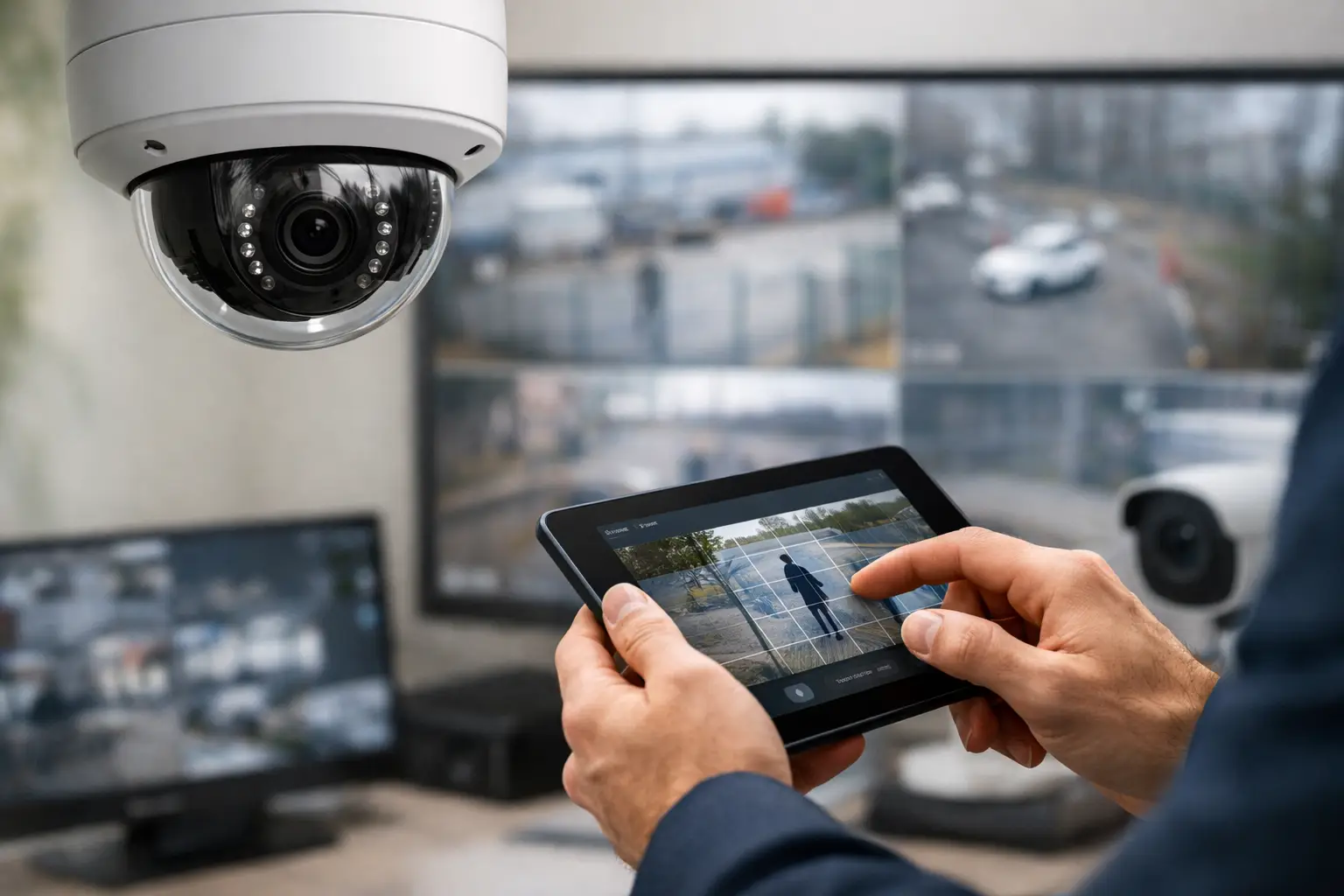
A perimeter camera that sends an alert for every headlight sweep, moving palm frond, or wind-blown plastic bag does not improve security. It transfers the problem to the control room. Milesight false alarm calibration is the process of aligning AI event rules with the real conditions of a site so operators receive fewer irrelevant alarms and can respond faster to genuine intrusion, loitering, or restricted-area events.
For system integrators, consultants, and procurement teams, calibration must be considered part of the camera specification and handover process. A Milesight AI CCTV camera may offer capable analytics, but the result depends on scene selection, mounting position, rule logic, object filtering, and environmental testing. A well-selected camera with poorly tuned rules will still create operator fatigue.
Why Milesight False Alarm Calibration Matters
False alarms carry an operational cost that is often missed in tender schedules. Every unnecessary event occupies an operator, increases incident review time, and reduces confidence in the surveillance system. At a logistics yard, government facility, power site, or construction perimeter, that loss of confidence can lead staff to ignore a later event that does matter.
Milesight AI cameras use intelligent analytics to distinguish people and vehicles from general motion. This is fundamentally different from conventional pixel-change motion detection, which reacts whenever enough of the image changes. Properly applied, AI-based object classification can reduce nuisance notifications from rain, shadows, vegetation, small animals, and passing light. Milesight states up to 95% false alarm reduction in applicable AI analytics scenarios, but this is not a substitute for proper calibration. Site conditions determine the real outcome.
The objective is not to suppress alarms indiscriminately. A perimeter with rules that are too restrictive may miss a slow-moving person, a partially obscured intruder, or a vehicle entering from an unusual angle. Calibration is therefore a balance between detection sensitivity and alarm relevance, based on the threat model for each camera view.
Start With the Scene, Not the Analytics Menu
The fastest way to create recurring false alarms is to configure analytics before evaluating the image. The camera view must first support reliable object classification. If people occupy only a few pixels at the far end of a wide scene, no rule adjustment can make that view suitable for dependable person detection.
Milesight Pro Series, Mini Series, PTZ Series, and panoramic models serve different coverage purposes. A Milesight Q Series 360-degree fisheye or P Series panoramic camera can provide broad situational coverage in a courtyard, lobby, or access area, but an analytics rule should be evaluated across the usable part of the image rather than assumed to work equally at every edge. For long perimeter runs, a purpose-selected fixed camera or Milesight PTZ camera may provide a more appropriate subject size and viewing angle.
Before creating rules, assess camera height, angle, focal length, illumination, and likely movement paths. Avoid positioning a critical intrusion line where vehicle headlights directly strike the lens, where a gate arm crosses the scene, or where dense planting moves through the detection area. Milesight TrueColor AI capability, low-light performance down to 0.002 Lux on applicable models, and 140 dB WDR on applicable cameras can improve usable video in difficult light, but physical scene design remains decisive.
At Saudi sites, environmental conditions deserve particular attention. Dust accumulation, high daytime contrast, heat haze over paved areas, reflective glazing, and strong vehicle headlights can all affect video interpretation. A rule proven during a daytime acceptance test should also be reviewed after dark and, where applicable, during dusty or windy conditions.
Build Rules Around Actual Security Behavior
A useful rule describes an unwanted action in a defined place. An unhelpful rule simply detects motion across the entire frame. Milesight analytics should be configured according to the operational question: Is a person entering a vehicle-only gate? Is a vehicle crossing a perimeter boundary? Is somebody remaining near a protected door beyond an acceptable time?
Tripwire rules work well where traffic must cross a clear line, such as a fence opening, vehicle entrance, or corridor boundary. Intrusion area rules are more suitable for controlled yards, roof spaces, substations, and exclusion zones. Loitering rules can support protection around entrances or critical assets, but they need realistic dwell times. A short dwell threshold near a busy reception or loading bay will create unnecessary events from legitimate activity.
Object type filtering should reflect the threat. If a sterile perimeter is concerned with pedestrian intrusion, person classification may be the right trigger. At a vehicle yard or service gate, vehicle detection may be equally important. Filtering out all vehicles to reduce event volume could remove the very event a security team needs to investigate.
Rule schedules also matter. A contractor access route may require event reporting only outside approved work hours. A roadway visible beyond a fence may be acceptable during the day but become relevant after site closure. Time schedules should support documented operating procedures, not conceal a poorly positioned rule.
Calibrate One Variable at a Time
When a camera creates unwanted alerts, teams often change multiple settings at once: sensitivity, minimum object size, detection zone, object type, and schedule. That approach makes it difficult to identify why performance improved or deteriorated. A structured test is more defensible for consultant review and project handover.
Begin by recording several examples of false alarms and several examples of the events the site wants to detect. Confirm whether the source is scene motion, incorrect object classification, reflections, poor nighttime image quality, or a detection zone that includes non-critical activity. Then adjust one parameter and retest.
Minimum and maximum object-size settings are particularly valuable. A person at the expected detection distance should fall clearly within the permitted size range, while small animals, distant road users, or moving debris should not. These thresholds should not be copied blindly from one camera to another. A subject’s pixel size changes with lens selection, mounting height, perspective, and the distance from the camera.
Sensitivity requires the same discipline. Lowering sensitivity may reduce nuisance events, but it can also make slow movement or low-contrast subjects less likely to trigger. In many cases, refining the detection area or applying person and vehicle filtering is preferable to aggressively reducing sensitivity.
Validate Day, Night, and Operational Exceptions
A practical acceptance test should include normal and abnormal behavior. Test a person walking, walking slowly, approaching diagonally, and entering near the detection boundary. Where vehicles are relevant, test different vehicle sizes and approach directions. Review daytime, nighttime, and transitions around sunrise or sunset, when shadows and exposure changes can be most disruptive.
The team should also test known exceptions. Examples include guard patrols, authorized delivery access, gate movements, cleaning teams, and routine vehicle circulation. These are not edge cases. They are the conditions most likely to generate repeated alerts if rule areas and schedules are not set correctly.
For a large site, document each camera’s rule purpose, event type, object filter, schedule, and test outcome. This record helps the integrator support the system after handover and gives the end user a clear basis for later changes. It also avoids a common problem in multi-phase projects, where new landscaping, barriers, lighting, or adjacent construction changes the scene after the original commissioning test.
Consider the Full Video Path
Analytics performance does not end at the camera. Event handling within the VMS, recording policy, network design, and operator workflow influence whether calibrated alerts create a usable security outcome. Milesight event metadata should be checked within the selected management platform so the operator can locate the relevant clip quickly and understand why the event was raised.
For larger deployments, storage performance should be planned alongside event volume. A flood of nuisance alarms can generate excessive bookmarked footage and operator review activity even if retention capacity appears adequate on paper. Where projects use ISS SecurOS or another VMS, integrators should validate camera event integration and alarm presentation during the proof-of-concept stage. Rasilient, FIBRENETIX, or Dell surveillance infrastructure may be selected according to the project’s recording, retention, and resilience requirements.
Network stability is equally relevant for outdoor cameras. An AI event is only useful if the camera remains connected and recording during adverse conditions. AETEK H-series IP67 PoE switches and PoE extenders for runs up to 250 m can be considered where the physical network design requires outdoor-rated or extended-reach PoE infrastructure. AETEK is PoE infrastructure, not a camera platform, but reliable power and connectivity protect the operational value of Milesight analytics.
Procurement Considerations for Saudi Projects
For government and Vision 2030-related projects, camera selection should account for compliance requirements before analytics settings are discussed. Milesight cameras are NDAA-compliant, supporting projects that require verified supply-chain and specification compliance. Procurement teams should confirm the exact model, country-of-origin requirements where applicable, VMS compatibility, retention design, and project documentation requirements early in the submittal process.
Calibration should also be written into the scope of work as a measurable activity. Rather than stating that cameras must provide AI analytics, require defined detection scenarios, acceptable false-alarm conditions, time-of-day testing, and documented acceptance results. This gives consultants and contractors a clearer standard than a generic analytics claim.
Milesight false alarm calibration is most effective when it is treated as an operational design task, not a final checkbox. The right camera view, carefully defined rules, and repeatable site testing give security teams alerts they can act on with confidence.
For Milesight AI CCTV availability, compliant project sourcing, and technical product guidance in Saudi Arabia, contact Seven Sectors at info@7sectors.com or submit your requirements through the website’s Get Quotation form.
Ready to discuss your project? Contact Seven Sectors or contact us directly on +966-012 229 3474.