
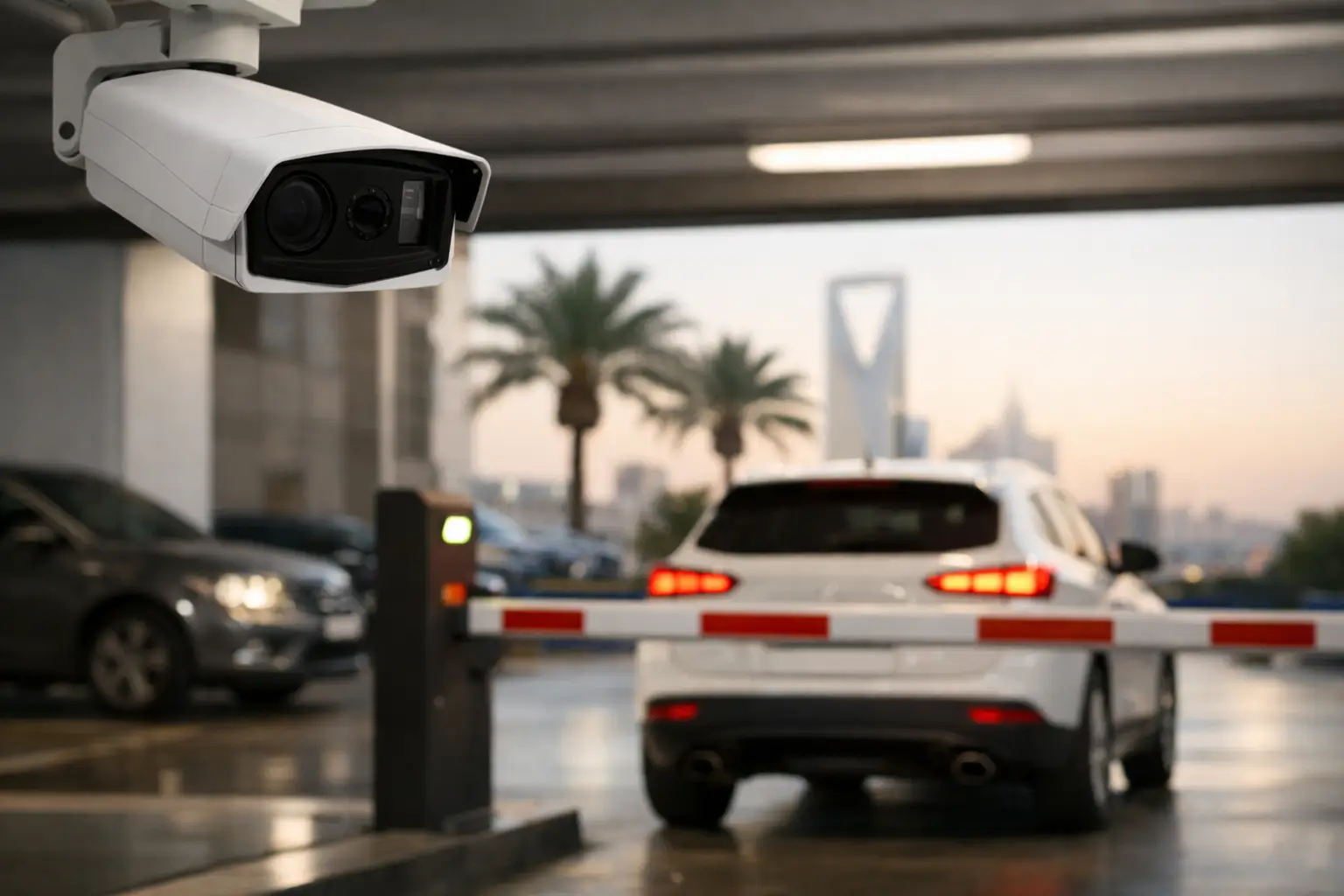
A Milesight LPR camera for license plate recognition in Saudi Arabia car parks must do more than record a vehicle entering a gate. It must capture a usable plate image at the lane, under difficult lighting, while vehicles are moving and access decisions need to be made quickly. For system integrators, consultants, and procurement teams, the specification needs to connect camera performance, lane design, network infrastructure, VMS integration, and compliance requirements.
Milesight’s LPR Pro Bullet Plus Camera is intended for this controlled vehicle-access role. It gives car park operators a dedicated recognition point rather than asking a general-purpose surveillance camera to perform a task it was not positioned or configured to handle. That distinction matters in commercial towers, airports, government facilities, logistics sites, mixed-use developments, and Vision 2030 project environments.
Why a Milesight LPR Camera Fits Saudi Car Parks
Car park entrances in Saudi Arabia can create a demanding image-capture environment. Strong daylight, low-angle sun, headlight glare, shaded ramps, reflective plate surfaces, and vehicle queues all affect the image reaching the camera. A camera selected only by resolution may produce an acceptable overview of the lane but still fail to provide a dependable plate read at the moment a vehicle passes the barrier.
The Milesight LPR Pro Bullet Plus Camera is purpose-built for license plate recognition. Its 0.002 Lux low-light capability and 140 dB WDR are relevant specifications for entrance and exit lanes where bright outdoor conditions can sit directly beside a covered parking area. WDR helps preserve detail when the background is bright and the vehicle front is in shadow. Low-light performance supports plate visibility after dark without relying entirely on a broad flood of external light.
This is also an NDAA-compliant Milesight camera platform, which is significant when procurement policy, government requirements, or consultant specifications call for traceable compliant products. Compliance should be confirmed against the final tender’s exact requirements, particularly where TAA compliance is also requested. NDAA compliance and TAA compliance are separate requirements and should not be treated as interchangeable.
LPR Recognition Is a Lane Design Question
No LPR camera can compensate for an uncontrolled lane. Recognition performance depends on the relationship between the camera and the plate at the capture point. Before selecting the final Milesight model configuration, the integrator should establish the traffic direction, lane width, vehicle speed, barrier location, expected plate orientation, mounting height, and camera-to-vehicle distance.
A dedicated LPR camera should normally view a defined approach lane rather than a wide parking forecourt. The objective is to make the plate occupy the correct portion of the image while minimizing steep horizontal and vertical angles. If one camera is expected to cover two lanes, read performance may become less predictable because each plate appears at a different distance and angle.
Saudi projects should also validate the target recognition workflow with the actual plate population expected at the site. Recognition software may need to process local plate formats, Arabic and Latin characters, visitor vehicles, fleet vehicles, and plates that are dirty, damaged, partially obscured, or mounted at unusual angles. A proof of concept using real lane conditions is more valuable than a laboratory demonstration.
Vehicle speed is another practical boundary. A barrier-controlled office car park with slow, single-file traffic is very different from an open industrial gate with vehicles arriving in bursts. Where traffic moves faster, the camera exposure, shutter configuration, mounting geometry, and trigger logic require closer attention. The design target is not simply to identify a vehicle after an incident. It is to capture an actionable plate read consistently enough to support daily operations.
From Plate Capture to Access Decision
A Milesight LPR camera can form the recognition layer of a wider parking access workflow. The camera identifies the vehicle plate, then the approved system logic can compare it with an allowlist, denylist, tenant list, visitor record, or time-based access rule. Depending on the chosen architecture, the event can trigger a barrier controller, notify security personnel, create an audit record, or send the plate and associated video to the VMS.
The camera should not be viewed as a replacement for every access-control component. At sites where people and vehicles require controlled entry, HID access control can provide the credential layer for drivers, guards, and authorized staff. HID Signo readers support RFID, NFC, Bluetooth, and mobile credential options, allowing the project to establish clear rules for pedestrian and vehicle access without forcing every decision into the camera layer.
For higher-risk or operationally complex sites, ISS SecurOS can provide the VMS and analytics environment around the LPR event. This is useful when security teams need searchable plate history, live alarm handling, camera association, and centralized monitoring across more than one entrance. The right VMS tier depends on the number of cameras, retention requirements, operator workflows, and whether the project needs a central command center view.
A sensible workflow separates three functions: accurate plate capture at the lane, access authorization through defined business rules, and video investigation through the VMS. Keeping those functions clear makes fault finding easier. If a vehicle is recognized but a barrier does not open, the issue may be in permissions or controller integration, not camera image quality.
Network and Power Must Match the Outdoor Environment
An LPR camera is a network device at a critical operational point. Loss of power or network connectivity at the vehicle gate can create delays, manual intervention, and security exceptions. The camera infrastructure should therefore be selected with the same care as the optics and analytics.
AETEK is relevant here as a PoE infrastructure brand, not as a camera brand. Its H-series outdoor PoE switches are IP67-rated for exposed field locations, while AETEK PoE extenders can support cable runs up to 250 meters where a gate is beyond normal Ethernet distance. For indoor car park cabinets and control rooms, AETEK C-series switches may be better suited to the environment.
The final power calculation should include the camera’s PoE requirement, any local network equipment, surge protection approach, enclosure conditions, and headroom for future devices. Outdoor heat, cabinet ventilation, and cable routing deserve specific review in Saudi deployments. A camera can be technically capable of reading plates, yet become unreliable if its power source or network enclosure is not designed for the operating environment.
For projects with substantial camera counts or long retention obligations, storage architecture must also be planned. Rasilient surveillance servers and forensic storage are suitable considerations where no-frame-drop recording performance is a priority, while FIBRENETIX and Dell infrastructure can support different VMS and retention architectures. The required solution depends on recording resolution, frame rate, number of LPR lanes, linked overview cameras, retention duration, and redundancy requirements.
Pair the LPR Camera With an Overview Camera
Plate recognition answers one question: which vehicle entered or exited? It does not always provide the operational context required for an investigation. For this reason, many professional car park designs use an LPR camera together with an overview camera that records the driver-side area, vehicle type, lane activity, barrier condition, and surrounding movement.
Milesight AI cameras can provide that overview layer, including TrueColor AI options where low-light color image detail is important. The overview camera should be positioned for evidential context, not forced to duplicate the LPR camera’s tight plate framing. This two-camera approach improves incident review when a plate is unreadable, a tailgating event occurs, or a vehicle is associated with a disputed access transaction.
There is a cost trade-off. A single camera may appear attractive on a small project, but it concentrates all operational and evidential expectations into one viewpoint. A dedicated LPR camera plus overview camera generally gives the operator better records and gives the integrator a clearer basis for acceptance testing.
What to Include in the Car Park Specification
A useful specification should define measurable operating conditions rather than merely state “license plate recognition required.” It should identify the number of lanes, inbound and outbound traffic direction, maximum expected vehicle speed, day and night requirements, plate formats to be tested, required read rate, integration method, barrier behavior during a system outage, and the required retention period for associated video.
It should also state who owns the plate database and who is authorized to add, remove, or export vehicle records. In government, hospitality, healthcare, and commercial developments, plate data can be operationally sensitive. The project team should agree on user permissions, audit records, retention policy, and cybersecurity responsibilities before handover.
Acceptance testing should be performed on site. Testing during bright daylight only is not enough. The project should test entry and exit conditions, nighttime operation, glare, rain or dust conditions where relevant, several vehicle classes, and realistic traffic flow. A documented test plan protects the consultant, integrator, operator, and procurement team from vague expectations.
Seven Sectors supports Saudi system integrators and procurement teams as an authorized partner for Milesight AI CCTV, AETEK PoE infrastructure, HID access control, ISS VMS, and supporting surveillance infrastructure. For a car park project, the practical starting point is a lane survey and an agreed performance brief, not a generic camera schedule.
The right Milesight LPR camera deployment gives the operator a repeatable way to connect a vehicle, a time, a lane event, and a video record. When the lane geometry, access rules, network design, and acceptance criteria are defined early, license plate recognition becomes a dependable operational control rather than another camera feed for security teams to review after the fact.
LPR deployments at car park entrances are frequently combined with the WS301 magnetic contact switch for barrier status and the TS201 cost-effective temperature sensor for equipment rooms.
Related building automation devices: WS156 smart scene panel and WS203 motion and TH sensor.
Related reading: For a broader comparison of Milesight camera options suited to parking environments, see the Best Milesight Cameras for Parking Security.
Ready to discuss your project? Contact Seven Sectors or contact us directly on +966-012 229 3474.