
A single blind spot can create problems. It might be in an airport concourse, a public lobby, or a warehouse intersection. Government reception areas often have this issue too, and several fixed cameras may still fail to close the investigation gap.
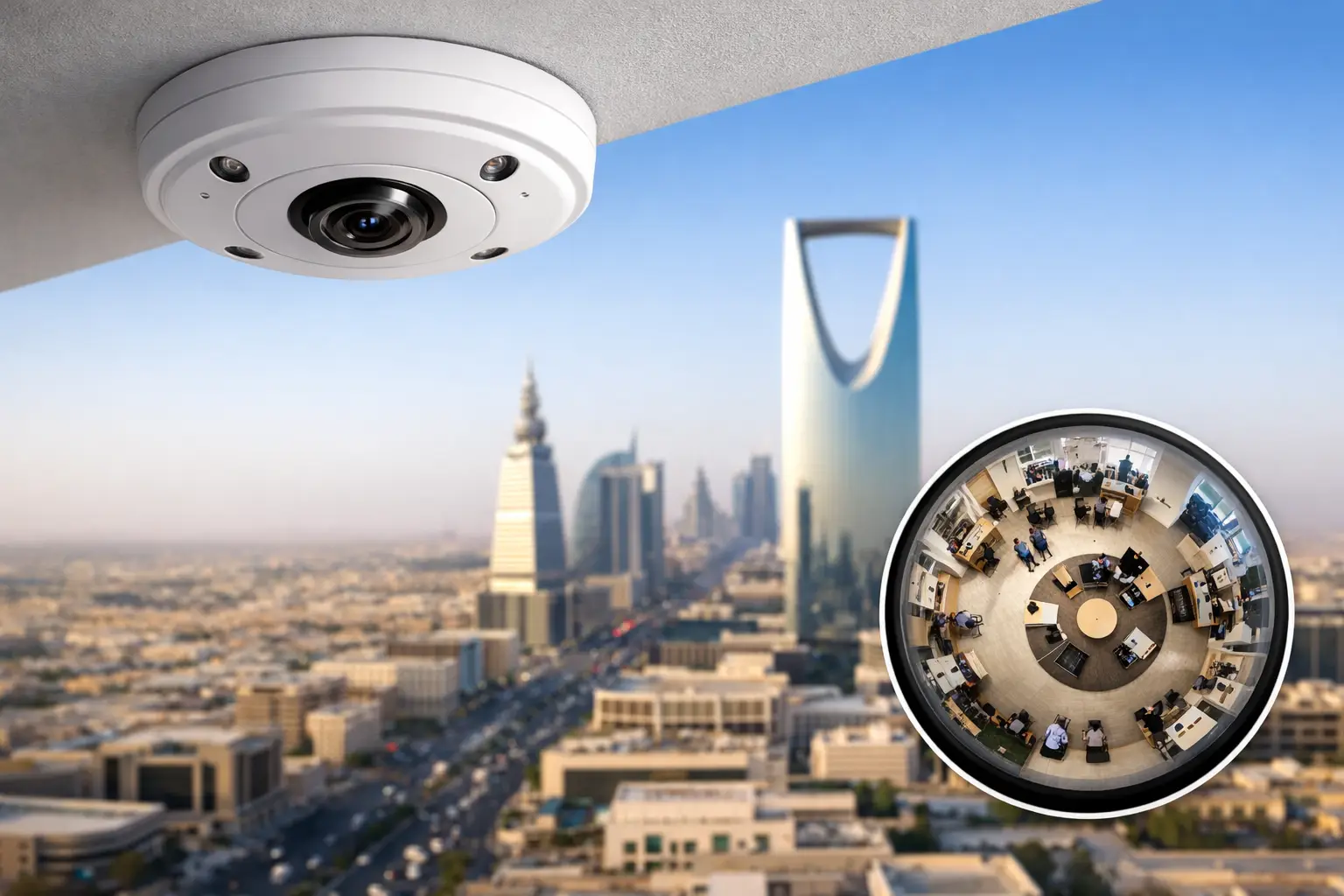
A Milesight fisheye panoramic camera 360 degree coverage Saudi Arabia deployment gives consultants and integrators a different design option. One ceiling-mounted camera can observe an entire defined area. As a result, this reduces the number of edge devices, cable runs, and mounting positions required.
For Saudi commercial, government, and Vision 2030 projects, the appeal is not simply a wider image. It is the ability to specify an NDAA-compliant Milesight panoramic surveillance point. This supports operational oversight, post-event review, and more efficient infrastructure planning.
The right result, however, depends on mounting height, scene geometry, lighting, network capacity, and the VMS environment. A fisheye camera is highly capable. But it is not a replacement for every fixed or PTZ camera in a project.
Why Milesight 360 Fisheye Coverage Changes Camera Design
Conventional fixed cameras create a familiar coverage pattern. Each camera protects one direction, and wider spaces require more devices aimed at adjacent zones. This can work well on corridors, gates, perimeter lines, and vehicle lanes.
In an open area, though, overlapping fixed-camera views can introduce unnecessary hardware. They also create complicated camera schedules and more points to maintain.
Milesight Q Series fisheye cameras are designed for panoramic viewing. They offer 360-degree coverage from an appropriate ceiling position, plus 180-degree viewing options for wall-mounted scenarios. Their value is strongest where activity can occur in multiple directions at once.
Good examples are retail floors, hotel entrances, transit waiting areas, and office reception zones. Warehouse packing areas, school common spaces, and building atriums also benefit.
The operational advantage is perspective. An operator no longer needs to move between multiple camera tiles to understand activity around a central point. A panoramic view captures the whole scene at once.
During investigation, recorded video can be digitally dewarped into more natural viewing formats, such as quad views or directional views. The exact options depend on the VMS and camera configuration.
That does not mean the original circular fisheye image disappears. The raw panoramic stream remains useful as a complete record of the scene. Dewarped views make live monitoring and evidence review more practical.
For a security control room, this distinction matters: wide coverage supports situational awareness, and dewarping supports faster interpretation.
Where a Milesight Fisheye Panoramic Camera Fits Best
The best fisheye deployments begin with the space, not the product catalog. A centrally mounted camera works particularly well when the protected area is open and its boundaries fall within a usable identification range. A square lobby, circular waiting area, indoor loading zone, or open-plan office is generally a better candidate than a long, narrow corridor.
In major Saudi developments, common applications include public-facing reception areas, command center support spaces, and mixed-use building entrances. Logistics facilities, healthcare waiting zones, educational common areas, and commercial concourses are also strong fits. On a site with several access paths, 360-degree coverage can help establish who entered and where they moved.
It can also reveal whether activity occurred outside the primary operator view.
Wall-mounted 180-degree panoramic coverage also has a clear role. It can cover the width of a hall, entrance frontage, or loading bay where ceiling mounting is impractical. The decision between 180 and 360 degrees should be based on scene shape and mounting feasibility. It should not come down to a preference for the largest possible field of view.
A fisheye camera is less suitable in some cases. These include projects that require detailed facial identification at long distances, close monitoring of a distant perimeter, or active tracking across a large outdoor site. In those cases, Milesight Pro Series fixed cameras or Milesight PTZ cameras may be the more appropriate primary device.
A PTZ provides optical zoom and operator control, while a fisheye provides persistent panoramic context. Many well-specified systems use both, with each camera assigned a distinct operational purpose.
Design Factors That Determine Useful Coverage
A 360-degree claim is only meaningful if the camera is installed in a position that lets the lens see the scene. Ceiling height is the first consideration. Mount too low, and people or fixtures can block parts of the view.
Mount too high, and subjects occupy fewer pixels, reducing the detail available for identification. Consultants should define the intended detection, observation, recognition, or identification outcome before finalizing the location.
The second factor is obstruction. Pendant lights, signage, columns, soffits, sprinkler pipework, decorative finishes, and HVAC elements can compromise a panoramic view. On projects with complex architectural ceilings, coordination with MEP and interior teams is essential before camera locations are released for installation.
Lighting requires equal attention. Strong backlight from glazed entrances, high-contrast interior spaces, and changing daylight conditions are common in Saudi commercial projects. Milesight camera technologies are relevant where scenes combine bright external light with darker internal areas. This includes TrueColor AI capabilities and 140 dB WDR on applicable models.
The exact model and its low-light performance should be selected against the project specification and actual lighting conditions. It should never be assumed from a generic camera schedule.
Network planning also affects the outcome. A panoramic camera can reduce the number of physical cameras, but it still produces high-value video that must be correctly streamed, recorded, and viewed. Bitrate settings, frame rate, retention requirements, VMS dewarping support, and storage calculations should all be assessed during the design stage.
Reducing camera count does not automatically mean reducing storage demand.
AI Analytics Need the Right Scene
Milesight AI cameras are valued because analytics can focus operator attention on relevant activity, rather than every movement in the image. Milesight AI functions can support people and vehicle classification, helping reduce nuisance alarms in suitable applications. Milesight states that its AI technology can reduce false alarms by up to 95% in applicable scenarios.
This result depends on correct rule setup, camera placement, scene conditions, and testing.
For a fisheye camera, analytics should be considered carefully. The camera sees a large area, and objects near the edge of the panoramic image can appear distorted before dewarping. Rules such as intrusion detection, people counting, occupancy awareness, or movement in a defined zone should be validated in the actual layout.
A rule that works well in a quiet lobby may need different sensitivity and exclusion zones in a busy transport or retail environment.
This is particularly relevant for government and infrastructure projects, where an alert is expected to be actionable. Excessive false alarms reduce confidence in the system and burden control-room teams. Accurate specification is therefore more valuable than enabling every available analytic feature by default.
Power, Recording, and Compliance for Saudi Projects
A Milesight panoramic camera should be treated as part of a surveillance architecture, not as an isolated device. For network power, AETEK PoE switches provide the supporting infrastructure, with appropriate series selection based on indoor, outdoor, or industrial deployment conditions. AETEK is a PoE infrastructure brand, not a camera manufacturer, and its role is to deliver managed power and connectivity to edge devices. AETEK PoE extenders can support longer runs up to 250 meters in suitable designs.
At the recording layer, the selected VMS and storage platform must support the project’s viewing and retention needs. Dell platforms can be specified for surveillance recording, server, and storage requirements according to the project architecture. The preferred platform depends on camera quantities, analytics, retention duration, redundancy expectations, and procurement standards.
For public-sector, critical infrastructure, and giga-project procurement, compliance is not a footnote. Milesight NDAA-compliant camera options and AETEK NDAA/TAA-compliant PoE infrastructure give project teams a clearer path when security sourcing requirements are strict. Procurement teams should still verify the exact model, country-of-origin requirements, approved VMS compatibility, and tender documentation before submission.
A Practical Specification Approach
Before adding a Milesight fisheye to a bill of quantities, define the protected footprint, mounting height, and lighting profile. Also define the expected subject detail and required live-view format. Then confirm whether 360-degree ceiling coverage, 180-degree wall coverage, a fixed camera, or a PTZ best serves the requirement.
This avoids a common mistake: selecting a panoramic camera for a space that needs long-range detail rather than complete situational context.
System integrators work across Jeddah, Riyadh, the Eastern Province, and Vision 2030 project zones. Local product guidance can prevent late changes to camera schedules and network calculations. Seven Sectors supports Milesight camera sourcing alongside AETEK PoE infrastructure and compatible surveillance platform requirements. This gives procurement teams a specialized Saudi partner for technically aligned supply.
The strongest panoramic deployment is rarely the one with the widest advertised view. It is the one in which the Milesight fisheye camera is positioned around a clearly defined security outcome. It should be powered correctly and recorded intelligently.
It should be specified with enough detail that the installed system performs as expected on day one.
Fisheye coverage in open-plan areas is commonly paired with the VS121 AI workplace occupancy sensor for space utilization analytics.
Frequently Asked Questions
What is the Milesight fisheye panoramic camera and how does 360-degree coverage work?
The Milesight fisheye panoramic camera uses an ultra-wide fisheye lens to capture a full 360-degree horizontal field of view from a single ceiling-mounted or wall-mounted point. The raw circular image is dewrapped into flat panoramic views, virtual PTZ views, or quad-split views by the camera’s on-board processor or the connected VMS. This eliminates coverage gaps that multiple fixed cameras might leave in large open spaces.
How many standard fixed cameras does one Milesight 360-degree fisheye replace?
In a typical large lobby, concourse, or warehouse bay, one fisheye camera can replace four to six fixed cameras covering the same area. The exact number depends on ceiling height, required image resolution, and whether AI analytics are active. The reduction in camera count, cable runs, and PoE switch ports also reduces total infrastructure cost, which matters on large Saudi projects with many similar spaces.
Is the Milesight fisheye camera NDAA compliant for Saudi government and giga-project sites?
Yes. All Milesight cameras, including the Panoramic fisheye series, are NDAA Section 889 compliant. They are not produced by any company on the prohibited list, making them appropriate for government buildings, Vision 2030 giga-projects, and procurement scopes with supply-chain requirements.
Seven Sectors can provide NDAA compliance documentation for tender submissions.
What dewarping modes does the Milesight 360-degree camera support?
Milesight fisheye cameras support multiple dewarping modes including: full-circle panorama, single panoramic strip, quad-view (four directional views simultaneously), and virtual PTZ — where operators can digitally pan and zoom within the circular image without any mechanical movement. Dewarping can run on-camera or within ISS SecurOS, Milestone XProtect, and other compatible VMS platforms.
Which Saudi facility types benefit most from Milesight 360-degree fisheye surveillance?
The strongest use cases are airport terminals and gate areas, hotel lobbies, government reception halls, large retail concourses, warehouse floor areas, stadium concourses, and open office floors. Any space that requires complete situational awareness from a single overhead point — while minimizing the number of cameras, cabling, and maintenance access points — is a candidate for fisheye deployment.
Ready to discuss your project? Contact Seven Sectors or contact us directly on +966-012 229 3474.