
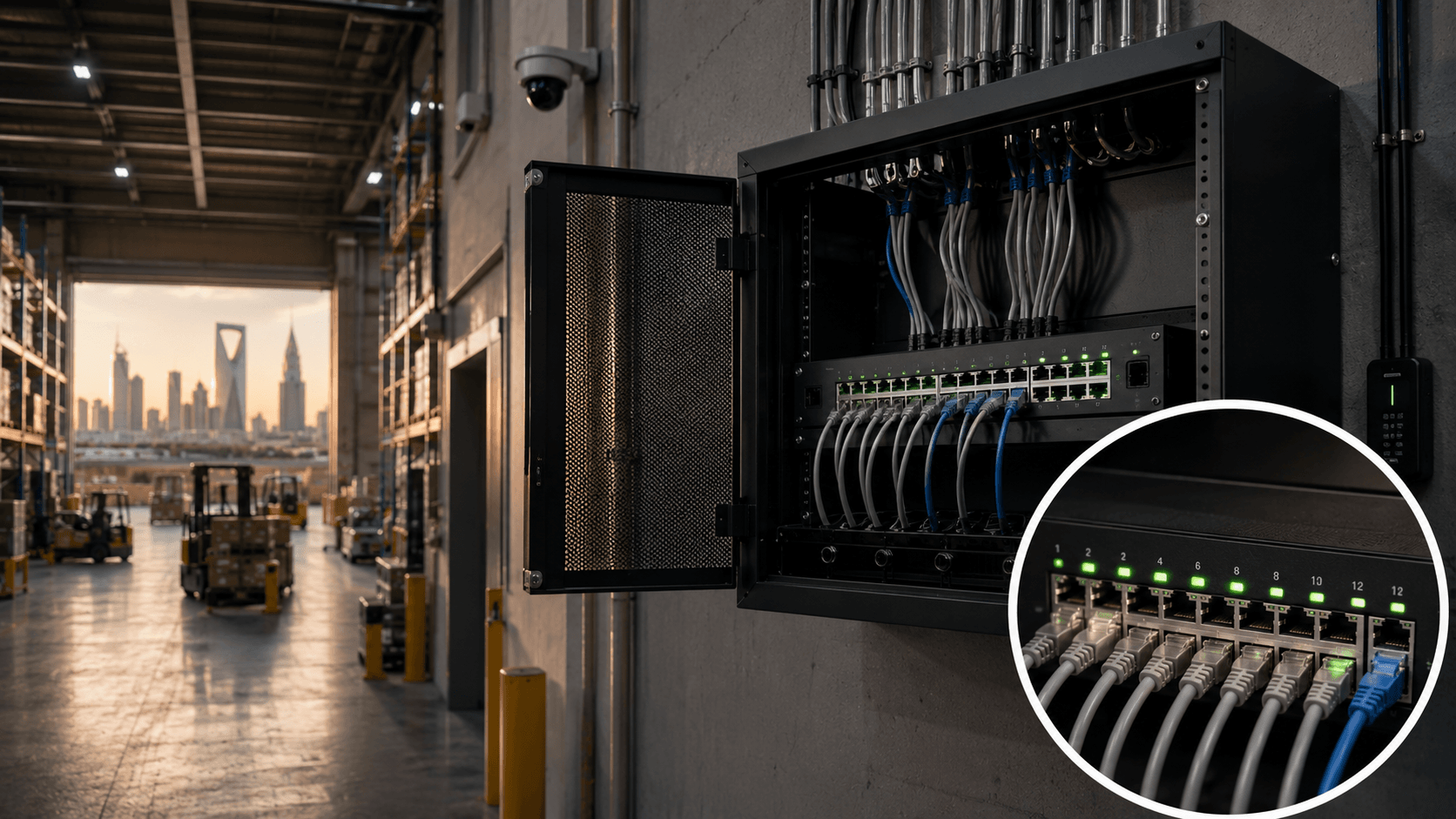
Warehouses and logistics hubs across Saudi Arabia run on a density of network-connected devices that most office buildings never see. Dock-door cameras, handheld scanner access points, PoE lighting, environmental sensors, and access-controlled staging areas all draw on the network. These devices often spread across tens of thousands of square meters of steel-frame, high-ceiling space. An industrial PoE switch built for Saudi warehouse conditions makes the difference. A well-specified network survives forklift traffic, dust, and 45-degree summer heat. A poorly specified one fails during peak shipping season, exactly when downtime costs the most.
Why warehouses and logistics hubs in Saudi Arabia demand PoE network infrastructure
Vision 2030 logistics investment is pushing warehouse operators toward one global standard. From NEOM’s Oxagon to the expansion of Jeddah Islamic Port and King Abdullah Economic City, the shift is toward converged IP networks. These networks carry video, access control, and data over a single Cat6 run instead of separate power and data cabling.
For a facility manager, that means fewer electricians on site during fit-out. It also means fewer points of failure once the facility is live. Instead of a dozen power supplies scattered across the floor, one switch handles centralized control of every powered device.
Standard commercial-grade switches lack the environmental ratings for vibration, dust ingress, and wide temperature swings inside an unconditioned warehouse shell. That gap is where industrial-rated PoE hardware becomes a genuine specification requirement. It is not a nice-to-have upgrade.
Teams that skip this step often discover the gap only after a switch fails during the first hot season. By then, a design change is no longer easy to make.
Dust ingress is a particular concern across the Kingdom’s interior logistics corridors. Unpaved yard traffic and desert conditions push particulate levels well above what a standard IP20-rated commercial switch can tolerate. Heat load inside an uninsulated steel warehouse shell adds to the problem. For several months of the year, it can exceed the operating range of consumer networking gear.
AETEK D60-244-30: what it actually does
AETEK designed the D60-244-30 24-port industrial PoE switch specifically for this environment. It is a managed, DIN-rail-mountable switch. It delivers PoE to 24 downstream ports simultaneously. One unit can cover a warehouse zone with dock doors, a staging area, and racking-mounted cameras or access points. No second switch closet is needed nearby. As part of AETEK’s D-series, it targets control-cabinet and industrial-floor installation, not server-room use. That matters when the nearest mounting point is a steel post next to a conveyor line, not a climate-controlled rack.
Key capabilities
Industrial PoE switch Saudi warehouse checklist
Before specifying a switch for the floor, confirm it covers the basics. An industrial PoE switch Saudi warehouse deployment needs five things: DIN-rail mounting for a steel post or control cabinet, an operating range wider than commercial-grade gear for vibration and heat, dust-ingress tolerance above standard IP20 commercial switches, NDAA/TAA-compliant Taiwan-made hardware for government-linked procurement, and a power budget sized against real device draw rather than port count alone.
- 24 managed PoE ports with a switch-level power budget suited to mixed camera, access-control, and wireless access-point loads
- DIN-rail industrial enclosure rated for wider temperature and vibration tolerance than commercial-grade switches
- Centralized management for port-level power cycling. This is useful for remotely rebooting a frozen camera or reader without a site visit or a technician on a lift
- NDAA/TAA-compliant, Taiwan-made hardware, relevant for any facility tied to government or giga-project procurement standards
- DC input option, giving facilities teams a path to UPS-backed power for continuity during grid interruptions on a working shift
Deployment considerations for warehouse and logistics sites
The most common design mistake on Saudi warehouse projects is treating the switch closet like an office IT rack. That means assuming ambient conditions, standard cable runs, and low vibration. In practice, PoE runs to dock-door cameras and access readers often exceed the 100-meter Cat6 limit. So pairing an industrial switch with the right PoE extender matters more here than in a typical commercial build.
Cable pathways along racking and conveyor lines also need mechanical protection from forklift and pallet-jack traffic. Switch placement should account for dust extraction and periodic cleaning cycles, not just cable-distance optimization.
Facility teams sourcing for a new distribution center should map port count against total device count, with 20 to 30 percent headroom. Warehouse fit-outs are rarely final on day one. Mezzanine expansions or additional dock doors tend to appear within the first operating year. It is also worth specifying surge protection at the switch and extender level. Outdoor dock-door runs are exposed to lightning-induced transients during the Kingdom’s rainy season.
How this fits alongside surveillance and access control
A PoE switch is infrastructure, not the finished system. It should be sized alongside an NVR storage platform built for continuous surveillance recording. A warehouse’s camera count and 24/7 recording load can outgrow standard storage quickly, especially on sites running high-resolution cameras across every dock door and aisle.
Getting the network and storage sizing right together at the design stage avoids a costly mid-project upgrade once camera counts climb past initial estimates. This is a recurring pattern on phased warehouse builds, where security scope grows after the first phase goes live.
Sites often run badge or biometric access control at loading bays and staging areas too. The same PoE backbone typically carries those readers as well. This is worth specifying at the switch-selection stage. Otherwise, a parallel cable run has to be retrofitted later, once walls and racking are already in place.
Power budgeting deserves its own line item in the design. A 24-port switch rated for a given total wattage does not mean every port can run a high-draw PTZ camera simultaneously. Undersizing this at the design stage is one of the most common reasons a warehouse network underperforms. This typically shows up once the network is fully populated with devices in its second phase of build-out.
Compliance, support and sourcing in the Kingdom
For government-linked logistics and giga-project contractors, NDAA and TAA compliance is frequently a hard procurement requirement, not a preference. AETEK’s Taiwan-manufactured PoE line meets that requirement without the compliance workarounds some regional suppliers require. Seven Sectors is AETEK’s authorized partner for the Saudi market. We supply the full industrial PoE switch specification for new-build and retrofit logistics facilities across the Kingdom.
Support runs through the same channel as sourcing. A specification question during design and a stock question during procurement go to one accountable partner. That beats juggling two separate vendors with different lead times and different answers.
FAQ
How many PoE devices can one D60-244-30 switch support?
Up to 24 downstream PoE devices per switch, with total power draw governed by the unit’s power budget. Actual device count in a live deployment depends on whether connected cameras, readers, and access points are high-draw PTZ-class devices or lower-draw fixed units. A proper bill of materials should size against real device wattage, not just port count.
Does an industrial PoE switch cost more than a commercial-grade one?
Industrial-rated hardware is a different product category, built for DIN-rail mounting and wider environmental tolerance. Seven Sectors can size a bill of materials against your specific warehouse layout on request. Contact us for a technical recommendation rather than assuming a standard commercial quote applies to an industrial environment.
Can this switch run PoE extenders for long warehouse cable runs?
Yes. AETEK’s PoE extender line pairs with its switches for runs beyond the standard 100-meter Cat6 limit. This matters in large warehouse footprints, where the switch closet sits far from perimeter dock doors or mezzanine-level equipment.
If you are specifying network infrastructure for a new or expanding logistics facility in Saudi Arabia, request a technical recommendation from Seven Sectors. We will size the switch, extender, and storage bill of materials against your actual site layout.
done
Frequently Asked Questions
Why do Saudi warehouses and logistics hubs need industrial PoE switches rather than commercial-grade equipment?
Warehouse environments expose network equipment to conditions that commercial office switches are not built for. Sustained ambient temperatures above 40°C, airborne dust and particulate from forklifts, vibration, and electrical noise from large motors all take a toll. Industrial PoE switches such as AETEK’s D-Series are rated for -40°C to 75°C operating ranges with fanless cooling and robust enclosures. In a large Saudi distribution center, this difference determines whether surveillance and access control stay online during peak summer operations.
What PoE switch specifications matter most for a large warehouse CCTV and access control network?
Key specifications for Saudi warehouse PoE networks include: operating temperature range (minimum 0°C to 60°C, ideally higher), total PoE budget per switch, PoE+ (30W) or PoE++ (60-90W) support for high-power cameras, uplink speed (Gigabit or SFP fiber for long cable runs), and NDAA compliance for any government-adjacent procurement. Redundant power input is advisable for critical distribution nodes.
Which AETEK PoE switch series is most suitable for Saudi warehouses and logistics centers?
The AETEK D-Series industrial PoE switches are the primary recommendation for warehouse floor deployment. They are designed for industrial environments with extended temperature ratings and DIN-rail or wall-mount options. The H-Series (IP67) applies to outdoor dock areas, perimeter gates, and covered loading zones exposed to elements. Seven Sectors can advise on the right series based on your warehouse layout and installation zones.
Are AETEK industrial PoE switches NDAA and TAA compliant for logistics projects in Saudi Arabia?
Yes. AETEK PoE switches are manufactured in Taiwan and carry both NDAA Section 889 and TAA compliance. This is relevant for logistics facilities operated under government contracts or serving Vision 2030 projects where supply-chain documentation is part of the site requirements. Seven Sectors provides compliance certificates alongside product supply.
How do I size a PoE switch installation for a Saudi warehouse surveillance project?
Start with the camera count per zone, each camera’s PoE class requirement, and the cable run distances from each switch point. Then map the uplink route to the central NVR or VMS server. Seven Sectors will review your floor plan or BOQ and recommend the switch model, port count, PoE budget, and cabling approach for each network node. We will also provide a formal quote in SAR.
Ready to discuss your project? Contact Seven Sectors or contact us directly on +966-012 229 3474.