
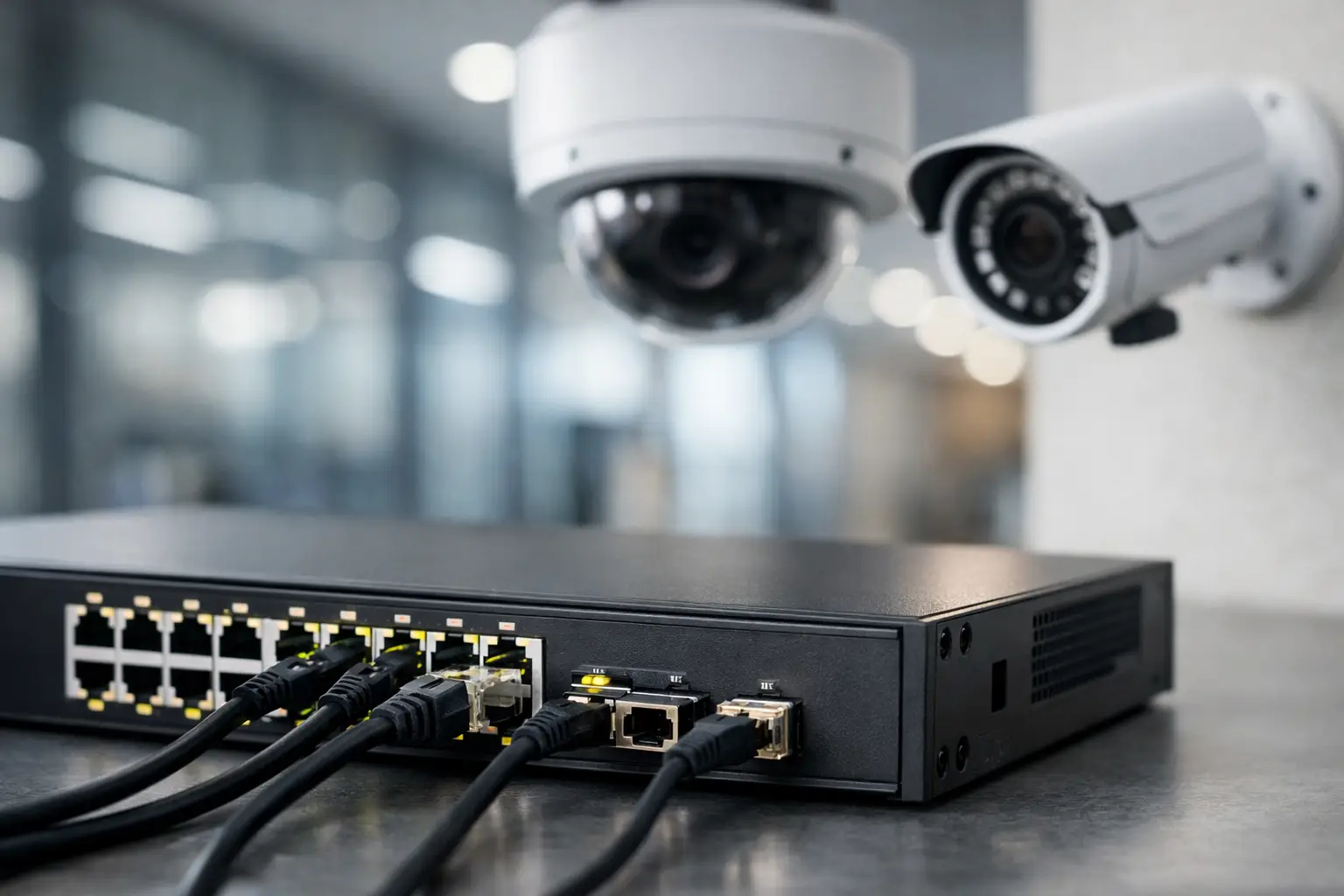
A PoE switch for IP cameras is not a minor network accessory in a commercial CCTV project. It is the power and communications layer that determines whether cameras remain online at the far end of a parking area, perimeter road, plant yard, or multistory building. For Saudi system integrators and procurement teams, specifying the correct AETEK PoE infrastructure protects camera availability, simplifies field deployment, and avoids costly redesigns after equipment reaches site.
AETEK is a Taiwan-made PoE infrastructure manufacturer, not a camera brand. Its H-series outdoor switches, C-series indoor switches, D-series industrial switches, ceiling-mounted PoE switches, and PoE extenders address different parts of a surveillance network. Selecting among them requires more than counting ports. The decision must account for power budget, cable distance, uplink architecture, environmental conditions, and the uptime requirements of the project.
Start With Camera Power, Not Port Count
A 16-port switch is not automatically suitable for 16 cameras. Every PoE switch has a total power budget, and every endpoint has a power demand that can change during operation. A fixed bullet camera may use modest power under normal conditions, while an AI camera with IR illumination, heater, wiper, or active analytics can draw significantly more at night or in adverse weather. PTZ cameras require particular attention because pan, tilt, zoom, IR, and heater functions can create higher peak demand.
The correct approach is to document each camera model, its PoE class or maximum wattage, and its anticipated peak operating condition. Add the required load across all connected devices, then retain sensible headroom rather than designing precisely to the published maximum switch budget. Headroom allows for startup demand, later camera additions, and realistic operating variation.
This matters when connecting advanced cameras such as Milesight AI models. A Milesight Pro, PTZ, panoramic, or LPR deployment may have different power characteristics depending on the specific model and enabled functions. Camera selection and AETEK switch selection therefore deserve joint review at the bill-of-materials stage, not treatment as independent procurement packages.
Choose the AETEK Series for the Site Environment
The cabinet or mounting location is often the fastest way to narrow the switch choice. Indoor telecom rooms, ceiling spaces, roadside cabinets, and industrial process areas are not interchangeable environments.
C-Series for Controlled Indoor Networks
AETEK C-series switches are suited to indoor CCTV and security networks where equipment is installed in a controlled technical space or approved enclosure. These deployments are common in commercial buildings, education facilities, hospitality, offices, and central security rooms. The key considerations remain available PoE power, copper port quantity, and the uplink capacity back to the aggregation layer.
A switch serving a modest group of cameras may be adequate with a conventional uplink. A switch aggregating multiple high-resolution streams, especially from AI cameras or panoramic views, may need greater uplink capacity. Network design should account for actual video bitrate, recording mode, and retention policy. It should also confirm whether live viewing will occur simultaneously from a control room.
H-Series for Outdoor CCTV Points
Outdoor surveillance frequently creates the hardest infrastructure decision. Cameras may be mounted across vehicle gates, fence lines, warehouses, substations, ports, or external building elevations where placing a conventional indoor switch is impractical. AETEK H-series outdoor PoE switches provide an IP67-rated option for exposed or harsh field locations.
IP67 protection does not remove the need for sound deployment practice. Integrators should still consider cabinet placement, cable entry, grounding, surge protection strategy, local power availability, solar exposure, and service access. In Jeddah and other coastal areas, heat, dust, humidity, and corrosion risk all deserve consideration in the equipment selection process. A switch that is technically operational but inaccessible for maintenance is not a good field solution.
D-Series for Industrial Conditions
For industrial sites, utilities, transport facilities, and infrastructure projects, AETEK D-series industrial PoE switches are the more appropriate category to evaluate. These environments can introduce vibration, temperature variation, electrical noise, and operational constraints that are not typical in an office CCTV network.
Industrial switching should be selected alongside the project’s enclosure, power, and network-resilience requirements. If a surveillance camera supports a critical operational or safety workflow, the network path deserves the same level of scrutiny. Specify it with the same rigor as the camera itself. Procurement teams should ask for an end-to-end architecture. It should identify field switch locations, fiber handoff points, backup power arrangements, and the consequence of a single switch failure.
Distance Is a Design Constraint
Standard Ethernet cabling has a practical channel limit of 100 meters. On large compounds and linear sites, this becomes a frequent issue. Adding an unplanned local power source, installing a secondary cabinet, or changing the camera location late in the project can affect both schedule and cost.
AETEK PoE extenders can extend PoE and Ethernet transmission to 250 meters, depending on the system configuration and endpoint power requirements. This is useful for selected perimeter cameras, gatehouses, long corridors, parking zones, and remote structures where a standard copper run is insufficient.
However, an extender is not simply a cure for every long cable route. The remaining power delivered at the far end must be verified against the camera’s requirement. Cable quality, conductor size, temperature, connector quality, and the number of devices in the path affect the result. For distant PTZ cameras or power-hungry devices, fiber with local power or a properly engineered field-switch arrangement may be the better option. The right answer depends on the actual camera load and site topology.
Uplinks Must Carry the Video Load
PoE power is only half the switch selection. The switch must also move video reliably toward the VMS and recording platform. A project can have fully powered cameras and still suffer from poor live video performance, recording gaps, or congested uplinks if network bandwidth has been underestimated.
Calculate bandwidth based on codec, resolution, frame rate, scene complexity, VBR behavior, and recording profile. Do not use a single nominal bitrate for all cameras. An LPR lane, a busy entrance, or a panoramic camera covering a wide public space can behave very differently from a low-activity indoor corridor camera.
At the core, the server and storage platform must be specified for the recorded workload as well. ISS SecurOS can support enterprise video management and analytics workflows, while Rasilient, FIBRENETIX, and Dell platforms address surveillance server and storage requirements in different project architectures. AETEK switching should be considered part of this complete video path, from camera edge to recording and operator workstation.
Power Resilience and Field Maintainability
For government facilities, critical infrastructure, and large Vision 2030 developments, resilience should be visible in the specification. Determine which field switches are fed from UPS-backed power, which are connected to generator-backed circuits, and how loss of a cabinet or uplink affects camera coverage. These questions are especially relevant where cameras protect entrances, perimeters, vehicle routes, or critical assets.
Maintainability also deserves procurement attention. Label field ports and uplinks, preserve switch power-budget records, and document the connected camera at every port. When a future expansion is requested, this information allows the integrator to assess whether spare ports also have spare power and available network capacity. It prevents a common mistake: treating an unused PoE port as proof that another camera can be added.
For outdoor switches, keep service access and replacement procedures practical. A field device should be identifiable by cabinet, zone, and network address. Clear documentation reduces downtime when site teams must isolate a fault or replace a component.
NDAA/TAA Compliance for Specified Projects
Government procurement teams and consultants increasingly require verified compliance positioning, particularly on sensitive facilities and Vision 2030 programs. AETEK’s Taiwan-made PoE infrastructure is NDAA/TAA-compliant, making it a relevant option where these requirements form part of the tender or approved-material process.
Compliance should be confirmed across the relevant supplied scope, not assumed from a single component. The same discipline applies to the camera, VMS, server, storage, and access-control layers. Milesight AI cameras are NDAA-compliant, and project teams should validate the exact compliance documentation and specification requirements before submission.
Source AETEK PoE Infrastructure With Project Context
The best AETEK selection is the one that fits the project’s cameras, cable routes, cabinet environment, network uplinks, and compliance schedule. A low-cost switch that lacks power margin or environmental suitability can create a much higher cost in commissioning delays, replacement work, and lost surveillance coverage.
Seven Sectors is an authorized Saudi partner for AETEK PoE infrastructure, supporting system integrators, consultants, and procurement teams with product availability and technically relevant sourcing for projects across the Kingdom. Contact Seven Sectors at info@7sectors.com or use the website’s Get Quotation form for pricing and availability. A clear camera schedule and network topology are the most useful starting point for a dependable PoE specification.
Ready to discuss your project? Contact Seven Sectors or contact us directly on +966-012 229 3474.