
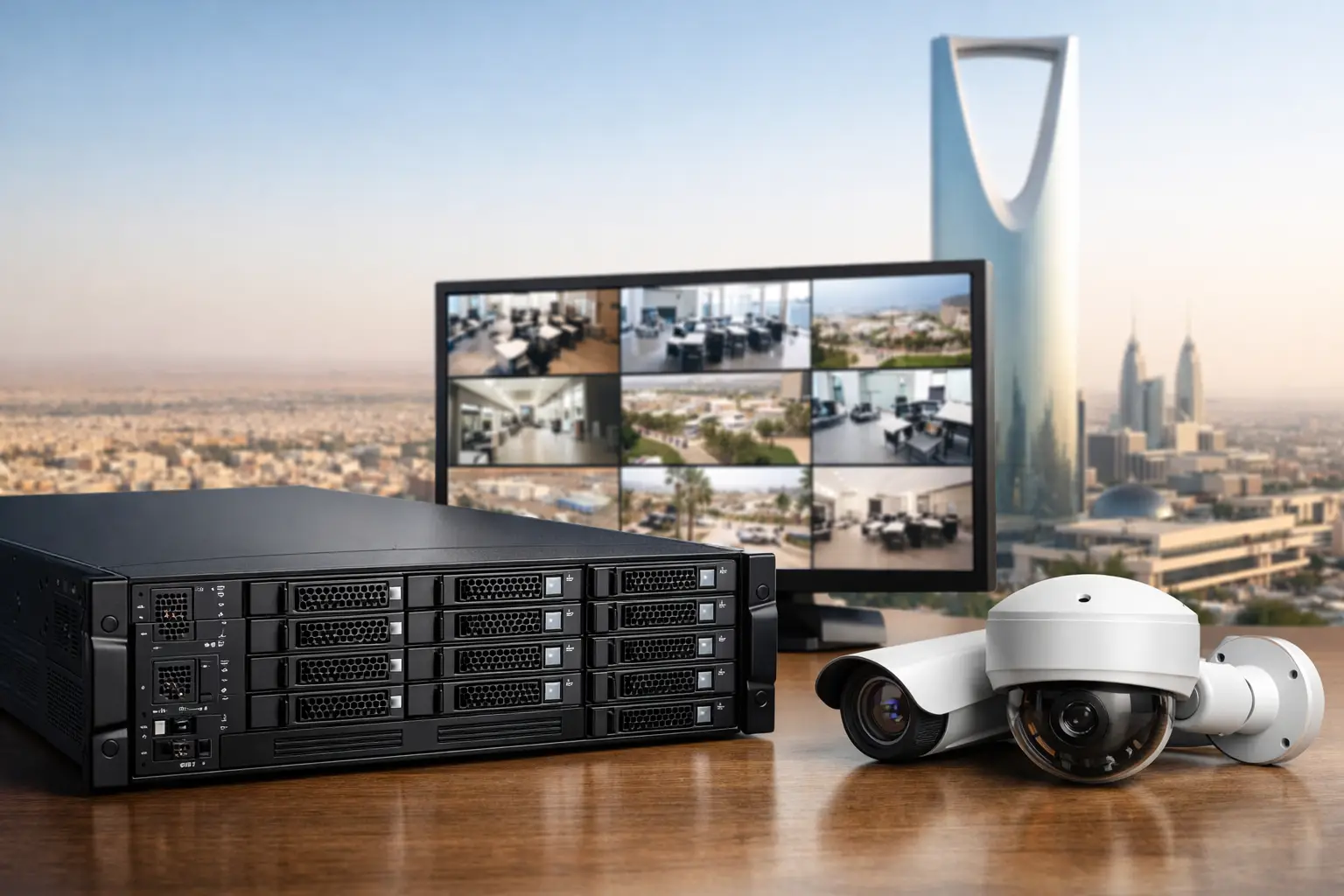
Surveillance storage servers for data centers in Saudi Arabia sit at the center of Vision 2030 digital infrastructure plans. Every data center runs surveillance around the clock — racks, corridors, loading docks, and perimeter fencing all need continuous recording that cannot afford a dropped frame during an incident review. For consultants specifying storage behind a data center’s CCTV system, the storage layer is not a commodity add-on. It is the one component that determines whether footage is there when compliance, security, or a client audit requires it.
Why data centers in Saudi Arabia demand purpose-built storage
A data center is one of the highest-scrutiny sites a security integrator will ever wire. Client audits, ISO and tenant compliance requirements, and internal incident investigations all depend on footage being retrievable, not just recorded. Standard NVR storage built for a retail branch often cannot handle the sustained, many-camera write load a data center campus generates 24/7. A dropped frame during the wrong five minutes can turn a routine audit into a real liability question.
Saudi data center operators — whether hyperscale campuses, colocation providers, or enterprise server rooms tied to giga-projects — face increasing pressure from tenants and regulators to prove footage retention and integrity, not just camera coverage. That shifts the specification from ‘how many cameras’ to ‘can the storage layer guarantee no frame is ever dropped.’
FIBRENETIX enterprise servers: what the platform actually does
FIBRENETIX builds enterprise-grade CCTV servers, NVRs, and specialist surveillance storage designed specifically for continuous, high-camera-count recording environments — the kind of sustained write load a data center campus produces every hour of every day. The platform keeps ingesting and writing footage reliably under full load. This is exactly the scenario where lower-grade storage starts silently dropping frames long before anyone notices.
Key capabilities
- Enterprise-grade CCTV server and NVR hardware built for continuous, high-camera-count recording
- Engineered for sustained write loads rather than short recording bursts
- Positioned for VMS-agnostic deployment behind whichever platform a data center already runs
- Built for environments where footage retrieval integrity is a compliance requirement, not a convenience
- Scales from a single server room to a full campus of racks and corridors
Deployment considerations: surveillance storage servers for Saudi data center sites
Surveillance storage servers for data centers in Saudi Arabia require a different specification approach than standard commercial security storage. The camera counts, retention obligations, and compliance scrutiny are on a different scale entirely.
Data center security specification differs from a typical commercial site in a few important ways. Camera counts per square meter tend to be much higher across racks, cold aisles, and corridors. Retention periods follow tenant contracts or national compliance requirements, not the integrator’s default preference. Storage sizing must account for the highest-resolution cameras running continuously, not an average across the whole camera count. A single missed high-resolution stream is exactly what auditors flag during an incident review.
Physical placement of the storage hardware also matters at this class of site. Consultants should plan for the server room’s own power redundancy and cooling to extend to the surveillance storage layer. A storage outage during a facility-wide event is precisely when security teams most need the footage.
Facility teams should also weight vendor support response time heavily in the specification. A data center rarely tolerates a multi-day wait for a storage vendor to diagnose a fault. Integrators scoping this class of project should confirm regional support turnaround before committing to a platform — not after a fault ticket is already open.
Redundancy and failover planning
Redundancy deserves its own line item in a data center security bill of materials. Unlike a retail branch where a brief storage gap is an inconvenience, a data center’s tenants may contractually require proof of continuous coverage. The surveillance storage layer needs the same failover thinking as the data center’s own compute and power infrastructure. This means redundant write paths, health monitoring that alerts before a drive fails, and a clear recovery procedure the facility team has tested — not just documented. Seven Sectors also supplies RASILIENT NFD storage for sites with similar zero-dropped-frame requirements, and consultants comparing platforms should weigh both against the specific compliance and retention obligations of the site rather than defaulting to a single brand out of habit.
How this fits alongside VMS and network infrastructure
Surveillance storage does not operate in isolation. It sits behind whichever VMS platform the data center runs. The storage server depends entirely on the PoE and network switching layer feeding cameras reliably into it — a storage server is only as good as the video actually reaching it. Seven Sectors has covered how ISS SecurOS VMS deployments handle continuous, high-camera-count environments, and the same reliability requirements apply directly to a data center’s storage layer: the VMS, the network, and the storage all have to hold up together, not just individually.
Giga-project timelines add a scheduling pressure most commercial security jobs never face. Data center builds tied to national infrastructure programmes often have fixed commissioning dates the security package cannot push. Consultants should confirm storage hardware lead times and regional support availability early in design — not during a delayed handover. Consultants who bring storage vendor lead-time confirmation into the initial bill of materials conversation, instead of treating it as a late-stage procurement detail, consistently avoid the last-minute substitutions that compromise a spec.
Compliance, support and sourcing in the Kingdom
Seven Sectors Trading Co. is an authorized partner for FIBRENETIX in the Saudi market, supplying system integrators and security consultants specifying storage for data centers, government facilities, and other high-scrutiny sites. We work exclusively through the trade, which means integrators get direct product guidance and stock visibility without a manufacturer-direct sales layer slowing a project down. See more Seven Sectors security infrastructure coverage. FIBRENETIX is a separate platform from Dell’s server line — the two are not interchangeable, and a consultant specifying one should not assume compatibility or support overlap with the other.
Surveillance Storage Platforms — Positioning Comparison
| Specification | FIBRENETIX | RASILIENT (PixelStor / ApplianceStor) | Dell PowerEdge |
|---|---|---|---|
| Platform Type | Enterprise CCTV server / NVR / storage | Purpose-built surveillance server & forensic storage | General-purpose enterprise server |
| Recording Technology | Engineered for sustained, high-camera-count write loads | No Frames Dropped (NFD) technology | Standard enterprise RAID (not surveillance-specific) |
| Form Factor | Server / NVR chassis (project-specified) | 1U/3U NVR & appliance formats | Rack server (PowerEdge line) |
| VMS Compatibility | VMS-agnostic | VMS-agnostic (ISS SecurOS, Milestone, major VMS) | Compute/OS layer — not surveillance-specific |
| Best Fit | Data centers, government, high-scrutiny sites | Government, oil & gas, smart cities, zero-gap requirements | General VMS/command-center compute — not a substitute for surveillance-grade storage |
* FIBRENETIX and Dell PowerEdge are separate platforms serving different roles and are not interchangeable. Contact Seven Sectors to confirm exact server/storage configuration, capacity, and VMS compatibility for your project.
Need the full datasheet or project spec?
We’ll send you official documentation + B2B pricing within 2 hours.
FAQ
Is FIBRENETIX a VMS or an NVR/storage platform?
FIBRENETIX is enterprise CCTV server and storage hardware — not a VMS. FIBRENETIX runs behind whichever VMS platform a data center chooses, providing the reliable recording and storage layer that platform depends on.
How does storage sizing work for a data center campus versus a typical commercial site?
Sizing has to account for much higher camera density per square meter and for the highest-resolution cameras on site running continuously, since retention requirements at data centers are frequently driven by tenant contracts or compliance obligations rather than a general default.
Does FIBRENETIX work with our existing VMS, or does it require a specific platform?
FIBRENETIX deploys behind the VMS a site already runs rather than forcing a platform switch. Confirm specific compatibility for your chosen VMS with Seven Sectors before finalizing a bill of materials. This is worth flagging explicitly to procurement teams who default to whichever server brand they last specified: FIBRENETIX and Dell PowerEdge serve different roles on a security network and should never be treated as interchangeable line items on the same bill of materials.
If you are specifying surveillance storage for a data center or high-scrutiny facility in Saudi Arabia, request a technical recommendation from Seven Sectors and we will help size the server and storage layer around your camera count and retention requirements.
See the full Surveillance Storage & Servers overview for the complete Rasilient, Dell and Fibrenetix range.
Ready to discuss your project? Contact Seven Sectors or contact us directly on +966-012 229 3474.