
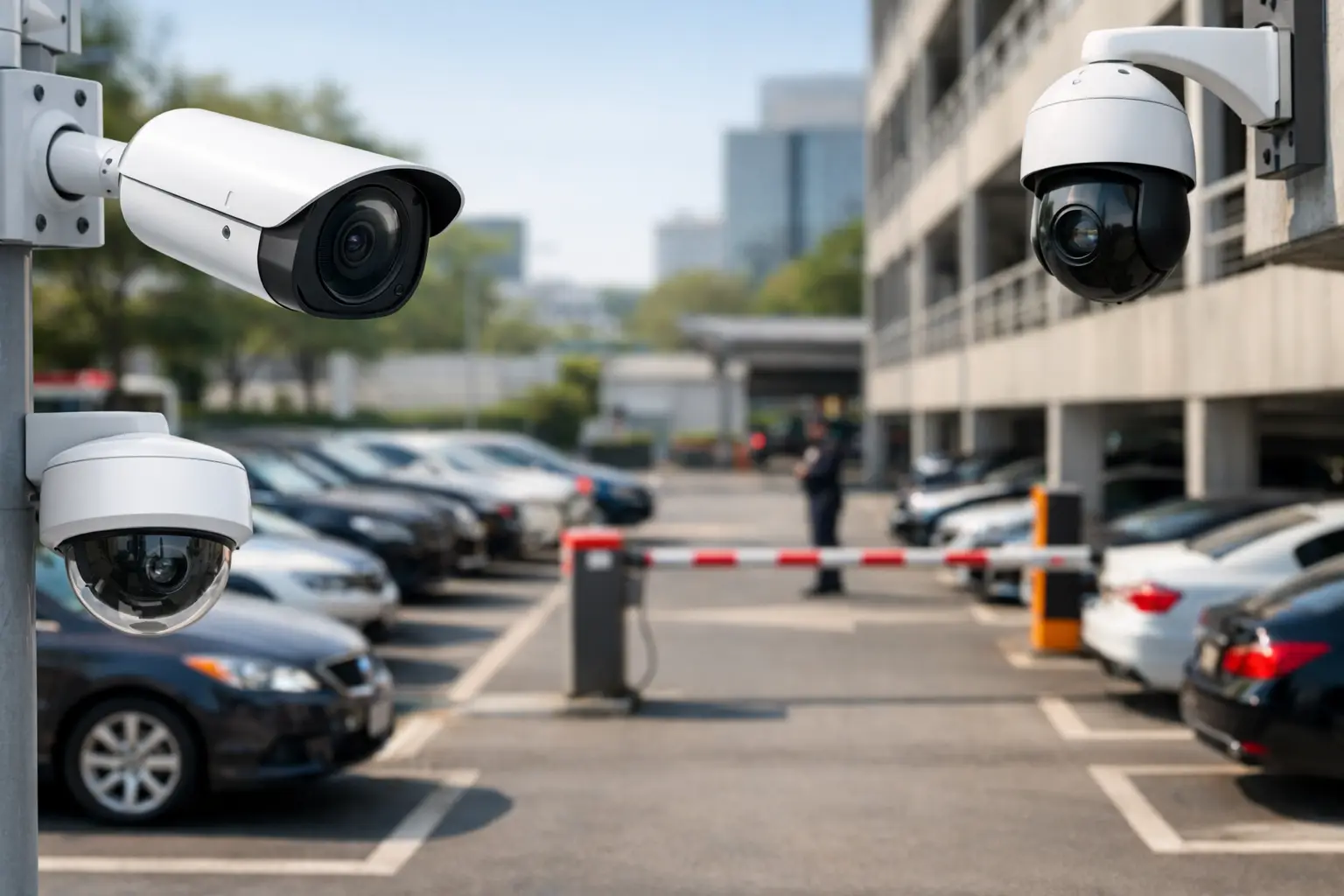
A parking facility can have excellent general surveillance and still fail at the point where incidents matter most: the vehicle entrance, payment exit, pedestrian route, or isolated deck. The best Milesight cameras for parking security are not one camera type deployed everywhere. They are a coordinated selection of Milesight LPR, panoramic, PTZ, and AI camera models matched to the operational risk at each zone.
For system integrators, consultants, and procurement teams, this distinction affects more than image quality. It determines whether operators can associate a vehicle with a plate, investigate a collision across a wide deck, verify a suspicious person after dark, and retain usable evidence without overbuilding the project. Milesight’s NDAA-compliant AI camera portfolio provides practical options for commercial, government, transport, hospitality, and mixed-use parking projects across Saudi Arabia.
Start With Parking Zones, Not a Camera Count
A parking-security specification should begin with coverage objectives. Entry and exit lanes require capture of vehicle identity. Open decks and surface lots require broad situational awareness. Ramps, pedestrian doors, elevator lobbies, payment stations, and loading interfaces require identification-level coverage and intelligent event detection. Perimeter roads need the ability to follow an unfolding event beyond a fixed camera’s field of view.
Treating all of these areas as a standard fixed-bullet deployment creates gaps. A wide-angle view that works well for a deck cannot reliably provide license-plate evidence at a moving vehicle lane. Conversely, a tightly framed LPR camera is not intended to replace overview coverage. Select Milesight cameras as layers. Each layer should deliver a specific evidentiary or operational outcome.
Lighting is the other defining condition. Parking structures combine bright external daylight, shaded ramps, reflective painted surfaces, headlights, and low-light interiors. In appropriate Milesight models, TrueColor technology, low-light performance down to 0.002 lux, and 140 dB WDR address these difficult lighting conditions. Without these capabilities, plate reflections and vehicle headlights would obscure useful detail. The final choice must still be validated against actual lane speed, mounting distance, illumination direction, and local site conditions.
Milesight LPR Pro Bullet Plus for Entry and Exit Lanes
For controlled vehicle lanes, the Milesight LPR Pro Bullet Plus Camera is the priority recommendation. It is purpose-built for license plate recognition rather than general scene viewing. That makes it the correct choice for gates, barriers, visitor entrances, staff parking, logistics access points, and paid-parking exits.
The key value of an LPR camera is not simply recording a passing car. It is capturing a plate in a usable, searchable form that can support investigations, access workflows, and parking enforcement. This requires disciplined placement. Align the camera to the expected vehicle approach. Maintain a controlled capture zone with limited variation in speed, plate angle, and headlight glare. A poorly positioned LPR camera can underperform regardless of its analytics capability.
For Saudi projects, consultants should account for local plate formats, dual-language content where applicable, and the vehicle mix on site. Also consider plates that are dirty, partially occluded, or mounted at nonstandard angles. LPR analytics should be specified as an operational tool with realistic exception handling, not as a claim that every plate is readable in every weather, speed, or lighting condition.
A common design approach is to pair the Milesight LPR Pro Bullet Plus Camera with a separate overview camera aimed at the lane and barrier. The LPR view supplies vehicle identity, while the overview image provides context: driver-side activity, tailgating, barrier damage, or a vehicle changing lanes. This two-view approach is particularly valuable in government and commercial facilities where incident evidence must stand up to later review.
Milesight Q Series for Decks and Open Parking Areas
Milesight Q Series panoramic cameras are a strong fit where a large area must be monitored from a limited number of mounting points. The series includes 360-degree fisheye and 180-degree dual-sensor options, making it useful for indoor parking decks, open lots, circulation zones, and intersections where several aisles meet.
A 360-degree fisheye camera is often suitable for a central ceiling position in a parking level, where the objective is to observe vehicle movement, pedestrian activity, and occupancy-related events across the surrounding area. Its advantage is coverage efficiency. Instead of placing several conventional cameras around one central zone, a properly positioned panoramic camera can provide a continuous overview.
The trade-off is detail at the outer edge of the scene. Panoramic coverage is valuable for understanding what happened and where it started, but it should not be treated as the only evidence source for distant faces, plates, or transactions. Use dedicated Milesight Pro Series cameras at entrances, pedestrian doors, pay stations, and high-risk bays where identification detail is required.
Milesight 180-degree dual-sensor panoramic cameras can be preferable at a building edge, along a façade, or at the end of a long parking aisle. They provide a broad horizontal view without the full circular image of a fisheye. For consultants, the decision between 180-degree and 360-degree coverage comes down to geometry: use the camera that covers the required scene without spending pixels on walls, ceilings, or areas outside the risk zone.
Milesight Pro Series for Critical Fixed Views
Milesight Pro Series cameras are the practical fixed-camera layer for high-priority parking scenes. They suit locations where a defined field of view needs consistent detail, such as ramp entrances, pedestrian crossings, stairwell doors, cashier points, EV charging bays, loading-dock transitions, and access-controlled staff areas.
This is where AI-based event filtering can improve operator efficiency. Milesight AI functions can distinguish people and vehicles from non-target motion, helping reduce nuisance alerts caused by shifting light, rain, shadows, or general environmental movement. Milesight positions its AI capability as achieving up to a 95% false-alarm reduction in relevant scenarios. Actual results depend on scene configuration, analytic rules, camera positioning, and the discipline used in alarm management.
For a multi-level car park, fixed Pro Series cameras normally provide the backbone of the design. Position them to create traceable movement between key zones. If a vehicle appears on one deck, the operator should be able to follow its route toward ramps, exits, and pedestrian access points. A single distant overview camera is not sufficient for that.
Milesight PTZ Cameras for Perimeter and Active Response
Milesight PTZ cameras, available with 12X to 23X optical zoom options, are best used as an active-response layer. They are effective for large surface parking lots, perimeter roads, stadium parking areas, airport forecourts, and sites where security personnel need to verify an alert at distance.
A PTZ camera provides flexibility that fixed cameras cannot. An operator can zoom toward a vehicle of interest. They can also follow a person moving between rows, or inspect an incident beyond the original field of view. This makes PTZ particularly useful where a parking area connects to a wider campus perimeter.
However, PTZ should not be the only camera protecting a large area. While it is focused on one target, it is not watching every other direction. Fixed Milesight panoramic and Pro Series cameras should maintain continuous recording coverage. The PTZ adds live verification and tracking capability. This combination is more reliable than expecting a single PTZ to cover an entire lot autonomously.
Network, Storage, and Tender Compliance Matter
Camera selection is only part of a parking-security bill of materials. Outdoor and parking-deck locations may require weather-resistant network equipment, long cable runs, and careful power planning. AETEK H-series outdoor PoE switches offer IP67-rated infrastructure options for exposed locations, while AETEK PoE extenders can support runs up to 250 meters where conventional Ethernet distance is a constraint. AETEK is the PoE infrastructure layer, not the camera layer.
For larger facilities, storage must be sized for continuous recording, LPR events, panoramic streams, retention requirements, and investigation needs. The number of cameras alone is not enough. Resolution, frame rate, bitrate controls, recording mode, and retention policy all affect storage demand. Integrators can pair the camera layer with appropriately specified surveillance storage and VMS infrastructure based on the project’s retention and evidence requirements.
Document NDAA compliance early in government, critical infrastructure, and Vision 2030 tender discussions. Milesight’s NDAA-compliant camera range gives procurement teams a clearer path where compliance requirements influence approved-product selection. Tender documents should also define cybersecurity expectations, user access controls, audit requirements, and acceptance testing for LPR performance rather than treating these items as afterthoughts.
Specify the Camera by the Evidence You Need
The strongest parking design uses four camera types. These are the LPR Pro Bullet Plus Camera at vehicle lanes, Q Series panoramic cameras for broad deck visibility, Pro Series cameras for fixed critical views, and PTZ cameras for large-area verification. That combination can be adjusted for a compact commercial garage, a hospital visitor facility, an industrial logistics yard, or a major public venue without losing sight of each camera’s role.
Seven Sectors supports Saudi system integrators and procurement teams as an authorized partner for Milesight AI cameras, helping source the right camera mix for project requirements, compliance needs, and dependable long-term supply. The useful next step is not to ask which camera has the highest specification on paper, but which camera will produce the evidence the operator needs at each parking-zone decision point.
These parking cameras pair well with occupancy analytics such as the VS133/VS135 AI ToF people counting sensor and the VS350 passage people counter for tracking flow at entrances.
Additional occupancy sensors: VS360 IR breakbeam people counter, VS351 mini AI thermopile people counter.
Milesight Camera Series — Specification Comparison
| Specification | LPR Pro Bullet Plus | Q Series Panoramic | Pro Series | PTZ |
|---|---|---|---|---|
| Primary Use | Vehicle plate capture at gates/lanes | Deck & open-area overview | Fixed critical views (ramps, doors, EV bays) | Active response, perimeter, large lots |
| Field of View | Fixed, lane-aligned | 360° fisheye or 180° dual-sensor | Standard fixed FOV | Pan-tilt, wide coverage |
| WDR | Up to 140dB | Up to 140dB | Up to 140dB | Up to 140dB |
| Low-Light | IR-assisted for plate legibility | TrueColor, down to 0.002 Lux (model-dependent) | TrueColor, down to 0.002 Lux (model-dependent) | IR/low-light per model |
| AI Analytics | LPR / plate recognition | People/vehicle AI detection | Up to 95% false-alarm reduction | AI-assisted tracking |
| Zoom | Varifocal (lane-matched) | Fixed panoramic (no optical zoom) | Fixed/varifocal | 12X–23X optical |
| NDAA | Available | Available | Available | Available |
* Exact specification varies by model within each series. Contact Seven Sectors to confirm the model and NDAA-compliant configuration for your project.
Ready to order or need pricing?
Seven Sectors is the authorized partner in Saudi Arabia. B2B pricing · VAT invoice · Fast delivery.
📞 Call Us for Pricing
✉ Email for Quote
Mon–Sat · Jeddah, KSA · CR 4030312891
Frequently Asked Questions
Which Milesight camera is best for a parking deck with poor lighting?
For low-light parking environments, Milesight TrueColor AI cameras with 0.002 Lux sensitivity and full-colour night vision are the primary recommendation. They eliminate the need for supplementary lighting in many multi-storey decks while maintaining colour detail for evidence purposes. For perimeter lanes and entry/exit points, Milesight LPR models with IR illumination provide reliable plate capture.
Can Milesight cameras cover a full parking level with fewer mounting points?
Yes. Milesight 180-degree dual-sensor panoramic cameras can replace two or more fixed cameras in open parking areas, reducing cabling, mounting, and licensing costs. For complete bay-level coverage without blind spots, the dual-sensor format is the more practical choice compared to 360-degree fisheye in elongated parking layouts.
Do Milesight parking cameras integrate with LPR access control for automated barriers?
Milesight LPR cameras can be integrated with access control platforms to automate barrier operation, deny-list alerts, and entry logs. Combined with Milesight AI cameras for pedestrian detection, the system supports both vehicle and foot-traffic security management from a single VMS interface. Seven Sectors can assist with the integration design for your parking project.
Are Milesight cameras suitable for outdoor parking in Saudi climate conditions?
Milesight outdoor camera housings are rated for high ambient temperatures and dusty environments common across Saudi Arabia. IP67 ingress protection and operating temperature ranges suitable for KSA conditions are available across the outdoor product range. Seven Sectors can specify the correct model for your site environment.
Ready to discuss your project? Contact Seven Sectors or contact us directly on +966-012 229 3474.