
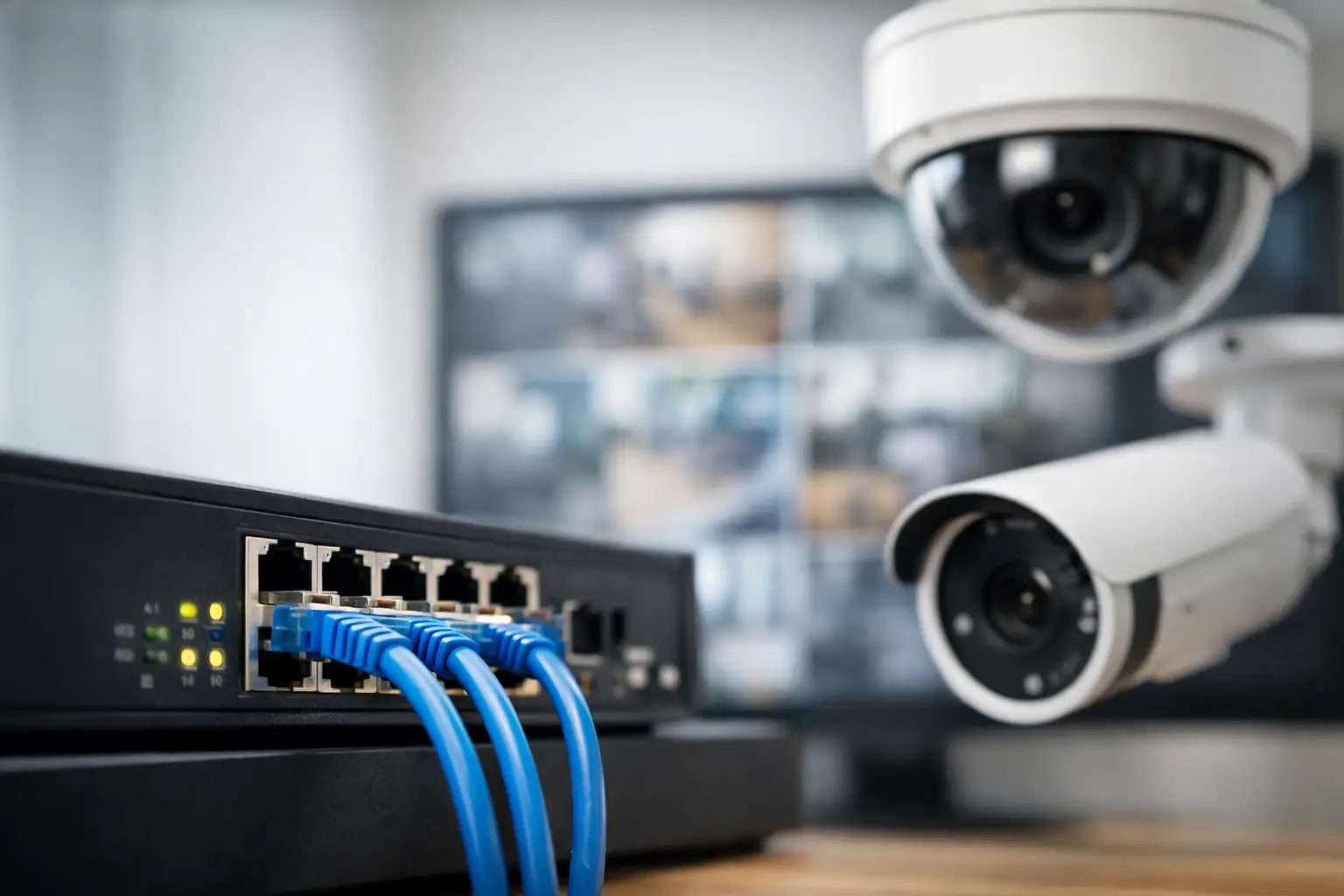
A camera schedule may look complete on paper. Yet the surveillance system can still fail at the network edge. The usual cause is not the VMS or camera specification. It is an undersized or poorly selected network switch for CCTV system deployment. For commercial, industrial, and government projects, the switch must carry video traffic, deliver predictable PoE power, tolerate its environment, and provide a practical path for expansion.
For system integrators and consultants, AETEK PoE infrastructure should be specified as an engineering component of the surveillance design, not treated as an accessory purchased after the cameras are chosen. Seven Sectors is an authorized Saudi partner for AETEK, supplying Taiwan-made PoE switches and extenders for project requirements across the Kingdom.
Start With the CCTV Load, Not the Port Count
An eight-port PoE switch is not automatically suitable for eight cameras. Port count is only the first filter. The actual decision begins with the camera power draw, the available switch power budget, expected bandwidth, and cable distance.
A fixed Milesight AI camera may have a moderate power requirement. A PTZ, integrated heater, illuminator, or high-performance AI model can require considerably more. A design based only on each camera’s typical wattage leaves little room for startup current, low-temperature operation where relevant, or accessory loads. Use the maximum published power consumption for each endpoint, add the total, and retain sensible headroom rather than consuming the entire PoE budget.
For example, an eight-camera area may physically fit on an eight-port switch, but it may not fit on its available PoE budget if several cameras use IR illumination or PTZ movement. In that case, a higher-budget PoE switch, a larger switch with spare ports, or a separate power strategy may be appropriate. The right choice depends on the camera mix and operating condition, not on a generic watts-per-port assumption.
Bandwidth deserves the same discipline. Camera bit rate varies with resolution, frame rate, scene activity, compression settings, and analytics. A busy vehicle entrance with Milesight LPR cameras produces different traffic patterns than a quiet internal corridor. Calculate the expected upstream load and include a margin for peaks. Make sure the switch uplink will not become the bottleneck between the field network and the recording platform.
PoE Standards and Power Budget Matter
Project teams often simplify PoE naming during tendering, but the standard determines what the switch can reliably support. IEEE 802.3af PoE is generally suited to lower-power endpoints. IEEE 802.3at PoE+, often specified for surveillance, provides more power for demanding fixed cameras and many PTZ applications. Where devices require higher levels, confirm the exact powered-device standard and the switch capability rather than assuming all ports provide the same output.
The switch’s total power budget is as important as its per-port rating. A switch may advertise PoE+ on every port. However, its total budget may prevent every port from operating at maximum load simultaneously. Procurement teams should request both figures in the submittal: maximum power per port and aggregate PoE budget.
This is particularly relevant for projects that combine surveillance with other PoE devices. HID Signo readers, IP intercoms, network audio endpoints, and cameras can share a building network. The team must clearly plan segmentation, power allocation, and operational responsibility. In many security projects, a dedicated surveillance access layer remains the cleaner and more controllable approach.
Select an AETEK Series for the Installation Environment
AETEK provides PoE infrastructure in distinct product families, allowing the switch location to guide the selection. The AETEK C-series is intended for indoor deployment, where equipment is housed in controlled telecom rooms, security cabinets, or protected electrical enclosures. It is a practical choice for office towers, retail areas, schools, hospitals, and indoor public facilities where standard network cabinet conditions are available.
For exposed field locations, the AETEK H-series addresses a different problem. Its IP67 outdoor construction is suited to deployments where placing a conventional indoor switch and cabinet near the camera cluster is impractical. Perimeter roads, gates, external parking areas, logistics yards, and infrastructure corridors often benefit from field-hardened PoE distribution close to the cameras. That can reduce copper cable runs and minimize the number of cabinets required, provided the wider network topology and maintenance access are considered.
The AETEK D-series is relevant where industrial conditions are a central selection factor. Industrial facilities, utilities, transport infrastructure, and oil and gas environments may impose constraints beyond ordinary office deployments. In these projects, switch selection should consider enclosure arrangement, temperature exposure, mounting method, power input, grounding, fiber integration, and the required certification package.
A ceiling-mounted access point or camera environment can also require a different physical approach. AETEK Ceiling PoE Switches support distributed network architecture where a centralized rack is not the most efficient route. Their value is not merely compact form factor. They can reduce horizontal cabling complexity in suitable building layouts while keeping local device connections manageable.
Plan Uplinks and Fiber Before the Cabinet Is Full
The access switch is only one part of the video path. Its uplink must carry aggregated traffic to the core network, NVR, server, or VMS environment. A surveillance design with many megapixel cameras or multiple downstream switches can outgrow a basic uplink. This can happen long before all physical ports are occupied.
Confirm whether copper or fiber uplinks are required, the speed needed at commissioning and future expansion, and the location of the aggregation point. Fiber is often the right choice between buildings, across large campuses, and in electrically noisy industrial areas. It also provides greater flexibility where distance exceeds copper Ethernet limits.
AETEK PoE Extenders can extend PoE and Ethernet transmission up to 250 meters in applicable designs. Gates, perimeter cameras, and remote poles beyond the conventional 100-meter Ethernet channel limit benefit from this approach. However, an extender is not a substitute for topology planning. Verify the endpoint load, available source power, link arrangement, environmental conditions, and maintenance access. For larger distances or high-consequence routes, fiber with local PoE distribution may be the better long-term decision.
Do Not Treat Outdoor Switching as an Indoor Switch in a Box
Putting a standard indoor switch inside a generic enclosure does not automatically create an outdoor-rated solution. Heat buildup, condensation, ingress protection, grounding, surge exposure, cable gland quality, and service access all affect field reliability. AETEK H-series IP67 switches are designed for the outdoor condition itself, which is materially different from a switch located in an air-conditioned IDF room.
Saudi projects add practical considerations. Equipment installed in Jeddah coastal areas may face humidity and corrosive exposure. Riyadh and inland infrastructure locations can experience severe heat and dust. Remote developments around NEOM, Umluj, and major construction zones may place extra emphasis on availability, logistics, and cabinet reduction. The correct product family should follow the actual site condition and project specification, not simply the lowest initial equipment cost.
Surge protection and grounding require attention at the overall system level. Transient events affect outdoor cameras and long copper runs. The switch specification should align with the project’s electrical protection strategy, and the integrator should verify applicable installation requirements with the consultant and site electrical team.
Managed Features Support Faster Fault Isolation
For a multi-camera project, managed switching is often worth the additional planning effort. VLAN separation can isolate surveillance traffic from corporate and general building systems. Port status and power monitoring help technicians identify camera issues. They show whether a problem relates to the endpoint, cable, PoE delivery, or upstream network. Controlled configuration also supports consistent handover documentation.
The exact managed feature set should match the project rather than becoming an exercise in over-specification. A small standalone camera cluster has different needs from a government campus. A government campus connecting to ISS SecurOS, Rasilient, FIBRENETIX, or Dell infrastructure requires more planning. The key is to preserve visibility and predictable traffic behavior from camera edge to storage.
For government and Vision 2030-related procurement, compliance documentation also matters. AETEK’s Taiwan-made PoE infrastructure supports NDAA/TAA-compliant positioning. This helps projects that require verified supply-chain and tender compliance. Confirm the compliance requirement at the quotation stage, especially where the end client requires documentation by model or country of origin.
A Better Specification Question
Instead of asking for “an eight-port PoE switch,” ask: What camera loads will it power, where will it be installed, how will it uplink, and what happens when the project adds cameras later? That question leads to a switch selection that protects recording continuity and avoids power-budget disputes during commissioning. It gives the end user a more maintainable system.
For AETEK C-series indoor switches, H-series IP67 outdoor switches, D-series industrial options, Ceiling PoE Switches, and PoE Extenders, contact Seven Sectors at info@7sectors.com. Use the Get Quotation form on the website for pricing and availability. A clear camera schedule and site topology are the best starting point for a dependable supply recommendation.
Frequently Asked Questions
What type of network switch is best for a CCTV system in Saudi Arabia?
A PoE network switch designed specifically for surveillance infrastructure — such as the AETEK C-series for indoor and H-series for outdoor installations — is the best choice for Saudi CCTV projects. Purpose-built surveillance switches provide predictable PoE power delivery per port, traffic prioritisation for video streams, and in the case of AETEK, NDAA/TAA compliance for government-aligned projects. General-purpose switches are often undersized for continuous video traffic loads.
What PoE standard does a surveillance network switch need to power modern IP cameras?
Most IP cameras, including Milesight AI CCTV models, require IEEE 802.3af (PoE, up to 15.4W) or 802.3at (PoE+, up to 30W) per port. PTZ cameras and multi-sensor models may require 802.3bt (PoE++, up to 90W). Specifying the correct PoE standard — and verifying the switch’s total PoE budget across all ports — prevents power shortfalls that cause intermittent camera dropouts on large deployments.
How far can a PoE switch run a camera without fibre?
Standard PoE over Cat5e/Cat6 UTP is limited to 100 metres. AETEK PoE extenders can push this to 250 metres per segment, making fibre-free perimeter deployment practical on many Saudi sites. For runs beyond 250 metres, fibre uplinks from the switch with a media converter at the camera end is the typical solution.
Is a managed or unmanaged switch better for a CCTV network in Saudi Arabia?
A managed switch is recommended for any commercial, government, or industrial CCTV deployment. Management features — VLAN segmentation, port mirroring, QoS prioritisation, and SNMP monitoring — are essential for isolating the camera network from IT traffic, troubleshooting faults, and meeting the network security requirements of Saudi government and giga-project specifications.
Ready to discuss your project? Contact Seven Sectors or contact us directly on +966-012 229 3474.