
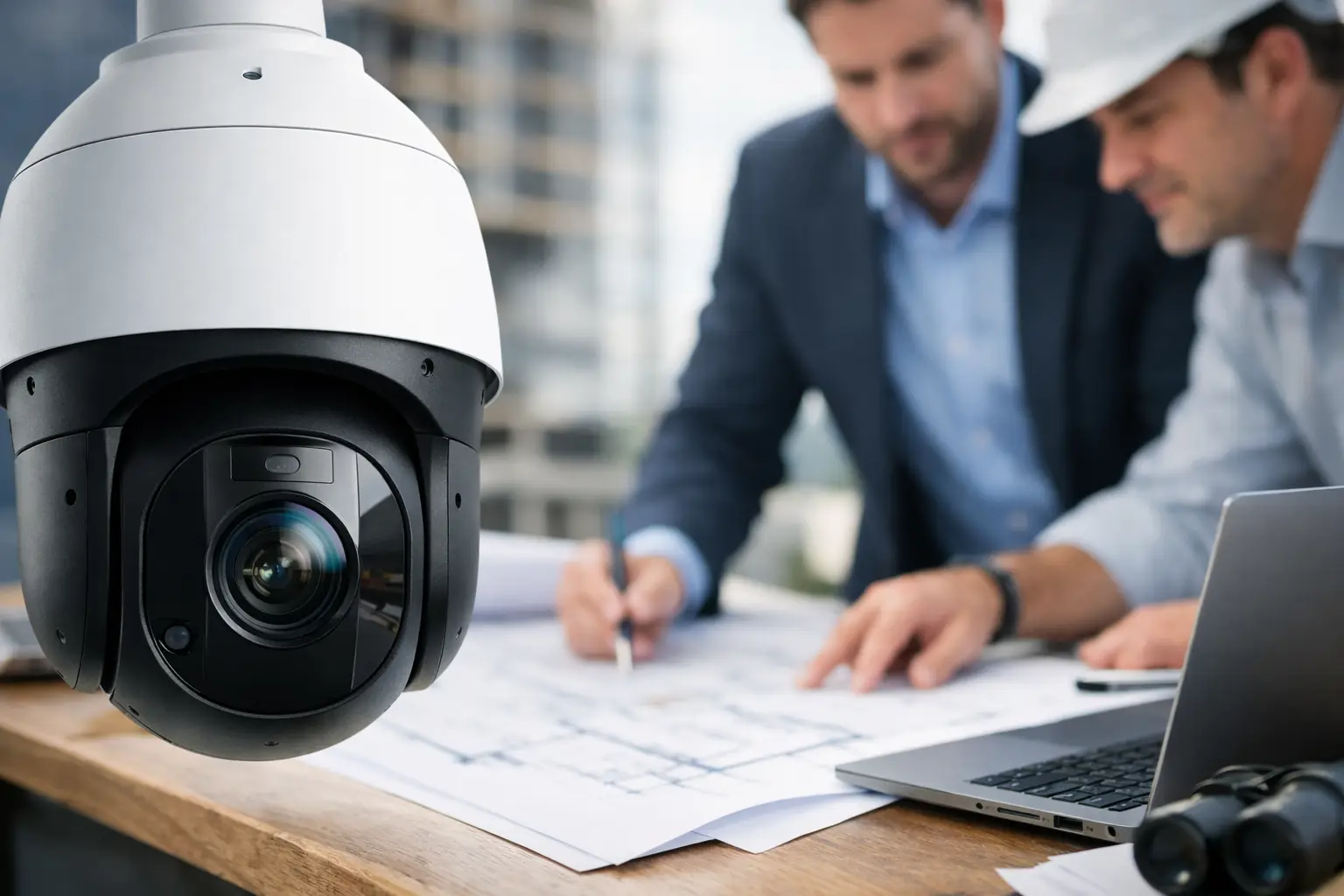
A PTZ camera can close a critical surveillance gap. Or it can become an expensive device that spends most of its time looking in the wrong direction. Knowing how to specify Milesight PTZ cameras starts with the operational requirement. What must an operator see, from where, at what distance, and under what lighting and network conditions? For Saudi government, commercial, industrial, and giga-project packages, the answer must also stand up to tender compliance, infrastructure constraints, and long-term support expectations.
Milesight PTZ cameras sit within a wider AI CCTV portfolio that includes 12X to 23X PTZ options. They are appropriate where fixed cameras alone cannot provide usable detail across a changing scene. This applies to sites such as perimeter roads, port yards, logistics facilities, public plazas, industrial compounds, and large parking areas. The specification should define their role precisely rather than treating PTZ as a general-purpose replacement for fixed coverage.
Start With the Operational Surveillance Task
The first question is not zoom ratio. It is whether the project needs a PTZ at all. For a defined entrance, corridor, cash point, gate lane, or perimeter crossing, a fixed Milesight AI camera is often the better choice. This is because its field of view is always available for recording and analytics. A PTZ is most valuable when the scene is broad, incidents are mobile, or an operator needs to investigate an alarm beyond the original detection point.
For example, a PTZ at a logistics yard may have the task of following vehicles from an entry checkpoint to loading bays. At a municipal facility, it may verify activity around a fence line after an analytics alert from a fixed camera. In both cases, write the camera’s expected operational task into the schedule. Terms such as “general external surveillance” leave too much room for unsuitable substitutions and inconsistent commissioning.
Define the target details required at the farthest point of interest. Does the operator need to recognize a person, identify a vehicle type, or read a plate? Or must they simply assess whether an incident requires a response? These are different outcomes. A PTZ can provide excellent situational awareness over a wide yard. However, it may not suit reliable license plate recognition. Where the project requires plate capture, a dedicated Milesight LPR Pro Bullet Plus Camera is normally the more appropriate complementary device.
How to Specify Milesight PTZ Optical Zoom
Optical zoom must be tied to scene geometry, not selected because the highest number appears safer. Milesight PTZ models in the 12X to 23X range offer different reach and field-of-view behavior. Higher zoom can provide more detail at distance, but it also creates a narrower view and makes manual tracking less forgiving. At maximum zoom, vibration, mounting movement, and heat haze can affect usable video more than the zoom figure suggests.
A 12X PTZ can suit sites where the operator needs flexible observation but not extreme long-range detail. Sites such as compact campuses, building approaches, vehicle gates, and medium-sized parking areas fit this profile. In contrast, a 23X option is more appropriate where subjects may be much farther from the camera position. Examples include larger perimeters, open yards, waterfronts, roadways, and infrastructure sites.
Ask the consultant or end user to provide the mounting height, target distance, coverage zone, and minimum identification objective. If those details are unavailable, a PTZ schedule is not ready for final selection. A site plan and a defined preset map should then support the optical zoom value, not assumption.
Presets, Tours, and Alarm Response
A PTZ should not remain permanently under manual control. Instead, the specification should state the required preset positions, patrol tours, dwell times, and alarm-triggered actions. A camera installed at a main gate may need presets for incoming lanes, outgoing lanes, pedestrian access, visitor parking, and the approach road. A perimeter PTZ may require presets at each fence sector and at likely intrusion paths.
This matters because a PTZ can only view one direction at a time. If it is following an incident, it is not observing the rest of the scene. For that reason, pair PTZ cameras with fixed Milesight AI cameras at persistent risk points. Fixed cameras can provide continuous detection and recording, while the PTZ supplies operator-led verification and close inspection.
Specify AI Analytics as a Workflow, Not a Checkbox
Milesight AI analytics can reduce nuisance alerts by distinguishing relevant human and vehicle events from less significant motion. Milesight states up to 95% false alarm reduction in applicable AI detection scenarios. However, the result depends on camera placement, rule configuration, scene conditions, and the type of event the system monitors. A specification should never promise a fixed percentage without validating the actual deployment environment.
Instead, state the intended analytics workflow. For a warehouse perimeter, this may mean human and vehicle classification within defined intrusion zones outside operating hours. For a road-facing site, it may mean excluding public traffic and creating rules only for vehicles entering a restricted service route. In public-sector facilities, establish escalation rules. These rules should show how the system presents an alert to operators and how the PTZ should respond.
Avoid specifying analytics without considering the video management platform. PTZ control, event handling, recording retention, operator maps, and alarm acknowledgment must work as one workflow. Project teams can consider ISS SecurOS where the project requires a VMS environment with enterprise-scale management, analytics, and command-center capability. The final VMS choice depends on the consultant’s approved platform, cybersecurity requirements, and the project’s existing estate.
Check Image Performance in the Actual Environment
Saudi outdoor locations create difficult imaging conditions: intense sunlight, deep shadows, dust, reflected light, and low-light operation after sunset. Evaluate the camera’s data sheet for wide dynamic range, low-light behavior, infrared capability where applicable, and environmental protection. Do not transfer specifications from one Milesight series to another without confirmation. Milesight’s wider AI camera portfolio includes figures such as 0.002 Lux sensitivity and 140 dB WDR on relevant models. However, verify each PTZ model against its own approved technical documentation.
Camera location is equally important. A PTZ facing west across an open yard may encounter severe afternoon glare. A unit mounted on a flexible pole may lose detail at high zoom because of wind movement. A camera positioned too close to floodlights can suffer flare and reduced contrast. The correct response may be a different mounting location, shielding, better scene lighting, or fixed cameras covering the most demanding angles.
For exposed sites, specify the required ingress protection, operating temperature range, mounting arrangement, surge protection, and cable route. A PTZ is a mechanical moving device. For this reason, consider maintenance access and safe service procedures at design stage.
Match Power and Network Infrastructure to PTZ Demand
PTZ cameras can have higher power requirements than fixed cameras, particularly when heaters, blowers, infrared illumination, and motor movement are involved. The camera schedule should identify the required PoE method and maximum power budget from the confirmed Milesight model documentation. Do not assume every network switch port can support the camera simply because it carries a PoE label.
AETEK PoE infrastructure is relevant here as a network power solution, not as a camera product. For external deployments, AETEK H-series outdoor PoE switches provide IP67 protection. Meanwhile, D-series industrial switches suit demanding infrastructure environments. Where cable distance exceeds standard Ethernet limitations, AETEK PoE Extenders can support runs up to 250 meters under the applicable design conditions. The integrator should still validate power loading, cable type, voltage drop, fiber uplinks, and network resilience for the complete path.
Specify separate network considerations for live viewing, recording, and remote PTZ control. High-resolution streams, continuous recording, operator viewing, and event-driven streaming can affect bandwidth differently. Define the required recording frame rate, codec, retention period, and failover expectations rather than placing generic bandwidth assumptions in the BOQ.
Address Compliance and Tender Documentation Early
For government facilities and Vision 2030 project packages, NDAA compliance is frequently a formal requirement rather than a preference. Milesight cameras are NDAA-compliant, but procurement teams should request the current manufacturer declarations and model-specific documentation required by the tender. If the project requires TAA compliance, do not assume it from NDAA compliance alone. Verify the exact requirement against the approved product and country-of-origin documentation.
The equipment schedule should clearly state the approved Milesight PTZ model, optical zoom, analytics requirement, power requirement, environmental rating, mounting accessories, warranty terms, and compliance documents. This protects the consultant, contractor, and end user from substitutions that appear equivalent but do not meet the operational or regulatory requirement.
A strong PTZ specification is not the longest one. It is the one that makes the surveillance outcome measurable. That means the operator can see the right area, respond to the right alert, and retain the evidence needed after an event. Seven Sectors supports system integrators, consultants, and procurement teams across Saudi Arabia with Milesight AI CCTV sourcing for project requirements. Contact Seven Sectors at info@7sectors.com or submit the website Get Quotation form for pricing and availability.
Frequently Asked Questions
What optical zoom range do Milesight PTZ cameras offer for Saudi surveillance projects?
Milesight PTZ cameras are available with 12X and 23X optical zoom. The 12X model suits mid-range perimeter surveillance, parking areas, and plaza monitoring where detail is needed at 50–150 metres. The 23X model is appropriate for long-range perimeter roads, port yards, logistics facilities, and large outdoor areas where useful identification detail is needed at 150–300 metres or beyond depending on lighting and resolution.
How do I decide between a 12X and 23X Milesight PTZ for a Saudi project?
The key variables are target distance, required image detail (detection vs. identification vs. recognition), lighting conditions, and whether the camera will be operator-controlled or run in AI auto-track mode. For most commercial and government perimeter applications in Saudi Arabia, 23X is the correct choice when the farthest point of interest exceeds 150 metres. Seven Sectors can review your site plan and recommend the right model based on your operational requirements.
Can Milesight PTZ cameras use AI auto-tracking for perimeter surveillance?
Yes. Milesight PTZ cameras support AI-powered auto-tracking, where the camera automatically detects and follows a human or vehicle target across its field of view without operator intervention. This is particularly effective for unmanned perimeter posts, remote entry points, and construction site perimeters in Saudi Arabia where continuous operator attention is not practical. The AI tracker distinguishes humans and vehicles from environmental false triggers.
How does a Milesight PTZ camera integrate with ISS SecurOS or other VMS platforms?
Milesight PTZ cameras integrate with ISS SecurOS, Milestone XProtect, and other major VMS platforms via ONVIF Profile S/T and native drivers. PTZ control — pan, tilt, zoom, preset positions, and patrol patterns — is available directly from the VMS operator interface. AI events from the camera, such as perimeter intrusion alerts, can trigger automatic PTZ slew-to-position in a VMS rule configuration. Seven Sectors can provide integration guidance for your chosen VMS.
How do I get a Milesight PTZ approved in a Saudi project tender?
Approval typically requires an NDAA compliance declaration, a product datasheet confirming the specification against the tender BOQ, and in some cases a sample camera for site testing. Seven Sectors provides NDAA compliance documentation, official Milesight datasheets, and can arrange demonstration units for pre-approval evaluations. Share your tender specification and we will advise on the exact compliance pack required.
Ready to discuss your project? Contact Seven Sectors or contact us directly on +966-012 229 3474.