
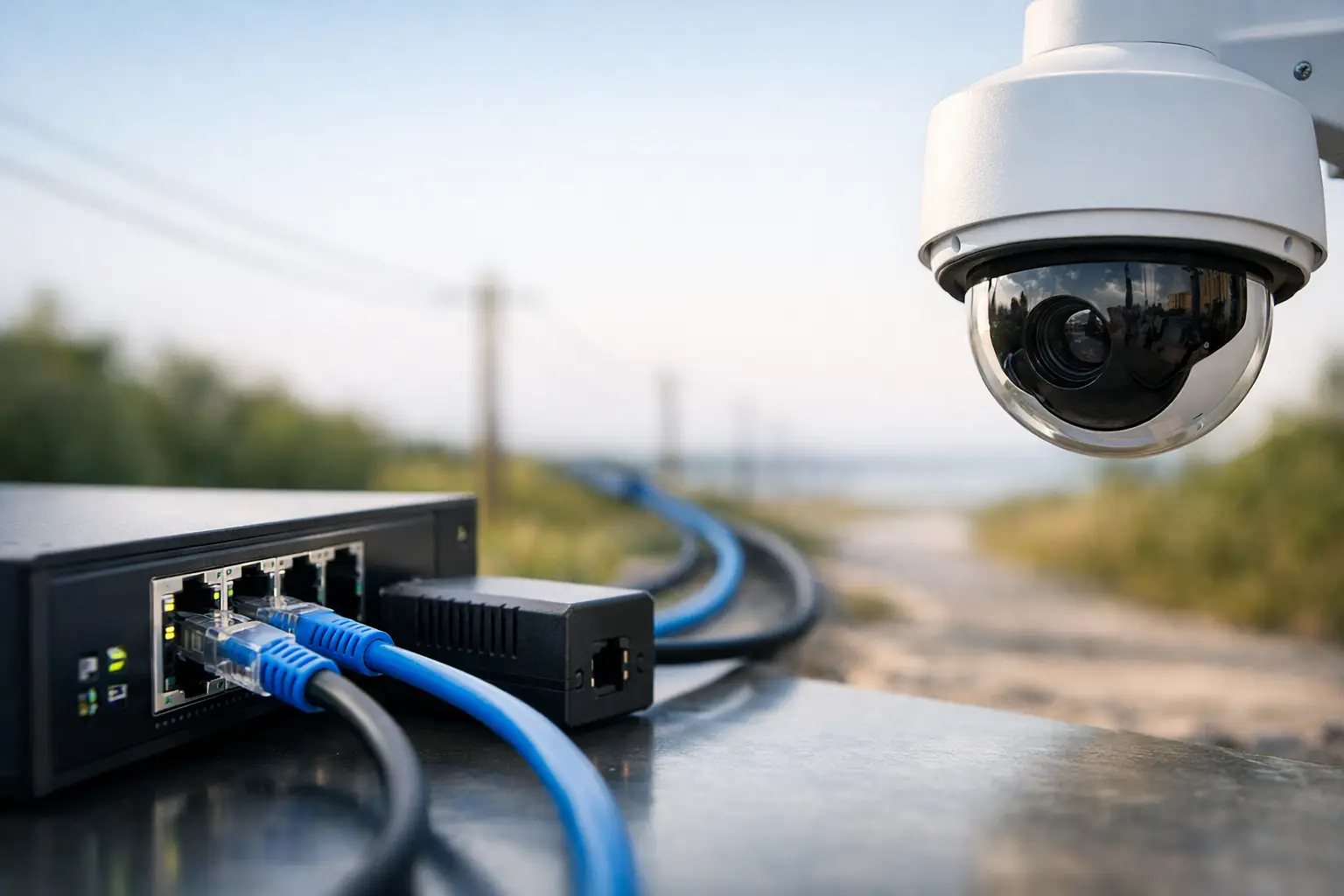
A perimeter camera is often 180 to 250 meters from the nearest telecom room, while the site owner still expects one structured cable route and no local power supply. So, can AETEK PoE reach 250m? Yes, an AETEK PoE extender solution can support a 250-meter IP connection when the selected extender, cable path, powered device, and upstream PoE source are specified as one system. It is not the same as sending ordinary Ethernet directly for 250 meters.
Why a standard PoE run stops at 100 meters
Conventional twisted-pair Ethernet is designed around a 100-meter channel limit. That allowance includes permanent horizontal cabling, patch cords, connectors, and cross-connect hardware. PoE follows the same physical Ethernet channel limitation. A standard AETEK PoE switch can provide power and data over compliant copper infrastructure, but it does not change the normal 100-meter Ethernet rule by itself.
This distinction matters in tender specifications. Calling for a “long-range PoE switch” without defining the endpoint load, cable type, network speed, and route length leaves too much room for assumptions. A 250-meter claim must identify the technology used to extend the link beyond the normal channel distance.
AETEK PoE extenders address this application by receiving PoE and Ethernet from the upstream switch, then regenerating the connection for the next cable section. Depending on the approved topology and product capability, an extender can create a longer path to an IP endpoint without a mains-powered field cabinet. For external security deployments, that can reduce civil work, simplify enclosure requirements, and avoid introducing a separate AC power source at the camera pole.
Can AETEK PoE reach 250m in a real project?
It can, provided that 250 meters is treated as a validated design limit rather than a generic cable-distance promise. The result depends on two separate questions: will the data connection remain stable, and will sufficient power arrive at the endpoint? Both must be answered before equipment is released for procurement.
For a single low-to-moderate-power IP device, the long-distance arrangement may be straightforward. However, a PTZ camera, heater-equipped enclosure, IR illumination, intercom, or multi-sensor camera can require considerably more power, particularly during startup or at night. The farther power travels through copper, the more voltage is lost through cable resistance. An extender helps create the longer communications path, but it also consumes part of the available power budget.
A system integrator should therefore evaluate the upstream AETEK switch output, the switch PoE standard, the total cable length, conductor quality, extender consumption, and the device’s maximum rather than typical wattage. The camera data sheet may state a normal operating figure that is much lower than its peak demand. Procurement teams should ask for the peak requirement, including auxiliary functions, because that is the figure that protects project performance.
The 250-meter figure is not a substitute for a power calculation
At 250 meters, cable quality has a direct operational impact. Copper-clad aluminum cable may appear attractive on a bill of quantities, but its higher resistance and inconsistent performance make it a poor choice for critical PoE links. Use verified solid-copper Category cable appropriate to the environment and project specification. Outdoor runs also need suitable UV resistance, drainage considerations, grounding practice, and surge protection based on the site risk assessment.
The endpoint matters just as much. A fixed Milesight AI camera with a documented PoE demand may be a different design case from a Milesight PTZ with zoom, illumination, and movement functions. The VMS stream may be stable while the camera reboots when high-power functions activate. That is a power-delivery fault, not necessarily a camera or VMS issue.
Where the load exceeds the validated budget for the 250-meter extender path, the correct answer may be a closer field switch, fiber uplink with local power, or a different network architecture. Extenders are valuable tools, but they should not be used to force a copper route beyond what the endpoint load and site conditions allow.
Specify the whole AETEK PoE path
For consultants and contractors, the most dependable approach is to specify the long-distance link as a complete path. Identify the AETEK switch or injector at the head end, the AETEK PoE extender, the cable category and conductor requirement, the expected route length, and the exact powered device. This gives all parties a measurable basis for submittal review and site testing.
Start with the actual route, not the drawing scale. A camera may be 180 meters from the control room in a straight line but require 245 meters of cable after passing through trays, risers, gates, and pole loops. Include patch leads and service slack. If the route is close to 250 meters, do not leave the final decision to assumptions made during installation.
Next, confirm the required network performance. Some long-distance applications are intended for surveillance endpoints where 100 Mbps is sufficient. That may be entirely suitable for one camera, but it is not automatically suitable for every device or every aggregation point. A long copper extension should be assessed against the expected camera bitrate, analytics traffic, firmware-update requirements, and network design policy.
Then calculate power from source to load. Verify the power available from the upstream port and its total switch budget, not only the maximum rating printed on one port. In a 24-port or 48-port surveillance deployment, the aggregate PoE budget can become the limiting factor even when each individual route appears acceptable. This is especially relevant for facilities with many IR cameras operating after sunset.
Finally, document acceptance criteria. A practical field test should confirm stable link negotiation, actual camera operation under maximum expected load, and recovery following a power interruption. For a critical government, transport, or industrial perimeter, testing should also account for environmental conditions and surge-protection coordination. A link that works briefly at commissioning is not the same as a dependable operating link.
Where AETEK 250-meter extension is useful
AETEK PoE extender architecture is particularly useful where the endpoint is beyond the nearest communications room but adding an AC-fed cabinet would add cost, approvals, or maintenance exposure. Typical examples include fence-line surveillance, vehicle gates, parking areas, logistics yards, port facilities, substations, and long building approaches.
For Saudi project conditions, outdoor equipment selection deserves particular attention. High ambient temperatures, dust, direct sun, and long exposed cable routes affect enclosure and infrastructure decisions. AETEK’s H-series outdoor PoE switches, with IP67 protection for applicable deployments, can support outdoor network distribution requirements where the project design calls for it. Indoor C-series and industrial D-series products address different installation environments, but each selection must follow the actual cabinet, ambient, ingress-protection, and power requirements.
The value is not simply avoiding an extra cabinet. It is creating a more controlled network edge with a documented power path. For high-consequence security systems, a well-specified AETEK infrastructure layer supports the performance of connected devices, whether the endpoint is a Milesight camera, an IP intercom, or another approved PoE device.
When fiber is the better choice
There are cases where a 250-meter AETEK PoE extension is feasible but not preferred. Fiber is usually the stronger option when distances will grow further, electromagnetic interference is significant, bandwidth requirements are high, or a field location needs to aggregate several cameras and access-control devices. Fiber also provides electrical isolation between buildings and distant structures, which can be valuable in exposed industrial environments.
The trade-off is that fiber requires an appropriate power strategy at the far end. That may mean an AC supply, solar arrangement, battery-backed cabinet, or another engineered source. The right decision is based on lifecycle reliability, not only the first installation cost.
For NDAA/TAA-compliant government and Vision 2030 projects, infrastructure selection should be traceable as well as technically correct. AETEK’s Taiwan-made PoE infrastructure and its compliance positioning can support procurement requirements where approved-origin and compliance documentation are part of the evaluation. Confirm the compliance requirement against the exact equipment schedule and project terms before final approval.
Procurement guidance for 250-meter PoE links
Do not approve a 250-meter copper path based only on a brochure headline. Request the exact AETEK extender model, supported topology, compatible PoE input and output requirements, stated distance condition, and endpoint power budget. Confirm whether the stated range applies to the required data rate and whether it assumes a particular cable construction.
This level of review prevents a common project issue: the cabling contractor completes the route, the camera powers initially, and failures appear later when IR, PTZ movement, or environmental load increases. Correcting the design after poles, paving, or ceilings are complete is more expensive than verifying the power path before material release.
Seven Sectors is an authorized Saudi partner for AETEK PoE infrastructure, supporting integrators, consultants, and procurement teams with product selection for long-distance PoE requirements. For AETEK extender availability, technical clarification, and project pricing, contact Seven Sectors at info@7sectors.com or submit the website Get Quotation form.
Ready to discuss your project? Contact Seven Sectors or contact us directly on +966-012 229 3474.