
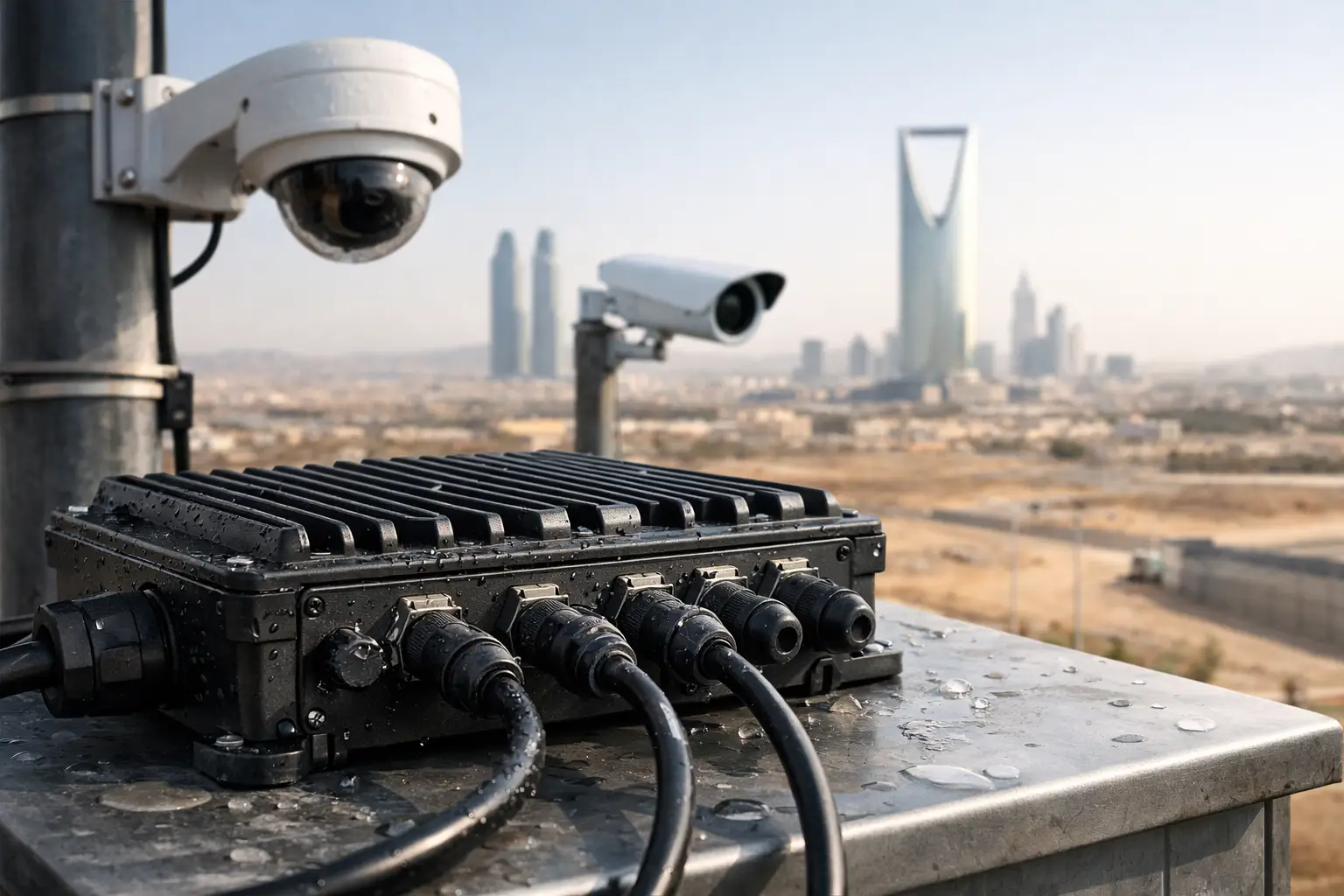
A perimeter camera can be specified correctly and still fail to deliver video. The reason is often simple: the network connection beside it was treated as an afterthought.
An AETEK industrial PoE switch IP67 outdoor surveillance KSA deployment addresses that gap. It keeps power and data moving at the edge. AETEK is a PoE infrastructure manufacturer, not a camera manufacturer.
That distinction matters when consultants and integrators build an accountable surveillance architecture.
For Saudi infrastructure, industrial, logistics, and government sites, the outdoor network edge needs careful design. It must account for enclosure protection, power availability, cable routes, service access, and compliance requirements. AETEK H-series IP67 outdoor PoE switches are built for this edge role.
They help project teams place managed network power closer to field devices, rather than extending every camera run back to an indoor communications room.
Why IP67 PoE Switching Changes Outdoor Surveillance Design
An IP67 rating indicates protection against dust ingress and temporary immersion in water under defined test conditions. For surveillance deployments, that means more than putting an indoor switch inside a generic outdoor box. The installation still needs correct cable glands, compatible connectors, sound mounting, and disciplined grounding. But the switch itself starts with an enclosure class suited to exposed infrastructure.
This matters across Saudi Arabia, because the environmental challenge is not the same from project to project. A coastal facility near Jeddah, Umluj, or the Red Sea Project may need close attention to salt-laden air and enclosure hardware. A logistics yard in Riyadh may be defined by dust and severe daytime temperatures.
Industrial and utilities environments can add vibration, washdown zones, and restricted maintenance windows. The correct design response is not one standard cabinet layout for every site. It is selecting the AETEK outdoor switch, power source, mounting position, and cable protection around the actual field conditions.
Placing PoE switching at the edge can also simplify topology. Instead of returning several individual copper camera runs over long distances, an integrator can aggregate nearby endpoints at a protected outdoor point. A single uplink then carries that traffic back. This can reduce pathway congestion. It also makes remote poles, gates, fence lines, substations, and parking areas more practical to cover.
Still, it does not remove the need for network design. Uplink bandwidth, fiber transition points, redundancy expectations, and cabinet power must all be engineered for the project.
Specifying an AETEK Industrial PoE Switch IP67 in KSA
Camera count is only one part of a correct specification.
Start with the Actual PoE Load
Every powered endpoint has a maximum power requirement, but the operating load can vary. Fixed cameras, PTZ cameras, IR illumination, heaters, intercoms, and wireless bridges all create different demand profiles. A field switch must have enough total PoE budget for the connected devices, plus an appropriate margin for peak activity and environmental operating conditions.
This becomes especially relevant when a site combines Milesight AI cameras with outdoor network infrastructure. A Milesight PTZ, panoramic camera, or AI bullet should be evaluated by its exact power requirement and operating features. It should not be treated as equivalent to a basic fixed camera. The switch selection must reflect the real endpoint schedule, including any future device additions stated in the tender.
Procurement teams should request a device schedule showing endpoint model, quantity, PoE requirement, connection type, and expected cable distance. This avoids a common late-stage problem. Enough physical ports get provided, but not enough available PoE power for the equipment expected to run at the same time.
Examine Distance Before Choosing Copper-Only Routes
Standard Ethernet over copper has practical distance limits. On long perimeter routes, pushing every device connection toward a distant telecom room can create unnecessary constraints and difficult fault isolation. AETEK PoE extenders can support PoE transmission up to 250 meters in suitable designs. This offers another option where a local powered field switch, or additional active equipment, may not be desirable.
The right approach depends on the route. An AETEK H-series switch is generally suitable where several devices need local aggregation at an exposed location. An AETEK PoE extender may be more appropriate for one remote endpoint on a long cable run. For larger distributed sites, fiber to a field enclosure with local PoE delivery can offer better reach and isolation. These are complementary design tools, not interchangeable products.
Treat the Cabinet and Incoming Power as Part of the Solution
An IP67 switch does not make every surrounding component weatherproof. Several items need coordination by the project team: incoming electrical supply, surge protection approach, grounding arrangement, cabinet ventilation strategy where applicable, fiber termination, and cable-entry methods.
Outdoor surveillance nodes are vulnerable when power and data enter from different directions without a defined protection plan. The risk increases on poles, perimeter fences, open yards, and remote gates, where induced surges, poor earthing, or damaged cable jackets can affect multiple endpoints. Consultants should make field-node protection part of the network specification, rather than leaving it to substitution after award.
Serviceability also matters. A switch mounted in a position that requires lifting equipment or access permits for routine inspection may be technically protected but operationally expensive. Favor locations that protect equipment while allowing safe access for authorized maintenance personnel.
Outdoor PoE Switches for High-Accountability Projects
Government, critical infrastructure, and Vision 2030 project packages often include origin, cybersecurity, and supply-chain requirements alongside technical specifications. For these projects, AETEK’s Taiwan-made PoE infrastructure and NDAA/TAA-compliant positioning can be relevant to compliant bill-of-material selection.
Compliance should be confirmed at the specific product and project-document level. A general compliance statement is not a substitute for tender schedules, country-of-origin requirements, approved makes lists, or client documentation. System integrators benefit from collecting data sheets, compliance declarations, and exact model references early. This should happen before the network package is locked into a larger CCTV, VMS, and storage submission.
The same disciplined approach applies to the broader surveillance stack. Milesight supplies NDAA-compliant AI camera options, while ISS SecurOS can serve as the VMS layer for projects requiring enterprise-scale video management and analytics. Rasilient, FIBRENETIX, or Dell infrastructure may support the recording and storage design according to retention, performance, and client standards.
AETEK’s role in that stack stays clear: dependable PoE network infrastructure between the endpoint and the core network.
Where AETEK H-Series Switching Fits Best
IP67 outdoor PoE switching is especially useful where cameras and other networked security devices are clustered beyond the main building envelope. Common examples include vehicle gates, external substations, construction perimeters, logistics yards, port zones, utility sites, remote access roads, and public-realm surveillance poles.
At a vehicle entrance, a field switch may power cameras, an intercom, and supporting network devices from a protected local point. At an industrial perimeter, it can consolidate several cameras positioned along a fence line. At a remote facility, it can reduce the dependence on long individual copper home runs.
Each use case requires confirming load, distance, network capacity, and environmental exposure. But the operational logic stays consistent: place the PoE infrastructure where the field devices need it, not where it is merely convenient indoors.
There are cases where an outdoor IP67 switch is not the best answer. An AETEK C-series indoor switch may be the cleaner choice. An AETEK D-series industrial range may fit the specification better. Product selection should follow the environment and topology, not a preference for the most heavily protected enclosure.
A Better Procurement Conversation
For integrators and procurement teams, the most useful request to a PoE infrastructure partner includes the site layout, device count, camera models, estimated cable distances, uplink preference, power availability, enclosure location, and required compliance documentation. That information turns a generic request for an “outdoor switch” into a selection that can be checked against project risk.
Seven Sectors is an authorized Saudi partner for AETEK. We support system integrators, consultants, and procurement teams with AETEK PoE infrastructure for project-led deployments. The value is not only access to the product line. It is having a local technical supply conversation before a field condition becomes a variation, delay, or repeat visit.
The strongest outdoor surveillance networks are usually the ones whose edge infrastructure was specified early. Give the AETEK IP67 PoE switch the same attention as the camera and recording platform. The field network is far more likely to perform when the site is under pressure.
Frequently Asked Questions
What is the AETEK H-Series IP67 PoE switch and what makes it suitable for outdoor surveillance in Saudi Arabia?
The AETEK H-Series is a line of IP67-rated industrial Power over Ethernet (PoE) switches built for outdoor deployment. IP67 means complete dust protection and resistance to temporary water immersion. In Saudi Arabia, this matters for perimeter cameras, gate systems, and exposed network edge points where heat, sand ingress, and occasional rain would damage standard commercial switches.
AETEK makes PoE infrastructure, not cameras. The H-Series is engineered specifically for this outdoor network edge role.
What does IP67 protection mean for a PoE switch in Saudi outdoor conditions?
IP67 means the enclosure is fully dust-tight (6) and can withstand immersion in up to one metre of water for 30 minutes (7). In Saudi outdoor environments, the practical benefit is resistance to sand and dust infiltration, direct rain, and occasional wash-down. It also withstands the temperature cycling that causes seals to fail on lesser-rated equipment. Combined with AETEK’s -40°C to 75°C operating range, the H-Series maintains network continuity in conditions that shorten commercial switch lifespans to months.
Is AETEK PoE infrastructure NDAA and TAA compliant?
Yes. AETEK PoE switches are manufactured in Taiwan and are both NDAA Section 889 and TAA compliant. This makes them appropriate for Saudi government facilities, military and defence projects, and Vision 2030 giga-projects where supply-chain compliance documentation is required in the tender.
Seven Sectors can provide the relevant compliance certificates alongside the product supply.
What PoE power budget does the AETEK H-Series provide per port?
AETEK H-Series switches support IEEE 802.3bt PoE++ (up to 90W per port on selected models), with total budgets scaled to the number of ports. Standard configurations support 30W (PoE+) per port. The correct model depends on the cameras and devices being powered. PTZ cameras, AI cameras with heaters, and multi-sensor devices may need 30W or higher.
Seven Sectors can advise on the right model for your power budget.
How do I source AETEK PoE switches for a surveillance project in Saudi Arabia?
Seven Sectors is the authorized AETEK partner in Saudi Arabia. We hold stock of H-Series, C-Series, and D-Series switches in Jeddah. Provide your camera count, PoE power requirements, installation environment, and cable run distances. We will return a product recommendation and formal quote in SAR with lead times.
Ready to discuss your project? Contact Seven Sectors or contact us directly on +966-012 229 3474.