
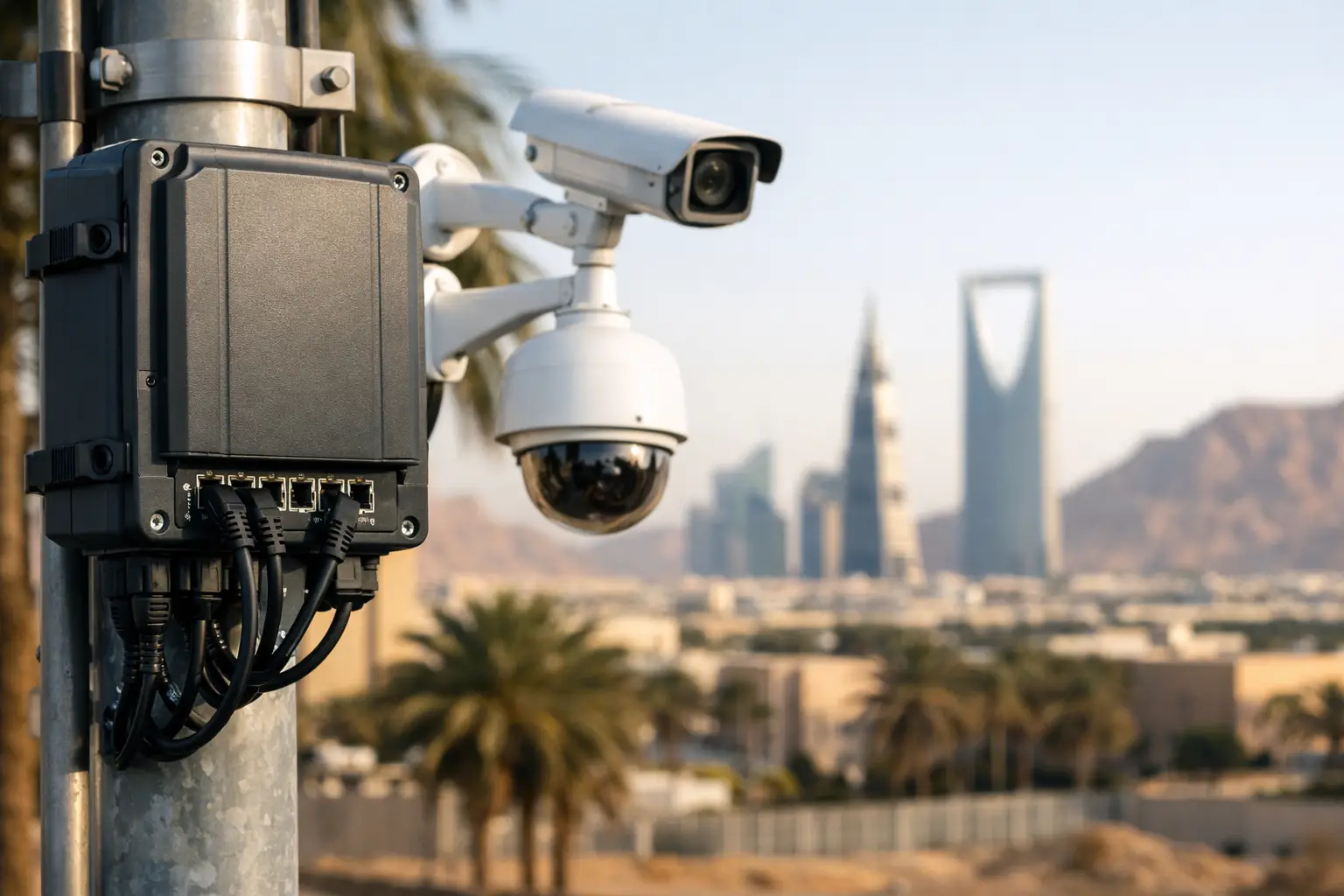
Outdoor CCTV failures are often blamed on cameras, while the real weakness sits much closer to the cable entry point. For aetek h-series poe switch outdoor cctv saudi arabia projects, the switching layer must deliver power and network connectivity where heat, dust, moisture, and long cable routes make a standard indoor network cabinet impractical. AETEK H-Series outdoor PoE switches address this infrastructure requirement with IP67 protection for field-deployed surveillance networks.
For Saudi system integrators, consultants, and procurement teams, this is not simply a question of selecting an outdoor-rated enclosure. The PoE switch is part of the operational path between the camera, the uplink network, and the recording platform. If it is poorly specified, an otherwise capable Milesight AI camera or enterprise VMS deployment can lose availability at the edge.
Why AETEK H-Series PoE Switches Fit Outdoor CCTV
AETEK is a PoE infrastructure manufacturer, not a camera manufacturer. Its H-Series is designed for outdoor applications where network equipment needs to operate close to perimeter cameras, roadways, gates, substations, industrial yards, and distributed site assets. The IP67 rating is central to the product line’s role: it supports deployment in exposed locations where dust ingress and water exposure are practical engineering concerns.
This matters across Saudi Arabia because outdoor surveillance conditions vary significantly. Coastal projects in Jeddah, Umluj, and Red Sea development zones must consider humidity and salt-laden air. Riyadh, Qiddiya, and inland industrial projects face heat, dust, and wide temperature swings. In the Eastern Province, oil, gas, logistics, and port environments can add demanding outdoor network routes and large site footprints.
An H-Series switch can reduce the need to bring every camera home-run cable back to a distant indoor telecom room. Instead, the integrator can create a properly planned field network segment, supplying PoE to cameras near the protected area while maintaining an uplink toward the core network. The value is not convenience alone. It can simplify cable pathways, reduce exposure created by excessive cable lengths, and make distributed camera zones more practical to build and maintain.
AETEK H-Series PoE Switch Outdoor CCTV Selection Criteria
An IP67 label is only the starting point. A procurement specification should match the selected AETEK H-Series model to the actual camera load, network topology, and site operating conditions. This is especially relevant in tender-driven government, transport, and Vision 2030 infrastructure projects, where substitutions can create later compliance and support issues.
Start with the PoE Power Budget
Every powered device must be counted, not just every camera. A fixed camera may have a modest power requirement, but PTZ units, integrated illuminators, heaters, or other edge devices can materially change the available power margin. The project team should calculate the total PoE demand at normal and peak operation, then verify that the selected switch can support the intended load without operating at its limit.
For example, a perimeter zone with several Milesight cameras may appear straightforward until IR operation, PTZ movement, or additional edge devices are included. The camera data sheet and the switch PoE capability must be reviewed together. This is a specification exercise, not an assumption based on port count.
Confirm Port, Uplink, and Fiber Requirements
The required number of PoE ports is determined by the local field devices, but the uplink method is equally important. Some outdoor CCTV zones need copper connectivity back to a nearby cabinet, while others need fiber because of distance, electromagnetic conditions, or the wider site architecture.
Consultants should define whether the field switch is serving a small camera cluster, a gatehouse, a road segment, or a larger distributed perimeter. They should also confirm bandwidth requirements based on camera resolution, frame rate, codec settings, analytics use, and retention design. A switch that powers cameras correctly but becomes a network bottleneck does not protect the project outcome.
Review Cable Distance as a System Issue
PoE cabling is not unlimited. Camera distance, cable quality, conductor size, voltage drop, and the device power draw all influence whether a field connection will perform reliably. Where camera locations extend beyond typical Ethernet distances, AETEK PoE extenders can support runs up to 250 meters in suitable designs.
That option should be evaluated carefully rather than used as a blanket answer. The final route still needs a clear power calculation, network layout, and maintainable physical pathway. For larger sites, fiber to a local H-Series switch may be the better architecture. It depends on distance, aggregation requirements, future expansion, and the project maintenance model.
Plan the Cabinet and Field Interface
An outdoor-rated switch does not eliminate the need for disciplined field installation practices. Cable glands, connectors, grounding approach, cabinet design where used, routing, labeling, and accessible service points all affect long-term availability. The integrator should also consider how technicians will isolate a fault or replace a device without disrupting an entire perimeter segment.
This is where an H-Series switch becomes part of a deployable field standard rather than a single line item. Standardizing the switching approach across gates, parking areas, fence lines, and remote buildings can make commissioning records, spares planning, and future expansion more manageable.
Compliance for Government and Giga-Project Procurement
NDAA and TAA compliance are increasingly relevant to public-sector, critical infrastructure, and internationally governed projects. AETEK’s Taiwan-made PoE infrastructure offers an appropriate option for procurement teams that require verified compliance alignment alongside outdoor environmental protection.
Compliance should not be treated as a last-minute declaration. It belongs in the bill of materials, submittal process, and approved-equipment review from the beginning. A camera may meet the required standard, but the project can still face procurement concerns if the supporting network infrastructure has not been reviewed with equal care.
For a complete surveillance architecture, this can mean pairing AETEK outdoor PoE infrastructure with NDAA-compliant Milesight AI cameras and suitable recording or server infrastructure. The components serve different functions: AETEK delivers network power at the edge, Milesight captures and analyzes video, and platforms such as ISS SecurOS can manage video operations where the project scope requires enterprise VMS capability. The key is to preserve compatibility and compliance through the whole chain.
Where H-Series Switches Add Practical Value
The strongest use cases are distributed outdoor areas where cameras are physically remote from indoor communications rooms. Perimeter protection is a clear example. A field-mounted PoE switch can support camera clusters along fencing, access roads, service entrances, and boundary zones, subject to the approved network and electrical design.
Transport facilities, ports, logistics parks, and large commercial campuses also benefit when surveillance coverage is spread across outdoor zones. Gate lanes, truck staging areas, parking structures, loading yards, and remote utility buildings frequently need dependable camera connectivity without excessive copper runs back to the core.
Industrial environments require additional discipline. The presence of dust, vibration, outdoor exposure, electrical noise, or difficult maintenance access means the switch should be selected as part of the site engineering standard. The correct answer is not always an outdoor switch at every point. In some areas, an AETEK D-Series industrial switch or a protected indoor cabinet may fit the environment better. The site condition and approved design determine the right product line.
Procurement Support from Seven Sectors
Seven Sectors is an authorized AETEK partner in Saudi Arabia, supporting system integrators, consultants, and procurement teams with AETEK PoE infrastructure for project supply. The focus is on providing the correct product direction for the application, including outdoor H-Series requirements, compliance considerations, and coordination with the rest of the specified security stack.
Before requesting a quotation, prepare the camera count per field location, estimated PoE load, cable distances, uplink preference, environmental exposure, and required compliance documentation. Those details allow the project team to evaluate the H-Series switch against real operating conditions rather than selecting on a generic outdoor specification.
For outdoor CCTV in Saudi Arabia, the switch should be treated as critical field infrastructure. Selecting AETEK H-Series around the actual camera load, network route, and environmental demand gives the surveillance system a stronger foundation long before the first video stream reaches the control room.
Ready to discuss your project? Contact Seven Sectors or contact us directly on +966-012 229 3474.