
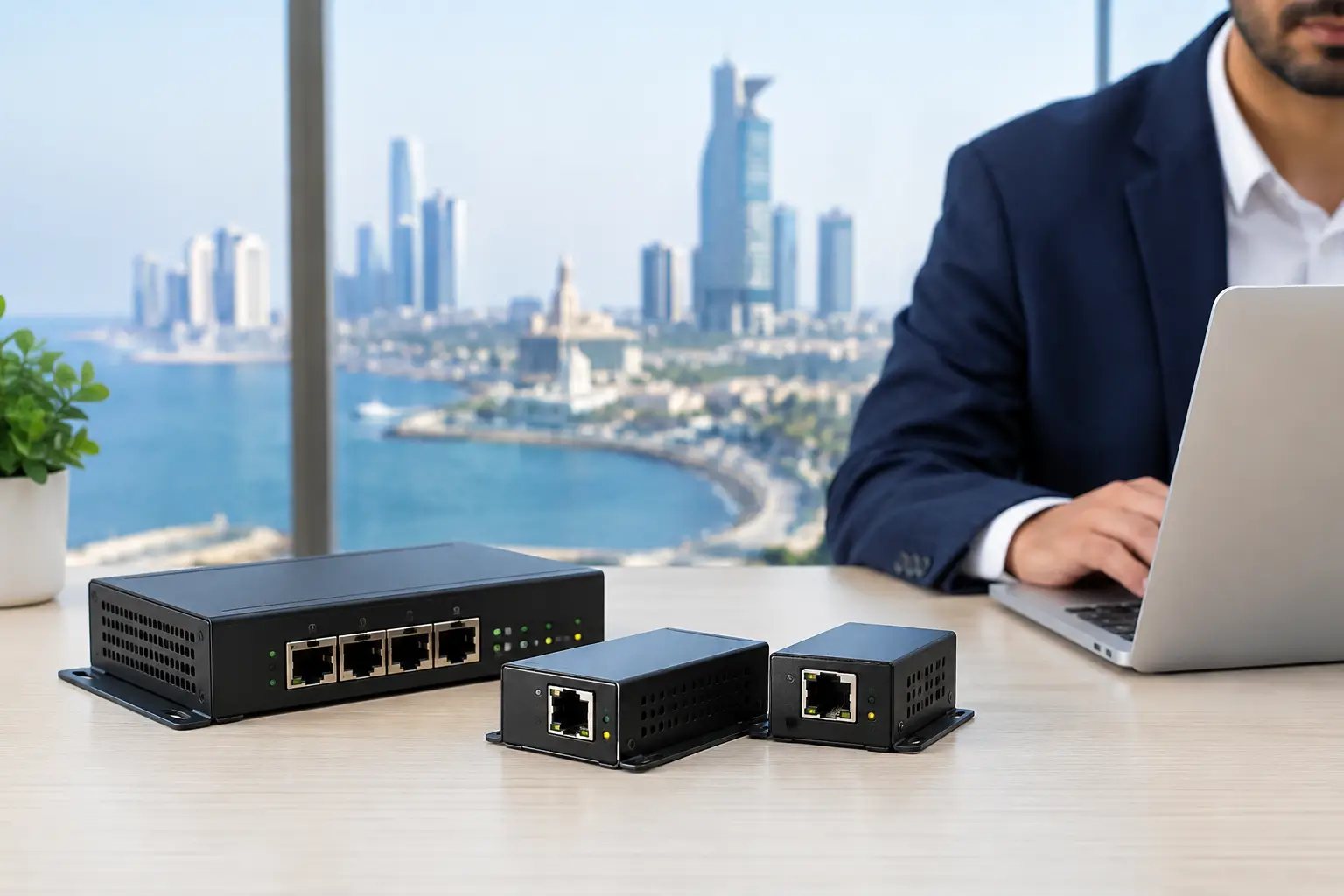
Extend PoE Links Without Creating a New Power Problem
A long cable route can turn a straightforward security or communications deployment into a coordination issue between network, electrical, and civil teams. When evaluating a Jeddah PoE extender supplier, the real question is not simply whether an extender is available. It is whether the proposed equipment will work as a documented part of the complete powered network path. Seven Sectors Trading Co. supports integrators, consultants, and procurement teams with AETEK PoE switches and network infrastructure for projects where compatibility, source availability, and tender clarity matter.
PoE extenders are often considered when a field device sits beyond the practical reach of a standard Ethernet run, or where adding a local electrical outlet would create delay, cost, or site-access complications. They can be useful in commercial campuses, industrial perimeters, government facilities, transport environments, and large mixed-use developments. But they are not a substitute for a power budget, a cable-path review, or a clear understanding of what the endpoint actually requires.
Start With the Full Powered Link
A PoE extender is one element in a chain. The chain begins at a switch or injector, continues through the structured cabling route, passes through the extender, and ends at a powered device. Each part affects the result.
The source equipment must provide the required PoE mode and enough available power for the intended endpoint. Cable type, conductor quality, route length, joints, patch panels, environmental exposure, and installation practices also affect performance. The powered device may have changing demand depending on its functions and operating state. A design that only confirms data connectivity can still fail if it does not account for delivered power at the far end.
This is why an extender should never be selected by catalog description alone. The system integrator should establish the source switch model, expected endpoint load, cable route, and any intermediate connections before submitting a material request. Where project documents specify a particular network architecture, the proposed extender must fit that architecture rather than force a late design change.
Confirm Whether an Extender Is the Right Method
Extenders are valuable where the existing route is usable, the endpoint can be supported from the available source power, and the project benefits from avoiding a separate local power arrangement. They are especially relevant when the field location is difficult to access or when additional electrical works would affect program dates.
However, an extender is not always the best answer. A remote network cabinet, fiber uplink, additional access switch, or redesigned device location may be more appropriate when the route is exceptionally long, multiple endpoints are involved, or the available power margin is limited. The right option depends on the physical site and the operational requirement.
For consultants, the key is to specify the intended outcome without leaving the critical compatibility question unresolved. For contractors, the priority is to identify limitations before procurement, not after cable has been pulled and field devices are ready for installation.
Treat Power Budget as a Design Input
Power loss across a route is not an administrative detail. It can determine whether the endpoint operates reliably under normal and peak conditions. A switch may support PoE at the port, but that does not automatically mean every downstream arrangement is suitable.
Review the total switch power budget as well as the allowance for the individual port. Then consider the endpoint’s stated operating requirement, the cable path, and the extender arrangement. If multiple field devices share a source switch, the calculation must account for the complete connected load rather than treating each port in isolation.
This process protects the procurement team from a common problem: equipment arriving on site that is individually correct but unsuitable as a system.
What a Project Supplier Should Clarify
A capable local partner does more than process a part number. For PoE extension requirements, the supplier conversation should help the buyer close technical and commercial gaps before an order is released.
First, confirm the application. Is the extender supporting a single surveillance endpoint, an access-control field device, a communications device, or another powered network component? The application influences the required interface, housing approach, source equipment, and documentation.
Second, confirm the network source. AETEK network infrastructure is relevant where the project requires coordinated PoE switching and extension planning. Providing the switch model or intended switch category with the request allows compatibility to be reviewed at the system level rather than as a standalone accessory purchase.
Third, clarify the site conditions. Indoor technical rooms, outdoor pathways, industrial zones, and roadside cabinets present different installation constraints. Project teams should identify whether the device will be housed inside an enclosure, whether surge protection is addressed elsewhere in the design, and whether a managed or unmanaged network function is required.
Finally, provide the procurement context. A tender submittal may require manufacturer literature, compliance documentation, country-of-origin information, an approved-equivalent process, or a defined delivery schedule. These requirements should be raised early, particularly for government and major infrastructure packages where documentation review can take longer than equipment selection.
Avoid the Common Specification Gaps
The most expensive PoE extender problems are usually created before the purchase order. They occur when the bill of quantities lists “PoE extender” without identifying the source equipment, the endpoint requirement, or the route conditions.
A vague description can lead to proposals that appear comparable but are not. One option may be suitable only for a narrow use case, while another may require different upstream equipment or site protection measures. The procurement comparison then becomes about unit cost instead of deployment suitability.
A stronger request includes the upstream switch information, endpoint type, estimated cable route, quantity, preferred mounting or enclosure arrangement, and documentation needs. If the equipment is being proposed as an alternative, state the original requirement and the reason an alternative is being considered. This gives the consultant or contractor a clear technical basis for review.
For major projects, keeping the extender and switching path within a defined network-infrastructure package can also simplify responsibility. It reduces the risk that one party supplies the switch, another supplies an extender, and neither confirms end-to-end operation criteria before delivery.
Procurement Considerations for Jeddah Projects
Jeddah projects frequently combine tight construction schedules with complex logistics, particularly in commercial, hospitality, port-related, government, and large-scale development environments. Local availability matters, but it should not override traceability and suitability.
A supplier should be able to support clear quotations, identified product references, manufacturer-backed documentation where available, and communication that matches the urgency of the project. For contractors coordinating multiple work packages, it is equally useful to source associated network items through a partner that understands the relationship between PoE switches, extension devices, field equipment, and surveillance storage infrastructure.
Seven Sectors Trading Co. is headquartered in Jeddah and serves project buyers across Saudi Arabia. The company supplies through established technology partners and supports technical product sourcing for system integrators, MEP contractors, security consultants, and procurement teams. The role is supply-focused: helping buyers obtain the right products and documentation for their own design and installation scope.
Questions to Ask Before Requesting a Quotation
Before approaching a Jeddah PoE extender supplier, prepare the information that affects selection. This will produce a more useful quotation and reduce clarifications later in the approval cycle.
- What is the upstream PoE switch make, model, and available port power?
- What device will be powered at the far end, and what is its stated power requirement?
- What is the approximate cable route and how many intermediate connections are planned?
- Is the installation indoor, within an enclosure, or exposed to demanding site conditions?
- Does the project require specific submittal documents, approvals, or delivery milestones?
These are not obstacles to buying. They are the information needed to buy once, specify correctly, and avoid field changes that can affect labor, approvals, and project handover.
FAQ
Can a PoE extender support any network endpoint?
No. Suitability depends on the source switch, the extender’s intended operating arrangement, cable route, and the endpoint’s power demand. Confirm the complete link before finalizing the item.
Should the extender and PoE switch come from the same infrastructure package?
Not in every case, but coordinated selection reduces compatibility risk and makes documentation review easier. It is particularly useful when the project has a defined switching standard or formal submittal process.
What should be included in an RFQ?
Include the required quantity, source switch details, endpoint type, expected cable route, installation environment, project location, and any required tender or consultant documentation.
A PoE extender should make a difficult field connection more practical, not introduce uncertainty into the network. Send your project requirement to info@7sectors.com or submit a Get Quotation form with the upstream switch and endpoint details, and the sourcing discussion can begin on the right technical basis.
Ready to discuss your project? Contact Seven Sectors or contact us directly on +966-012 229 3474.