
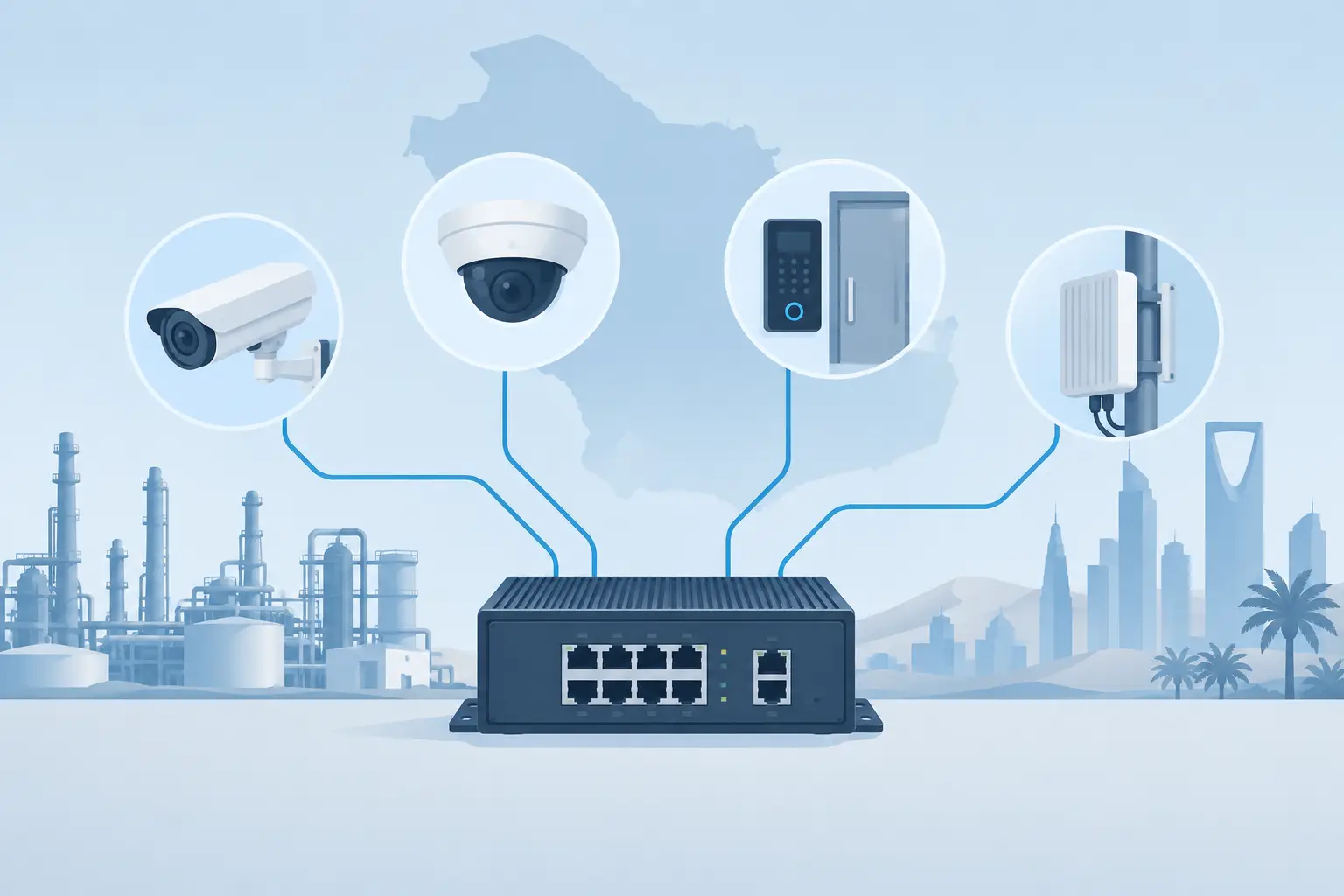
A network switch can become the single point of failure between a surveillance control room and the field devices it depends on. For contractors specifying an industrial PoE switch in Saudi Arabia, the real decision is not simply port count. It is whether the switch can power edge equipment, tolerate the installation environment, and support a recoverable network architecture over the life of the project.
AETEK industrial PoE switches are part of the network infrastructure range supplied by Seven Sectors Trading Co. for security and data infrastructure projects. The right unit should be selected against the equipment schedule, cable routes, cabinet conditions, uplink design, and owner requirements – not chosen as a generic accessory to cameras.
Start With the Power Budget, Not the Port Count
A switch with eight PoE ports does not automatically provide enough usable power for eight connected devices. The available PoE budget must cover the expected consumption of every endpoint, with allowance for peak operating conditions and future additions where the design permits them.
This matters most in surveillance networks. A fixed edge device may have modest demand under normal operation, while heaters, illuminators, PTZ movement, or other connected field equipment can change the load profile. The switch must supply the required PoE standard at each port and still remain within its total power budget. If the project schedule only lists device quantities, request the individual power requirements before finalizing the switch selection.
The same discipline applies to access control panels, intercom endpoints, wireless bridges, and networked audio devices where PoE is part of the infrastructure approach. A specification that only states “PoE switch” leaves too much open to interpretation. It should identify the required power class, total budget, port allocation, and whether any ports need higher-power capability.
Power input is a separate question. Industrial sites may use different cabinet power arrangements than commercial IT rooms, and the switch input must align with the available electrical supply and the project’s backup-power strategy. A well-sized PoE budget is of little value if the upstream power arrangement cannot maintain service during a local interruption.
Match the Switch to the Cabinet and Field Environment
Industrial-rated equipment is selected because the installation environment introduces risks that a conditioned office network room may not. Outdoor perimeter cabinets, utility buildings, parking structures, transport corridors, and process areas can expose network hardware to heat, dust, vibration, moisture, and unstable local power.
The switch itself is only one part of the environmental decision. The enclosure, DIN-rail or rack mounting method, ventilation approach, cable glands, grounding, surge protection, and available maintenance access all affect reliability. A high-quality switch placed in an unsuitable cabinet can still experience preventable failure.
For Saudi projects, cabinet temperature deserves early attention. Do not assume that an enclosure protects equipment from heat simply because it is weatherproof. Solar gain, limited airflow, and nearby power equipment can raise internal temperatures substantially. The consultant or contractor should evaluate the complete cabinet arrangement, then select switch hardware suitable for that intended operating environment.
There is also a trade-off between managed cooling and passive cabinet design. Active cooling can reduce heat exposure but adds components that require maintenance. Passive designs simplify the cabinet but may require more conservative equipment selection and heat calculations. The right answer depends on the site, enclosure location, power density, and maintenance model.
Define the Uplink Before Ordering the Edge Switch
The field switch is only useful if it can move traffic reliably back to the core. Many procurement issues arise because the PoE ports are reviewed carefully while the uplink is treated as an afterthought. For a multi-device surveillance cabinet, calculate expected traffic, identify the fiber or copper medium, and confirm how the switch will connect to the aggregation layer.
Fiber uplinks are commonly preferred for longer campus routes, perimeter networks, and electrically noisy areas because they support distance and provide electrical isolation. Copper may be appropriate inside a building or where routes are short and protected. The selected switch should match the planned medium and interface arrangement rather than relying on converters added late in the project.
Redundancy needs equal scrutiny. Some facilities can accept a single uplink where service restoration is straightforward. Others require a resilient ring or alternate path because a cable break, cabinet fault, or upstream device failure cannot interrupt critical coverage. Managed industrial switches can support network-control features that help build and monitor these architectures, but those features should follow an approved network design. They do not replace one.
For tender documentation, clarify whether the requirement is for an unmanaged edge switch, a managed switch with monitoring capability, or a unit intended for a redundant industrial topology. These are different operational requirements with different implications for configuration, handover, and troubleshooting.
Choose Management Features That the Operations Team Will Use
An unmanaged switch can be a sensible choice for a small, isolated segment where configuration is unnecessary and fault isolation is simple. It reduces setup effort and can suit straightforward deployments. It is not automatically the lowest-risk choice for a larger distributed security estate.
Managed switches provide visibility into port status, traffic conditions, power use, and network events. They can also support segmentation and controlled access practices that are relevant when surveillance, access control, building systems, and corporate services share physical infrastructure. For government facilities, industrial campuses, and major mixed-use developments, that visibility can reduce the time needed to identify whether a problem sits at the endpoint, cable, power supply, or uplink.
The trade-off is operational readiness. A managed switch should be documented, configured by the appointed project team, and included in the network management process. Buying a managed model without planning for configuration backups, credentials, IP addressing, monitoring, and support procedures creates complexity without delivering its full value.
A practical specification asks three questions: Who will administer the switch? What faults must be visible remotely? What level of network separation is required? The answers determine whether management is a requirement or an unnecessary layer.
Treat Security and Compliance as Schedule Requirements
Security infrastructure increasingly sits on networks that are expected to meet client, consultant, and procurement controls. Product approval can depend on country-of-origin requirements, cybersecurity expectations, documentation, and specific compliance declarations. These points should be verified for the exact proposed model, not assumed from a category description.
For projects that require NDAA or TAA compliance, request confirmation against the named AETEK model or series during submittal review. Requirements can differ across products, and a blanket compliance statement is not a substitute for model-level documentation. The same approach applies to industrial certifications, ingress protection expectations, and any owner-mandated network standard.
Early verification avoids a common tender-stage problem: a switch appears suitable technically, but its documentation does not match the consultant’s approved-material schedule. Procurement teams should compare the requirement matrix with the manufacturer documentation before the equipment list is finalized.
Build a Procurement Schedule That Can Be Defended
A complete switch schedule gives the project team a clear basis for evaluation. It should identify the installation location, required port count, PoE requirement and budget, uplink type, management requirement, mounting arrangement, power input, environmental need, and any compliance documentation required. It should also distinguish between field cabinets, IDF rooms, and control-room applications rather than treating all switches as interchangeable.
For large sites, standardization can simplify spares, training, configuration, and replacement planning. However, forcing one switch type into every location may raise cost or create technical compromises. A compact edge cabinet and a high-density equipment room have different needs. Standardize where the operating requirement is genuinely the same, then use purpose-fit models where it is not.
Seven Sectors Trading Co. supplies AETEK PoE switches and network infrastructure to system integrators, consultants, MEP contractors, and procurement teams across Saudi Arabia. Share the equipment schedule and project requirements with info@7sectors.com or submit a Get Quotation request to source the appropriate category of equipment through an authorized partner.
Frequently Asked Questions
What makes an industrial PoE switch different from a standard network switch?
An industrial PoE switch is intended for deployments where mounting, environmental exposure, power arrangements, and network reliability requirements differ from a typical office network. Selection should still be based on the named model documentation and the actual installation conditions.
Should every surveillance cabinet use a managed switch?
Not necessarily. A managed switch is valuable where remote diagnostics, segmentation, event visibility, or resilient network behavior are required. A simple isolated cabinet may be better served by an unmanaged unit if it meets the power, uplink, and environmental requirements.
Can one PoE switch serve security and non-security systems?
It can, provided the network architecture, power budget, traffic capacity, and security controls support that arrangement. Shared infrastructure should be intentionally designed and approved, especially where systems have different operational owners.
The strongest industrial network specifications are the ones that make failures easier to prevent and easier to isolate. Start with the conditions at the cabinet, document the required behavior at the uplink, and procure the switch as a defined infrastructure component rather than a line item with an assumed fit.
Ready to discuss your project? Contact Seven Sectors or contact us directly on +966-012 229 3474.