
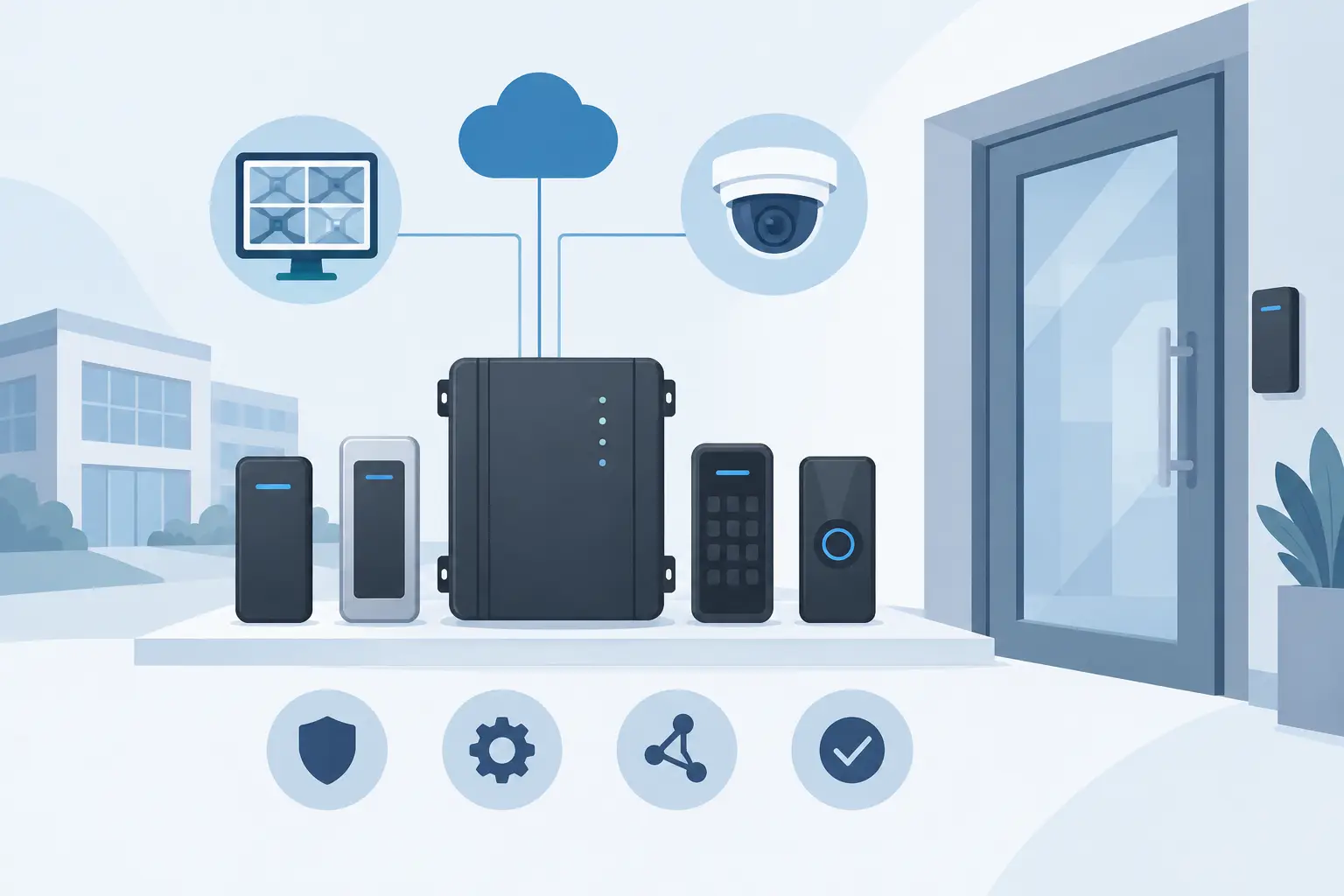
An access control controller is rarely the most visible line item in a door package, but it can determine how easily a facility expands, how faults are isolated, and how confidently an integrator hands over the system. Selecting an HID Mercury access controller is therefore an architecture decision, not simply a matter of matching a panel to a door count. HID access control products give consultants and integrators a recognized platform to evaluate when a project requires controlled credentials, centralized administration, and a path for phased growth.
For commercial buildings, government facilities, industrial locations, and major infrastructure packages, the right decision starts with the opening schedule, the security policy, and the software environment. The controller must fit the project design while leaving enough room for maintenance, network conditions, future doors, and changes in operational use.
Start With the Door and Risk Model
A controller selection should follow the actual behavior required at each opening. A main public entrance, a staff-only office door, a high-security equipment room, and a vehicle or perimeter gate may all need different lock interfaces, monitoring points, reader arrangements, and emergency behavior. Treating them as identical doors can create avoidable compromises later in the project.
The first question is whether each opening needs simple credential validation or more involved logic. Consider the required reader technology, door-position monitoring, request-to-exit devices, locking hardware, alarm inputs, and any requirement for two-person access, schedules, or visitor workflows. These requirements affect both controller capacity and the number of field interfaces required.
For consultants, this work should be reflected clearly in the specification and point schedule. For system integrators, it should be checked against the bill of materials before procurement. A controller that appears economical at the panel level may require additional modules, enclosures, power components, or wiring provisions to meet the intended function.
Where the HID Mercury Access Controller Fits
HID Mercury controller architecture is commonly considered for enterprise access control systems that need a structured relationship between management software, intelligent controllers, and downstream door interfaces. Rather than placing all decision-making at a single point, the architecture can support distributed control across a building or wider estate, depending on the system configuration.
This matters when a site includes multiple telecom rooms, separate buildings, or operational zones that must be managed together while retaining local door operation. It also matters for phased projects. A project may begin with a core building and later add administration areas, substations, warehouses, tenant spaces, or perimeter access points. Selecting a platform that accommodates that growth is more valuable than forcing a full redesign when the next phase starts.
There is a trade-off. A distributed architecture requires disciplined network planning, panel addressing, documentation, power allocation, and enclosure management. It is not a shortcut around engineering. The system integrator still needs to coordinate with the project team on cable routes, electrical interfaces, containment, and the network owner’s rules for switches, segmentation, and cybersecurity controls.
Match Controller Layout to the Physical Site
The placement of controllers should follow building topology rather than only the number of doors. Locate equipment where it can be protected, serviced, and connected to the relevant door circuits without creating unnecessary field cable runs. In many commercial and public-sector projects, this means using secure telecom or electrical spaces that have suitable access, power, grounding, and network availability.
A centralized panel layout can simplify supervision in a compact facility, especially where doors are grouped near one equipment room. A more distributed layout may reduce field wiring and support separate zones in larger sites. Neither approach is automatically better. The practical choice depends on distances, pathways, maintenance access, electrical coordination, and the consequences if one panel location becomes unavailable.
Do not overlook power and lock behavior. The controller is only one part of the door assembly. Electric locking, battery backup, fire alarm interfaces, emergency egress requirements, and local isolation all need to be coordinated by the responsible design and installation parties. Procurement teams should make sure the supplied controller package aligns with the approved system drawings and door hardware schedule rather than sourcing panels in isolation.
Check Software and Reader Compatibility Early
A controller cannot be selected responsibly without confirming the access control software environment. The management platform determines how credentials are issued, how events are presented, how operators manage cardholders, and how reporting or alarm workflows are handled. It also establishes the supported controller and interface combinations.
This is especially important in upgrade projects. Existing sites may have legacy readers, credentials, cabling practices, or third-party system interfaces that affect the migration path. Reusing equipment can reduce immediate costs, but it may also preserve limitations that the new project is intended to remove. Replacing readers and credentials can create a cleaner long-term standard, though it requires more coordination with the site’s users and operations team.
Ask for the approved compatibility matrix before finalizing quantities. Confirm reader interface requirements, credential technology, supported software release, controller firmware expectations, and any interface needed for elevator, visitor, intrusion, or building-management workflows. These points should be validated by the appointed system designer and integrator, not assumed from a generic controller description.
Plan for Network Resilience and Serviceability
Enterprise access control depends on more than a network connection. The project team should define what doors are expected to do during a network interruption, a controller fault, a power event, or a server maintenance window. Operational expectations must be agreed early, particularly at critical entrances and restricted areas.
Network teams may require documented IP plans, switch-port assignments, segmentation, approved protocols, and cyber hardening procedures. Security teams may require event retention, alarm escalation, and audit reporting. Facilities teams need clear labeling, as-built records, spare-part strategy, and a practical method to identify a failed field device. A controller package that is technically compatible but poorly documented becomes difficult to support after handover.
For large projects, standardizing panel labels, enclosure layouts, terminal references, and spare interface provisions can reduce commissioning confusion and future service time. This is not unnecessary paperwork. It is a direct safeguard against downtime and costly fault tracing across hundreds of controlled openings.
Procure Against an Approved Bill of Materials
Access control tenders often fail at the detail level: a controller is listed without its required interface modules, enclosure components are omitted, quantities do not match the final door schedule, or a substitution is proposed without checking software approval. The result can be a delayed installation sequence or a package that no longer matches the approved design.
A procurement review should compare the approved bill of materials against the latest drawings, door schedule, and integration requirements. It should also identify whether the project needs controllers, reader interfaces, input-output interfaces, power accessories, cabinets, and associated access control hardware. Where the design is still developing, separate confirmed quantities from provisional expansion allowances so the commercial and technical teams are working from the same assumptions.
Seven Sectors Trading Co. supplies HID access control hardware to system integrators, consultants, MEP contractors, and procurement teams across Saudi Arabia. As an authorized HID partner, we can support sourcing discussions around the approved HID Mercury controller package and related access control requirements. We supply products for the project scope; system design, installation, and commissioning remain with the appointed project parties.
Questions to Resolve Before Ordering
Is one controller type right for every door?
Usually not. The selected controller and interface arrangement must reflect the door function, required monitoring, reader configuration, and expansion plan. Standardizing where practical is useful, but it should not override a critical opening’s operational requirements.
Can an existing access control system be expanded?
It depends on the installed software, controllers, reader technologies, field cabling, and the client’s migration objective. Expansion is often possible, but compatibility should be confirmed from current records and approved technical documentation before equipment is ordered.
What should be included in the request for quotation?
Provide the approved controller model or system schedule, quantities, interface requirements, software compatibility information, project submittal requirements, and any requested delivery documentation. Clear inputs help prevent mismatched accessories or incomplete panel assemblies.
A well-selected controller should make the next phase of the project easier, not create another proprietary obstacle for the operations team. When your door schedule and approved system architecture are ready, send the HID Mercury controller requirements to info@7sectors.com or submit a Get Quotation form for a supply-focused review.
Ready to discuss your project? Contact Seven Sectors or contact us directly on +966-012 229 3474.