
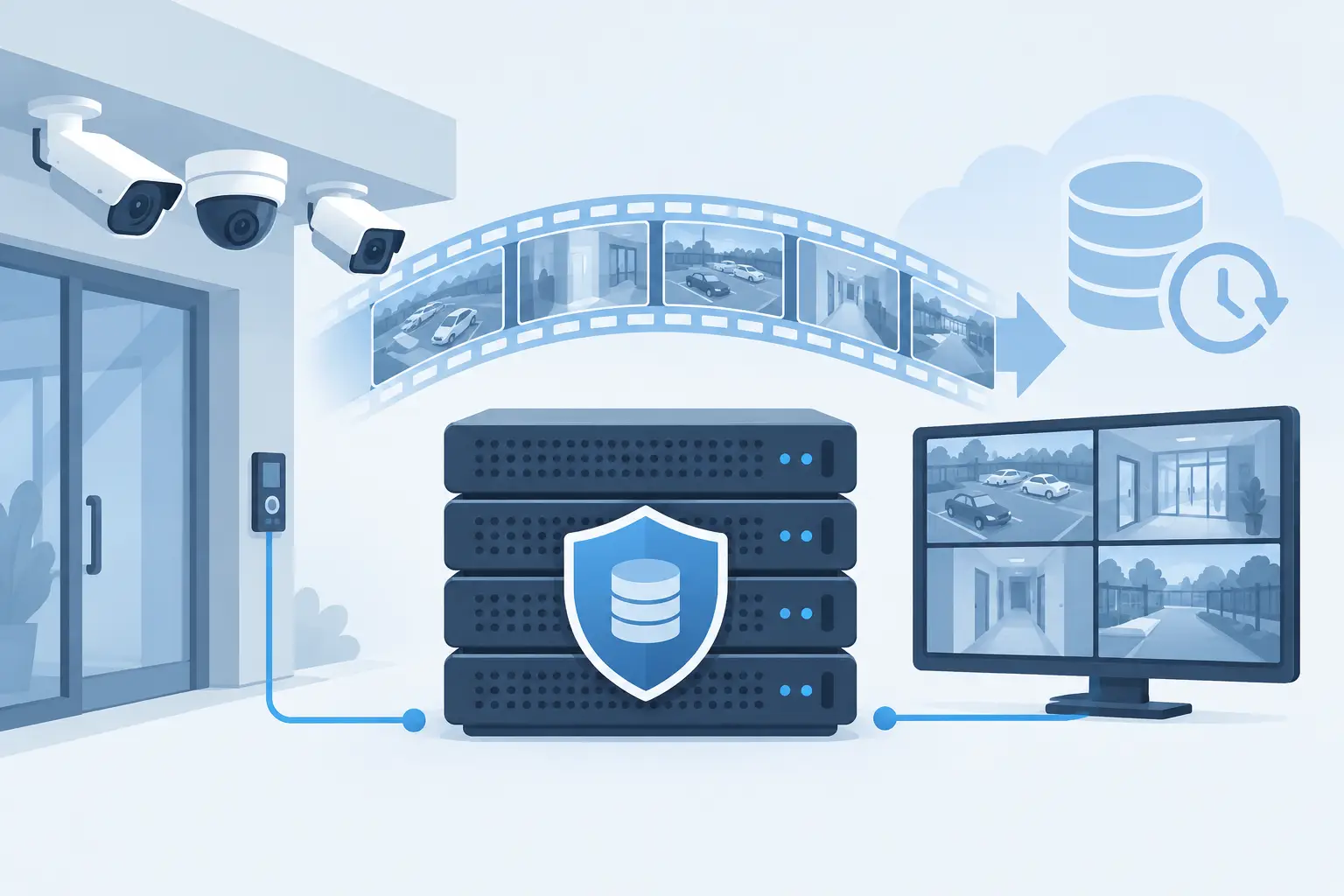
A surveillance system can have correctly selected cameras, stable switching, and a capable VMS, then still fail operationally because the storage platform was treated as an afterthought. When footage cannot be retained for the required period, recorded streams drop under load, or a drive failure creates uncertainty around evidence, the consequences reach beyond IT. They affect investigations, compliance, site operations, and project handover.
Rasilient storage is intended for the specific demands of video surveillance retention: sustained recording, simultaneous playback, high camera counts, and controlled recovery from component failures. For system integrators, consultants, and procurement teams, the decision is not simply about buying more disk capacity. It is about specifying a storage platform that matches the actual recording behavior of the project.
Seven Sectors Trading Co. supplies Rasilient surveillance storage solutions to trade customers across Saudi Arabia, supporting project sourcing with an authorized partner route.
Start With the Recording Workload, Not Raw Capacity
The first storage question is often, “How many days can this system retain?” That is necessary, but incomplete. Retention is the output of several inputs: camera quantity, compression method, resolution, scene activity, frame rate, recording schedule, and whether cameras record continuously or on events.
A site with a moderate camera count can produce a heavier workload than a much larger installation if it records high-motion scenes continuously. Perimeter cameras facing roads, logistics yards, transport areas, and industrial processes behave differently from cameras monitoring quiet corridors or controlled office entrances. Storage calculations should reflect the operational scene, not a generic bitrate assumption applied to every channel.
The VMS also matters. Recording architecture, archive management, playback patterns, failover requirements, and analytics can alter both capacity needs and input/output demand. A tender schedule that states only the number of cameras and retention days leaves too much open to interpretation. The storage schedule should identify the assumed recording profile and the conditions the platform must support.
Why Rasilient Storage Fits Surveillance Environments
General-purpose storage can be appropriate for some IT workloads, but surveillance creates a distinct pattern. Recording is continuous and write-heavy, while operators may need to retrieve footage at the same time. During an incident, several users may review archived video, export evidence, or search separate cameras while incoming streams continue without interruption.
Rasilient storage platforms are designed around surveillance video workloads rather than office file storage. This makes them relevant where recording continuity, archive availability, and simplified serviceability are central selection criteria. The platform must be assessed against the required VMS environment and the complete project architecture, but purpose-built surveillance storage gives consultants a clearer starting point than a capacity-only server specification.
This does not mean every CCTV system requires the same class of storage. A small site with limited retention, modest camera activity, and no demanding replay requirement may have a different fit from a command center, airport-related facility, city surveillance network, large industrial operation, or multi-building government estate. The objective is proportionality: specify enough storage performance and resilience for the risk, without paying for an architecture the project will not use.
Define Resilience Before the Tender Is Released
Storage resilience should be written as an operational requirement, not a vague request for redundancy. A drive-protection scheme helps protect data following a drive failure, but it does not by itself address every failure scenario. Power protection, controller architecture, network paths, monitoring, replacement procedures, and available support all influence the real level of continuity.
A practical specification asks what must happen when a component fails. Should recording continue? Must operators retain access to existing footage? Is there a permitted reduction in performance during a rebuild? How quickly must a failed component be identified and replaced? These questions are more valuable than copying generic storage terms into a bill of quantities.
For high-consequence sites, teams should also consider the effect of rebuild activity. When a storage system is recovering from a failed drive, it must still manage incoming video. The required behavior depends on the project’s recording load and available capacity headroom. Designing too close to the calculated maximum can leave little margin for investigations, increased scene activity, future camera additions, or recovery events.
Separate Usable Retention From Installed Capacity
Installed disk capacity is not the same as usable surveillance retention. Protection overhead, system requirements, configured reserve capacity, and performance design can reduce the amount available for video. A procurement team that compares only total raw terabytes can unintentionally compare unlike solutions.
Ask suppliers to make the assumptions visible. The proposed solution should show the intended usable capacity, the protection approach, estimated retention under the stated recording profile, and any growth allowance. This makes technical evaluation more transparent and prevents a low initial capacity figure from becoming a variation after deployment.
Growth should be handled honestly. If the project is phased, camera counts may rise after the initial handover. If retention policies are likely to change, the storage architecture should allow a realistic path to expansion. However, expansion potential should not be used as an excuse to undersize day-one requirements. The system must satisfy the approved scope from the start.
Confirm the Interfaces Around the Storage Platform
Storage does not operate alone. It sits between the recording server or VMS environment, network infrastructure, operator clients, and any archive or failover strategy. Compatibility should be validated before equipment is committed, especially when a project includes a specified VMS platform, existing servers, or a requirement to integrate separate sites.
The review should cover recording-server architecture, network connectivity, management access, user playback demand, and alarm-driven retrieval. It should also clarify responsibility boundaries. The storage supplier provides the specified hardware, while the project’s integrator, consultant, and VMS parties define and execute the wider system design, configuration, and commissioning activities.
This distinction matters on complex tenders. A storage platform can be technically suitable yet deliver poor results if the recording workload is placed on an undersized server, if the network is not sized for the traffic, or if retention assumptions differ between the consultant’s specification and the integrator’s proposal. Early coordination prevents those gaps.
Build a Procurement Schedule That Can Be Evaluated
A good storage schedule gives bidders enough detail to propose equivalent project-ready equipment while keeping the evaluation focused on outcomes. It should state the required recording workload, retention period, resilience expectation, compatibility requirements, physical deployment constraints, warranty or support expectations where applicable, and documentation required for submittals.
Avoid requiring unverified performance claims without defining the test conditions behind them. A figure has little procurement value unless it relates to the intended video workload. Likewise, avoid mixing recording capacity with playback performance or assuming that all storage is interchangeable because it uses the same drive interface.
For government and major infrastructure procurement, traceability matters. The sourcing route, product documentation, serial records, and clear bill-of-material alignment can be as important as the hardware itself. Working through an authorized partner helps procurement teams maintain a defensible supply chain and gives integrators a clear commercial contact during the quotation and submittal process.
When a Storage Review Is Worth the Extra Time
Not every order needs a long design workshop. But a structured review is worthwhile when retention is mandatory, camera counts are high, the site is geographically distributed, multiple operators require playback, or lost footage would create a serious operational issue. It is also valuable when the tender contains conflicting requirements, such as demanding extended retention while limiting the physical rack space or budget category.
Bring the recording assumptions to the quotation stage: camera count, expected recording mode, VMS platform, retention requirement, and whether the system will grow. With that information, the storage conversation moves from a generic capacity request to a sourceable, technically accountable proposal.
For Rasilient storage requirements in Saudi surveillance projects, contact Seven Sectors Trading Co. at info@7sectors.com or submit your requirement through the Get Quotation form. The strongest storage decision is the one that protects recorded evidence not only on day one, but when the site is under real operational pressure.
Ready to discuss your project? Contact Seven Sectors or contact us directly on +966-012 229 3474.