
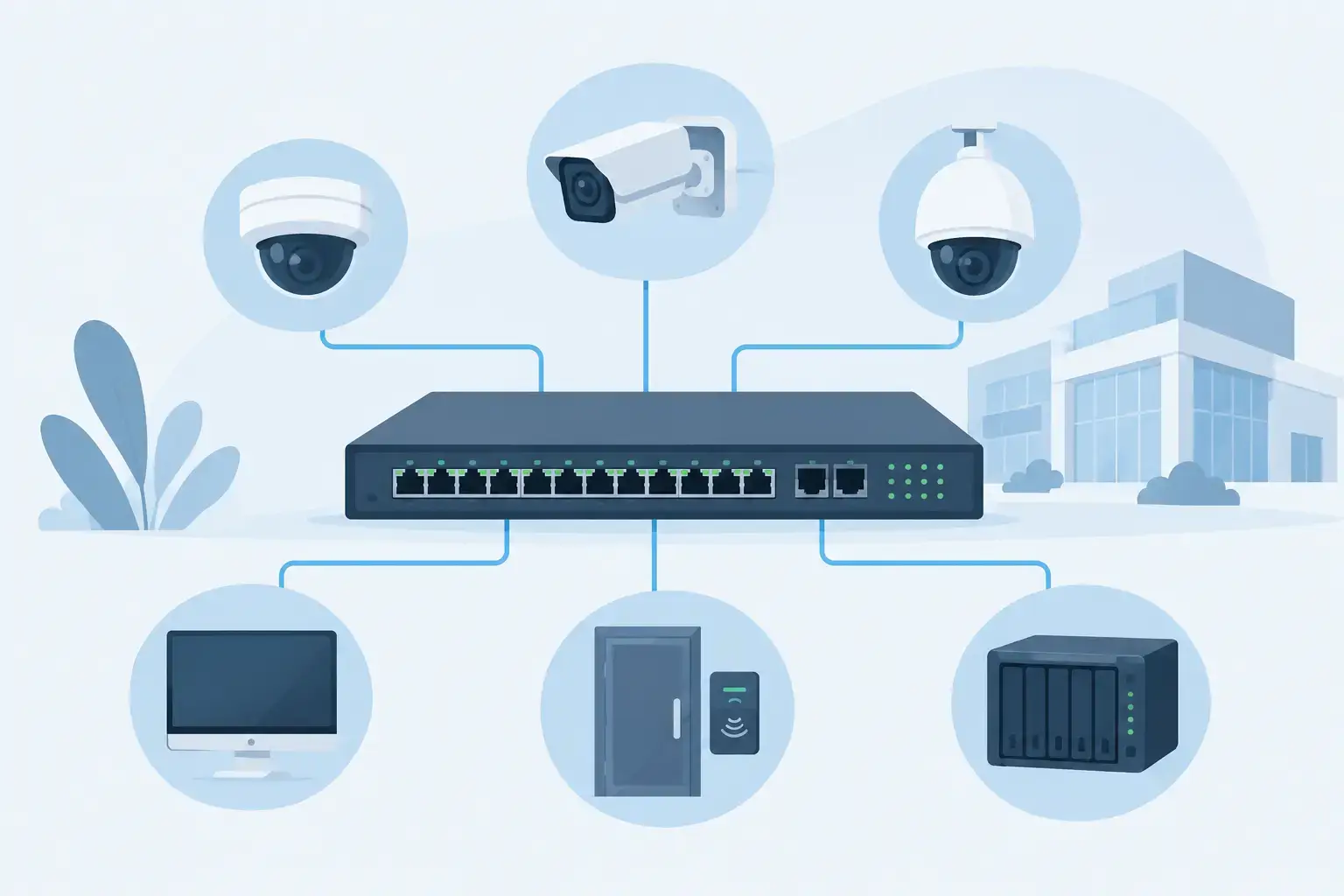
A surveillance or access-control network rarely fails because a switch was simply “too small.” It fails when the specified power budget ignores real endpoint demand, the uplink cannot carry aggregated traffic, or the cabinet environment was treated as an afterthought. An effective AETEK switch evaluation starts with those project conditions, not with a port-count request. AETEK provides PoE switches and network infrastructure for professional security and data deployments, and Seven Sectors Trading Co. is an authorized AETEK partner for supply across Saudi Arabia.
For system integrators, consultants, MEP contractors, and procurement teams, the objective is straightforward: source a switch that matches the network drawing, supports the intended endpoints, and can be documented clearly in a technical submittal. The evaluation should be disciplined enough for a government tender, yet practical enough to keep a commercial project moving.
Begin with the endpoint and power schedule
The first question is not whether a switch has PoE. It is whether its available PoE capacity supports the devices planned for that specific network segment. Build the evaluation from the endpoint schedule: cameras, access-control controllers, intercom devices, wireless equipment, and any other powered network hardware assigned to the cabinet.
Do not calculate on port quantity alone. A 24-port switch may physically connect 24 endpoints, but the actual design decision depends on the total power allocation, the expected operating demand of each device, and the level of contingency required by the consultant or client. The correct approach is to add the stated power requirements from the approved endpoint documentation, then retain a sensible allowance for startup behavior, future changes, and normal project variation.
Separate PoE capacity from electrical resilience
PoE budget is only one part of power planning. The wider review should also consider how the cabinet is fed, how critical network equipment is protected, and what happens after a power interruption. These decisions may sit with different project disciplines, but they affect whether the network remains available when it is needed.
A supplier can help align the switch selection with the specified equipment list, but final electrical design, installation, and commissioning remain with the appointed project parties.
Check uplinks before approving the access layer
An access switch may have enough PoE ports and still create a traffic bottleneck. Every switch evaluation should identify what traffic reaches the switch, where it is aggregated, and which uplink path carries it onward to the core network, server environment, or recording platform.
For surveillance applications, the issue is cumulative traffic. A single endpoint may be manageable, while a full cabinet creates a very different load profile. For access-control networks, bandwidth may be lighter, but availability and segmentation can be more important than raw throughput. Mixed-use cabinets need an even clearer review because video, building systems, and access devices may share the same physical infrastructure while requiring separate policies.
Ask three practical questions. What is the expected traffic load at full operation? What interface does the next network layer require? Is there a defined path for expansion without replacing the switch prematurely? The answers should be reflected in the bill of materials and topology, not left to site interpretation.
Match the switch to the installation environment
Network hardware is often specified in a clean technical room and installed in conditions that are less forgiving. Evaluation should account for the actual enclosure, ventilation, power quality, cable routing, maintenance access, and exposure risks at the proposed location.
An indoor communications room, a security control room, a roadside enclosure, and an industrial plant cabinet place very different demands on infrastructure. The suitable AETEK product family depends on the environment stated in the approved project documents. Avoid broad assumptions about temperature tolerance, protection level, or industrial suitability unless those details are confirmed for the named model in its current manufacturer documentation.
Treat management features as an operational requirement
A managed switch is not automatically the right answer for every location, and an unmanaged switch is not automatically a cost-saving choice. The decision depends on who will operate the network, what level of visibility the project requires, and whether the system needs segmentation, monitoring, controlled access, or centralized policy management.
During an AETEK switch evaluation, identify the specific management and security requirements in the specification. Then request the relevant product documentation for the proposed model and verify that it supports the required functions. This is more defensible than approving equipment on a generic description.
Build a submittal package that procurement can verify
Technical approval is easier when the supply request is complete. A clear package should connect the switch model to the network schedule, installation location, endpoint count, power requirement, uplink requirement, and any stated project standards. It should also identify accessories or supporting items that are necessary for the intended deployment.
Seven Sectors supports this process as a specialized trade partner, helping buyers source established infrastructure hardware with the documentation needed for professional project review. That is particularly useful when separate packages for surveillance, access control, storage, and network infrastructure must align under one security scope.
Questions to resolve before releasing a purchase order
A short pre-order review prevents most switch-selection problems. Confirm the final endpoint schedule, total PoE demand, uplink interfaces, installation format, and required management functions. Then verify that the selected model and all necessary supporting components appear consistently across the approved documents.
Frequently asked questions
Is port count enough to select a PoE switch?
No. Port count is only the starting point. The evaluation must also cover the available PoE budget, endpoint demand, uplink capacity, installation environment, and operational requirements.
Should every security network use managed switches?
It depends on the specified architecture and operating model. Managed switching is often appropriate where segmentation, monitoring, controlled configuration, or centralized administration is required. The approved project design should determine the requirement.
What information should be sent with an RFQ?
Provide the endpoint schedule, desired port count, endpoint power requirements, uplink requirement, installation location or cabinet type, and any mandatory specification clauses. This allows the supply request to be assessed against real project conditions.
A switch should make the network easier to operate, support, and expand – not become the unresolved item on a site punch list. For assistance aligning AETEK network infrastructure with your approved project requirements, email info@7sectors.com or submit a Get Quotation form with the available drawings and equipment schedule.
Ready to discuss your project? Contact Seven Sectors or contact us directly on +966-012 229 3474.