
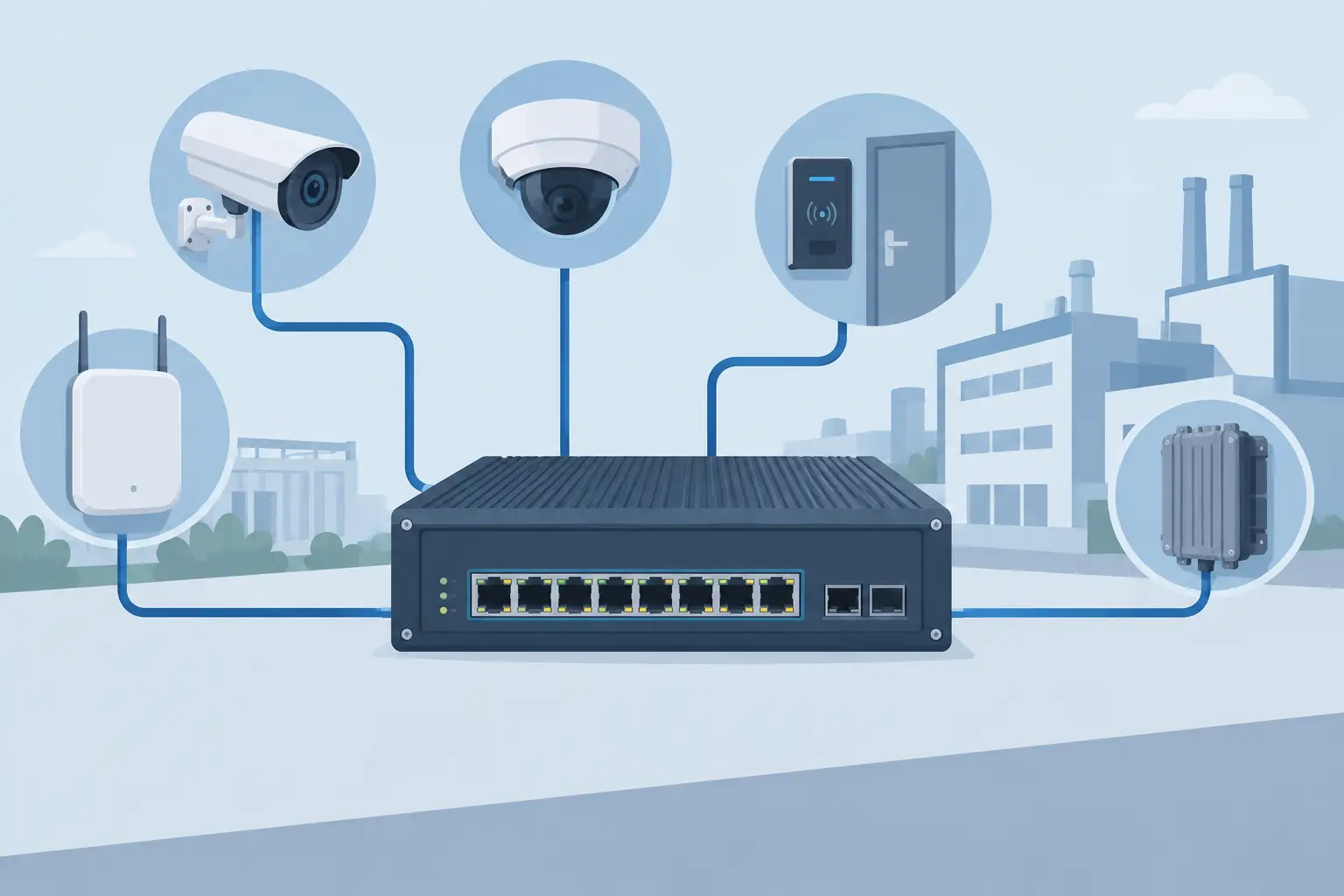
A switch can be the quietest failure point in a surveillance or access network. When it is underspecified, cameras reset during peak load, field cabinets become difficult to troubleshoot, and a local fault can affect far more devices than it should. The best industrial PoE switch features are therefore not a checklist of premium extras. They are the functions that protect power delivery, network availability, and maintenance access in the conditions your project will actually face.
For system integrators, consultants, and procurement teams, the first decision is not simply managed versus unmanaged. It is whether the switch matches the powered-device load, uplink architecture, enclosure environment, and handover requirements. Seven Sectors Trading Co. supplies AETEK PoE network infrastructure for projects where those decisions need to be made with greater discipline.
Start With the Power Budget, Not the Port Count
An eight-port PoE switch does not automatically support eight high-demand endpoints at their maximum draw. Each switch has a total PoE power budget, and each port may have its own delivery limit. Both figures matter.
Build the requirement around the highest credible simultaneous load. This includes fixed cameras, PTZ cameras where applicable, access control field devices, intercom endpoints, wireless bridges, or other powered equipment on the same switch. Do not base the calculation on average consumption alone. Startup behavior, heater operation, infrared illumination, motor movement, and low-temperature operation can all change demand depending on the endpoint and application.
A sensible design leaves capacity beyond the calculated requirement. The right margin depends on whether the cabinet is serving a small, static group of devices or a perimeter zone where later additions are likely. Excess capacity costs more upfront, but a switch replacement, cabinet rework, and network outage cost more after handover.
Verify Power by Port
Total budget is only one half of the question. Confirm which ports can supply the required power class and whether all ports can do so at the same time. This is particularly relevant when a design mixes lower-demand fixed endpoints with devices that have variable loads.
Also review how the switch behaves if available PoE power is exceeded. A controlled priority policy is preferable to unpredictable endpoint loss. In a security application, the project team should be able to identify which devices retain power and which devices are shed first under a fault or overload condition.
Choose Environmental Protection for the Actual Cabinet
Industrial does not mean the same thing in every deployment. A switch inside a conditioned communications room faces a different risk profile from one installed in an outdoor roadside cabinet, a parking structure, a substation enclosure, or an industrial process area.
Specify the operating environment before selecting the hardware. Consider ambient heat, solar gain on the enclosure, airborne dust, moisture exposure, vibration, cable entry quality, grounding arrangements, and the reliability of the local electrical supply. The enclosure and power accessories are part of the decision too. A capable switch placed in a poorly managed cabinet will still experience preventable failures.
For Saudi project conditions, temperature management deserves early attention. It is not enough to select equipment described as industrial and assume the cabinet environment is acceptable. Review the complete thermal path: the site location, enclosure placement, ventilation method, internal heat from power supplies, and expected connected-device load.
DIN-Rail Mounting and Practical Service Access
DIN-rail mounting can simplify organized cabinet builds and replacement work, especially where networking shares space with control panels and other low-voltage infrastructure. The benefit is not the rail itself. The benefit is disciplined layout, clear cable routing, accessible labeling, and the ability to service a component without disturbing unrelated equipment.
Check connector orientation and clearance as part of the panel layout. A switch that technically fits may still make fiber termination, bend radius control, or port labeling difficult after installation. Procurement teams should ask for cabinet drawings and device schedules early enough to prevent a last-minute substitution.
Managed Features Should Reduce Fault-Finding Time
A managed industrial PoE switch is justified when the project needs visibility and control, not simply because management is available. Large surveillance networks, distributed facilities, and sites with restricted maintenance access benefit when the network team can identify port state, power status, traffic behavior, and uplink health without opening every field cabinet.
The most useful functions are the ones that shorten the path from alarm to corrective action. Port monitoring helps distinguish a failed endpoint from a cable fault or a PoE issue. Event logging supports handover and maintenance records. Configuration backup helps restore a replaced device consistently rather than rebuilding settings under pressure.
Network segmentation is also a practical requirement in multi-system environments. Surveillance, access control, building systems, and corporate traffic should not be mixed without a deliberate policy. Where the network architecture requires VLANs, traffic prioritization, access controls, or multicast management, make sure the selected switch supports the necessary functions and that the integrator has a clear configuration standard.
Build Uplink Resilience Into the Topology
Field switches are only as useful as their path back to the recording, monitoring, or core network environment. Copper uplinks may be appropriate for short, protected runs, while fiber is often the better choice across longer distances or electrically noisy routes. The correct decision depends on the physical route, distance, electrical environment, and resilience target.
Look beyond the number of uplink ports. Confirm the media type, connector approach, aggregation requirement, and how the topology behaves if a path is lost. A ring or redundant path can improve availability, but only when it is designed as a complete system with compatible network behavior and documented recovery expectations.
Avoid treating redundancy as a universal requirement. For a small isolated cabinet, the expense and complexity may not be justified. For a perimeter, transport, utility, or government facility where visibility must continue through a single cable or uplink fault, it may be essential. The decision should reflect operational consequence, not a generic specification line.
Protect the Switch From Electrical Events
Industrial network hardware can be exposed to unstable power, grounding differences, induced surges, and long outdoor cable runs. These risks are often addressed too late, after selecting the switch, when they should inform the network and cabinet design from the start.
Assess the incoming power source, cabinet grounding, surge protection strategy, and the route of every copper connection leaving the enclosure. Fiber can reduce exposure between locations, but it does not eliminate the need for correct cabinet bonding and power protection. The specific protection approach must be coordinated with project electrical requirements and site conditions.
Power input flexibility may also matter where the project uses centralized DC supplies, battery-backed field power, or remote cabinets. Do not assume all industrial switches accept the same input arrangement. Confirm compatibility before procurement and make it part of the approved material submittal.
Make Procurement Requirements Testable
The strongest technical specifications are clear enough to verify before delivery and simple enough to check during acceptance. Instead of asking broadly for an industrial managed PoE switch, define the project requirement around endpoint count, power budget, port power needs, uplink media, environmental conditions, mounting method, management functions, and resilience expectations.
This avoids a common tender problem: two products appear equivalent because they have the same port count, yet differ materially in usable power, serviceability, or suitability for the field environment. A comparison should be based on the full application, not a single headline feature.
For consultant-led projects, include documentation requirements as well. The selected switch should arrive with identifiable model information, configuration support, and records that allow the integrator and facilities team to maintain the deployed network after handover.
Frequently Asked Questions
Is an unmanaged industrial PoE switch enough for CCTV?
It can be enough for a small, isolated group of fixed endpoints where there is limited need for segmentation, remote diagnostics, or redundant uplinks. For distributed sites, higher device counts, or facilities with formal maintenance requirements, managed visibility usually offers better operational value.
Should every field switch have fiber uplinks?
Not necessarily. Fiber is often appropriate for longer routes, electrically challenging paths, and interbuilding connections. A short internal run in a controlled environment may not require it. The cable route and continuity requirement should determine the choice.
What is the most common selection mistake?
Choosing by port count alone. The better approach is to validate power delivery, uplink design, cabinet conditions, and maintenance needs together before the switch is approved.
A dependable PoE network starts with an honest view of site conditions and endpoint demand. If you are preparing a specification, tender schedule, or material comparison for an industrial security or infrastructure project, contact Seven Sectors Trading Co. at info@7sectors.com or use the Get Quotation form to source the appropriate network infrastructure.
Ready to discuss your project? Contact Seven Sectors or contact us directly on +966-012 229 3474.